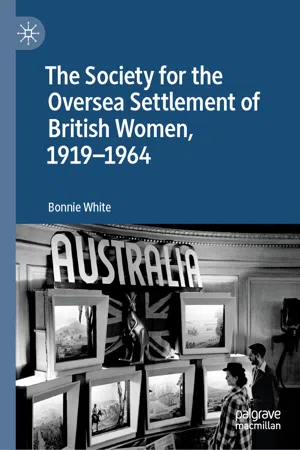
This book examines the British government's response to the 'superfluous women problem', and concerns about post-war unemployment more generally, by creating a migration society that was tasked with reducing the number of single women at home through overseas migration. The Society for the Oversea Settlement of British Women (SOSBW) was created in 1919 to facilitate the transportation of female migrants to the former white settler colonies. To do so, the SOSBW worked with various domestic and dominion groups to find the most suitable women for migration, while also meeting the dominions' demands for specific types of workers, particularly women for work in domestic service. While the Society initially aimed to meet its original mandate, it gradually developed its own vision of empire settlement and refocused its efforts on aiding the migration of educated and trained women who were looking for new, modern, and professional work opportunities abroad.
- English
- ePUB (mobile friendly)
- Available on iOS & Android
eBook - ePub
The Society for the Oversea Settlement of British Women, 1919-1964
About this book
Information
© The Author(s) 2019
Bonnie WhiteThe Society for the Oversea Settlement of British Women, 1919-1964https://doi.org/10.1007/978-3-030-13348-1_11. Introduction
Bonnie White1
(1)
Historical Studies, Grenfell Campus, Memorial University of Newfoundland, Corner Brook, NL, Canada
In 1917, the Daily Mirror proclaimed that Britain was facing an ostensible new crisis: one million surplus women. 1 Following the First World War, the British government expressed concerns that Britain’s reduced male population would leave too many women single, making them a burden on the state. While letters to the editor advocated polygamy or the importation of men as solutions for these would-be spinsters , the British government decided on a policy of government-controlled overseas migration. 2 This book examines the work of the Society for the Oversea Settlement of British Women (SOSBW) and its efforts to migrate Britain’s ‘redundant’ female population to the dominions between 1919 and 1964. The SOSBW was comprised of three migration societies: the South African Colonisation Society (SACS), the British Women’s Emigration Association (BWEA), and the Colonial Intelligence League (CIL), volunteer societies that counselled, nominated, and facilitated the movement of women from Britain to various overseas locations. Their amalgamation was envisioned by government as an important step in bringing female emigration under government control, thus reducing the role of philanthropic societies in migration work after the First World War.
The role of the SOSBW has often been overlooked in migration history due to the seemingly minor role the Society played in moving women from Britain to the empire following the end of hostilities in 1918. 3 The creation of the SOSBW was part of a broader effort by government to ease the transition from a wartime to a peacetime economy, but with the specific task of offering valuable advice about the nature of and logistical means for the transportation of women to the former white settler colonies to meet the dominions’ growing demand for domestic servants. 4 The creation of the SOSBW, first conceptualised in 1917, was part of an imperial strategy to strengthen the bonds of empire through the exploitation of women’s labour, but also through imperial marriages. While there was a surplus of women in Britain, the disproportionate number of men in Australia and Canada offered a ready market for imperial connections that would not only reduce Britain’s gender imbalance and the potential drain on financial resources necessary to support so many unwed women, but would also supply the dominions with the best British women to help stabilise populations, particularly in rural areas that were suffering from outmigration resultant from industrialisation and urbanisation. 5
While the SOSBW initially sought to follow its government mandate, it quickly realised that the plans for population redistribution were both undesirable and unsustainable. This study argues that although the migration of women to the empire was an imperative imperialist act wherein women were valued for their labour and their service to the empire, organisers like Gladys Pott (Chairman of the Executive Committee), Meriel Talbot (Publicity Officer), Edith Thompson (Chairman of the Executive), and Countess Bessborough (President) envisioned a pro-women, pro-imperialist scheme that would assist middle-class women in finding employment overseas. The SOSBW was formed as a migration society, but over the years of its operations it transformed itself into a labour exchange service that connected women with professional employment opportunities that simultaneously served imperial needs and promoted women’s economic advancement. This organisational history of the SOSBW contextualises the work carried out by the Society by examining the domestic and imperial relationships that were essential to the Society’s work from 1919 until it concluded its operations in 1964. Moreover, understanding the varied backgrounds and interests that its members brought to the SOSBW and the continuing importance of women’s relationships in migration work, even for a semi-governmental organisation, will help contextualise why the SOSBW survived for so long.
The SOSBW was reliant on a number of foreign and domestic networks, without which it would not have been able to succeed. Little work has been done on the organisational history of the SOSBW, and most studies fail to fully examine its leaders’ adaptability and ingenuity when faced with potential dismissal. With few exceptions, most studies of the SOSBW focus on what it failed to accomplish, notably its failure to precipitate the large-scale migration of women from Britain in the years after the First World War. Lisa Chilton provides an excellent overview of the SOSBW’s work in Canada and Australia, but dedicates only a few pages to the Society’s operations, and while Rebecca Mancuso’s work fits the Society’s work into the broader framework of Canadian immigration policies, her focus is on the role of Canadian women who worked with Canada’s immigration bureaucracy during the interwar years. 6 Paula Hamilton and B. W. Higman argue that the British government was most interested in female migration as part of the imperial project—a way to maintain its ‘preferred’ export arrangements with the dominions, while the SOSBW used training programmes and propaganda for self-promotion. 7 Although the Society did engage in self-promotion, its policies and practices evolved continually and the SOSBW adopted policies it believed would assist women workers without affecting imperial relations in ways that were ruinous to the empire.
The most concentrated work on the SOSBW comes from a few studies that have broadened our understanding of the women organisers, but which stop short of investigating the organisation as a whole. G. F. Plant offers a short account of the formation of the SOSBW, paying specific attention to the voluntary migration societies that came before it, and that amalgamated in 1919 to create the new Society. 8 Brian Blakely focuses on the Society’s limited success, which he blames on the control exerted by the dominions coupled with the Society’s inability to ingratiate itself with domestic volunteer migration organisations. Ultimately, Blakely argues that the SOSBW had little control over migration and that its failure was all but complete by the Great Depression. 9 Jean P. Smith’s recent study of the Women’s Branch of the Commonwealth Relations Office refutes Blakely’s earlier claim and argues that the SOSBW’s successes are best understood when studied holistically. Smith accentuates the remarkable consistency in the Society’s leadership and work over its forty-five-year history, but her primary focus is on the years after the Second World War, filling a notable gap in the historiography. 10 My study offers a re-evaluation of the Society’s activities from 1919 to 1964 to demonstrate that not only did its migration work continue after 1939, but its move towards a labour exchange system occurred earlier than historians have suggested, and the Society was more successful over the course of its tenure than has been previously acknowledged.
By all statistical accounts, the scheme was largely considered a failure by 1925 and the British government wondered what, if anything, the SOSBW contributed to alleviating the serious economic challenges facing the nation. The successes and failures of the SOSBW, however, cannot simply be evaluated based on the number of women migrated, which admittedly remained quite small after 1925. I argue that the Society’s greatest success was its leaders’ ability to create an international network of women, divided by organisations and differing priorities, and its aptitude for appropriating the services of these often conflicting and competing groups in the pursuit of professional work opportunities for women overseas. Even in the face of seemingly insurmountable challenges, including the Great Depression and the Second World War, the SOSBW was able to continually reinvent itself in an effort to respond to the challenges of the day. Its leadership not only navigated the difficult politics of oscillating policies that came with changes in government both at home and abroad, but was also able to manage the key domestic groups that were often at odds with an SOSBW Executive that was accused of manipulating, isolating, and intimidating the very groups it relied on.
This study focuses on the women who directed and carried out the various mandates handed down to the SOSBW by the British government. It seeks to understand how organisers envisioned the Society, what they hoped to accomplish, and the extent to which the Society was responding to conditions beyond their control or directing policy through specific actions and decisions. The SOSBW was certainly responsive to post-war unemployment, specifically the problem of women’s post-war employment, and aimed to reduce the number of unemployed, single, middle-class women in Britain through emigration. 11 Yet, its initial focus was not to move women into domestic service, although it accepted that that was where many women were likely to end up; rather, it pursued the employment of women in agriculture as part of a broader effort to revitalise rural areas, but also as a means by which to create new work opportunities that would meet dominion labour needs without relegating women to the domestic sphere. 12 The dominions were initially receptive to the employment of women in agriculture, if only because of lingering uncertainty about the return of male labourers and the pressing need to stabilise the agricultural sector. Once demobilisation was underway, however, the dominions insisted on the gendered division of labour: men for work in agriculture and women for work in domestic service. 13 Accepting these conditions and working within the parameters set by the dominions would have been the easiest path forward, but the three societies who made up the SOSBW decided to push for the employment of female agricultural workers, a position that it maintained throughout its existence. The three groups did not share a common vision for what women’s role in agriculture should be, but they understood the need to draft a plan that would distinguish the SOSBW from other migration groups and that was sustainable in the long term. In spite of remonstrations from dominion officials, the SOSBW Executive and Council operated on the assumption that it knew best how to meet the labour needs of the dominions and could do so in a way that was simultaneously supportive of women’s work and helpful in alleviating unemployment at home. 14
To this end, the SOSBW established working relationships with domestic women’s groups in Britain that would help ensure the feasibility of the scheme. These relationships were not always fruitful or cooperative, but they demonstrate the interconnectivity of women’s work in the early years of the twentieth century. 15 On agricultural matters, the SOSBW sought the assistance of various groups, including the Women’s Land Army (WLA), National Association of Landswomen (NAL), and Women’s Farm and Garden Union (WFGU) , as well as various farmers’ unions and associations, but most notably it worked through the National Federation of Women’s Institutes (NFWI), a relationship that the Society worked diligently to develop and maintain. With the assistance of the NFWI, the SOSBW initiated new training and education programmes, called attention to the deficiencies in women’s agricultural education , and worked to elevate women’s roles in the agricultural industry and farming communities. These initiatives helped to raise the status of women farmers in Britain by supporting new employment initiatives for women who wanted to pursue farming as a career in the dominions. Even when the British government pushed back against the migration of agriculturalists, male and female, after the Second World War, the SOSBW used labour exchange training programmes to help train women in Canada for work on the land.
Those who comprised the Executive and Council of the SOSBW were dedicated women striving to make an impact on women’s employment and place in the imperial structure. They wanted access to power and to maintain whatever power they had secured through their previous positions and in light of their new relationship with various government departments, most importantly the Oversea Settlement Committee (OSC). The SOSBW described its work as ‘serving two masters,’ referring to the British government and the SOSBW itself. The Society accepted its role as a quasi-governmental organisation, but this acceptance came from a desire for recognition, affiliation, funding, and access to the structures of power that would otherwise be beyond their reach. This is not to suggest that the relationship between the SOSBW and OSC was disingenuous; rather, it was a practical and necessary arrangement by which the Society could carry out its work. Over its years of operation, the SOSBW worked closely with the OSC, and with G.F. Plant in particular, and came to rely on his support for significant changes in the Society’s activities. This included support for training and education programmes, gender equality in migration policy, and the move away from emigrating domestic servants and towards the professionalisation of employment services through a system of labour exchange. Through Plant and the OSC, the Society also increasingly gained support in dealing with the dominions who wanted to exert greater control over immigration. Older priorities voiced by key imperialists like Leo Amery and Lord Milner, specifically regarding the migration of women to the empire to serve as domestic servants and wives and mothe...
Table of contents
- Cover
- Front Matter
- 1. Introduction
- 2. From Volunteerism to Government Control: The Formation of the SOSBW
- 3. Superfluous Women: Gender and Migration, 1919–1924
- 4. The Great Depression: New Fears, New Strategies, 1925–1935
- 5. The Second World War: New War, New Roles, 1936–1945
- 6. Temporary Migrants: Home, Abroad, and Home Again, 1945–1964
- 7. Conclusion
- Back Matter
Trusted by 375,005 students
Access to over 1.5 million titles for a fair monthly price.
Study more efficiently using our study tools.
Frequently asked questions
Yes, you can cancel anytime from the Subscription tab in your account settings on the Perlego website. Your subscription will stay active until the end of your current billing period. Learn how to cancel your subscription
No, books cannot be downloaded as external files, such as PDFs, for use outside of Perlego. However, you can download books within the Perlego app for offline reading on mobile or tablet. Learn how to download books offline
Perlego offers two plans: Essential and Complete
- Essential is ideal for learners and professionals who enjoy exploring a wide range of subjects. Access the Essential Library with 800,000+ trusted titles and best-sellers across business, personal growth, and the humanities. Includes unlimited reading time and Standard Read Aloud voice.
- Complete: Perfect for advanced learners and researchers needing full, unrestricted access. Unlock 1.5M+ books across hundreds of subjects, including academic and specialized titles. The Complete Plan also includes advanced features like Premium Read Aloud and Research Assistant.
We are an online textbook subscription service, where you can get access to an entire online library for less than the price of a single book per month. With over 1.5 million books across 990+ topics, we’ve got you covered! Learn about our mission
Look out for the read-aloud symbol on your next book to see if you can listen to it. The read-aloud tool reads text aloud for you, highlighting the text as it is being read. You can pause it, speed it up and slow it down. Learn more about Read Aloud
Yes! You can use the Perlego app on both iOS and Android devices to read anytime, anywhere — even offline. Perfect for commutes or when you’re on the go.
Please note we cannot support devices running on iOS 13 and Android 7 or earlier. Learn more about using the app
Please note we cannot support devices running on iOS 13 and Android 7 or earlier. Learn more about using the app
Yes, you can access The Society for the Oversea Settlement of British Women, 1919-1964 by Bonnie White in PDF and/or ePUB format, as well as other popular books in History & British History. We have over 1.5 million books available in our catalogue for you to explore.