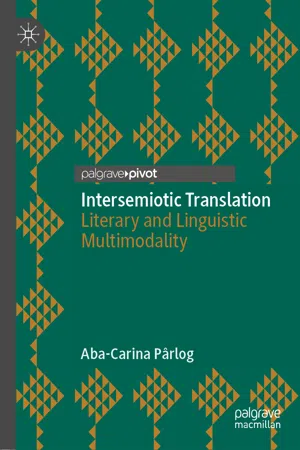
This book explores the practical aspects of intersemiotic translation, examining how different signs and sign sets can be transposed into different kinds of semiotic forms of reference. Drawing on theories from translation studies, semiotics, philosophy and stylistics, the author seeks to understand what happens when texts are translated from one genre or modality to another, and makes use of examples ranging from written texts to advertising, images, music, painting, photography, and sculpture. She also analyses related topics such as the differences between Romance and Germanic languages, the difficulties that arise when attempts are made to translate figures of speech or elements of authorial style, and how this interdisciplinary field relates to traditional language-based translation. This book will be of interest to students, teachers, translators and researchers working in the fields of translation studies and multimodality in particular.
- English
- ePUB (mobile friendly)
- Available on iOS & Android
eBook - ePub
About this book
Information
© The Author(s) 2019
Aba-Carina PârlogIntersemiotic Translationhttps://doi.org/10.1007/978-3-030-16766-0_11. Introduction
Aba-Carina Pârlog1
(1)
Department of Modern Languages and Literatures, West University of Timişoara, Timişoara, Romania
Aba-Carina Pârlog
Abstract
This chapter of the book is meant to offer a first glimpse of the main topic selected with a short presentation of the subtopics discussed. This part draws attention to the problems analysed in each of the theoretical/applicative chapters and informs the international readership about some of the issues that one must deal with when tackling particular types of intersemiotic translation (viewed as an umbrella construction for sign and sign set transposition—whether one deals with images, sounds, linguistic units). Signs, symbols and meanings are so closely related that one cannot create any communicative strand only by considering one of them.
Keywords
AestheticsCodeIntersemiotic translationMultimodalitySignIntersemiotic Translation: Literary and Linguistic Multimodality centres on the study of intersemiotic translation as a field meant to explain the complex process of understanding meaning that is necessary for various forms of coded expression . Even though less studied than other fields of knowledge, such as linguistics , semantics , phonetics, translation studies, etc., semiotics (or semiology, as it is also called) is paramount to the clarification of relations between different types of signs whose signification changes according to the links that can be made between the main subject, the predicate and the other less significant elements involved in the process of constructing meaning.
Among the most important representatives of this domain, one can mention the name of Charles Sanders Peirce (1839–1914), an American philosopher who laid the foundation of the theory of signs or semiotics , even though he actually focused more on pragmatics. Peirce (cf. Atkin 2010) defines “a Sign as anything which is so determined by something else, called its Object, and so determines an effect upon a person, which effect I call its Interpretant, that the latter is thereby mediately determined by the former”—a somewhat obsolete definition for nowadays semiotics and the process that it refers to. According to Albert Atkin (2010), he also makes use of such words as “representation” or “ground” for sign aspects, i.e., the way in which a sign is envisaged or one motivates its existence. For him, the object determines the sign and stresses the parameters that the object must have, a view which is still limitative, as it does not include the more complex aspects of a sign and its meaning(s) which are quite obvious nowadays.
As David Savan and James Liszka state, “an interpretant” is the manner in which one perceives a particular sign or its translation (cf. Atkin 2010). Even if the term is debatably illustrative rather making one think of a human being, in the light of this definition, the process of (intersemiotic ) translation can be viewed as an effect of understanding a semiotic set. For example, in George Orwell’s novel 1984, the author uses the diary as a sign of Winston Smith’s (the object) rebellion (the interpretant) against the totalitarian regime in Oceania.
Another very important representative of the field of semiotics is Ferdinand de Saussure (1857–1913), a Swiss linguist and semiotician, founder of structural linguistics whose notorious theory is still used nowadays to explain the original process of language creation. After his death, his students at the University of Geneva published his Cours de linguistique générale (1916) in which he defines several fundamental concepts:
- 1.the distinction made between “langage” (discourse ), “langue” (language) and “parole” (speaking);
- 2.the differentiation between the synchronic and the diachronic dimensions in general linguistics ; and
- 3.the arbitrary character of the linguistic sign (Saussure 1995).
For example, the word “desk” must be understood in terms of its arbitrary connection with the object proper, whether made of wood, metal, plastic and so on. The necessity of creating names for all objects, situations, phenomena, animals, types of persons, their features, etc. at one moment in time made it easier for one to identify them once these were invented. What he of course leaves out is the etymological history of words which would somehow explain the link one can find between words and their meanings. The so-called arbitrary nature of language with a few exceptions, represented by interjections, was under much study by Saussure and his followers.
Besides them, Charles William Morris (1901–1979), an American philosopher considered the most important founder of semiotics , even though his theory is also limitative to what we today know about language and its strata, divides this field into three scientific dimensions:
- 1.syntax,
- 2.semantics and
- 3.pragmatics.
In his essay “Esthetics and the theory of signs” (1939), Morris (cf. Rossi-Landi 1978: 8) distinguishes between “aesthetic semiotics ” and “semiotic aesthetics ”. While the former represents a special application of the science of signs and is a bridge between art and the theory of the art of signs, the latter may even be called “Speculative Aesthetics” and seen as a subdomain of “some Philosophical Super-science”. Their philosophical nature makes them rather less applicable in the case of intersemiotic translation.
Aesthetics and semiotics have already been considered as parts of the same area of knowledge due to the problem of style. This topic can be discussed in relation to any type of sign network which is meant to produce meaning in a certain way defined by the style used. Intersemiotic translation presupposes the establishing of parallel sets of signs between which a transfer can be achieved. These may belong to either art or literature, when one may deal with an ekphrasis or they may belong to other types of symbolic representation which can have various forms.
Generally, literary texts are filled with figures of speech (metaphors , personifications, epithets, metonymies, synecdoches, etc.) which are difficult to translate by maintaining the same level of textual aesthetics . Consequently, an intersemiotic translation takes place which is influenced by the linguistic and cultural permissibility of the target codification.
Morris (cf. Rossi-Landi 1978: 8) believes that “the field of aesthetic criticism” includes “aesthetic analysis and aesthetic judgment”, which he sees as metalinguistic disciplines, even though textual aesthetics can also be discussed in connection with the figurative language, the chromatic elements and the register employed in a certain text. The aesthetic sign is “an iconic sign whose designatum is a value”.
The value of an aesthetic sign or of a set of aesthetic signs can be viewed according to the impact it has on the receiver, be that a spectator, a reader or a listener, etc. S/He decides whether it is a complex value meant to be grasped depending on some semiotic sets which already lie at its foundation or a simpler value clarified by the new meanings that are created in the new representation.
The framework in which this value is included transforms the already existing semiotic sets and consequently, modifies the whole semiotic network, which defines a certain subfield or even field. Morris (cf. Rossi-Landi 1978: 9) makes a link between “aesthetic criticism” and the existence of values regarding “aesthetic analysis” and values regarding “aesthetic judgment”. The classification of values depends on the context which suggests their existence and on the role that they have in that particular context.
In art, aesthetics can be divided into two main directions the aesthetics of ugliness and the aesthetics of beauty. Various trends emphasise a different type of aesthetics which defines ugliness or beauty according to new sets of ideas taking the form of new sets of aesthetic signs.
William Shakespeare , for example, attaches diverse values to his texts which he creates with the help of colour symbolism . As I (1998: 74) point out in my article “Colour Symbolism in Shakespeare’s Plays”, words designating colours do not indicate anything else but colours, if they are not accompanied by other parts of speech and by a proper context in order to become a code which is meant to be broken. By their symbolism, these may sometimes suggest the main theme of a spectacle, for instance, being more than a simple ornamental element that is added to the topic of the play.
In A Midsummer-Night’s Dream, for example, as I (1998: 75) explain in this chapter, one can find that colour black may sometimes indicate unwished for things, such as evilness (“beetles black” (Shakespeare 1966: 205), i.e., ‘gândaci negri’, in the Romanian language or ‘des bousiers noirs’, in the French language) or the depth of hell (“fog as black as Acheron” [Shakespeare 1966: 213], i.e., ‘ceaţă neagră ca Aheronul’, in Romanian or ‘brouillard noir comme l’Achéron’, in French). At other times, they indicate the lack of colour or importance, as in As You Like It (“All the pictures fairest lin’d / Are but black to Rosalinde” (Shakespeare 1966: 267–268), i.e. “Ca Rosalinda chip frumos şi blând / N-a fost în lume, nu va fi nicicând” [Shakespeare 1964: 439] or “Les portraits les plus parfait / Sont noirs à côté de Rosalinde” [Shakespeare 1966]).
But Shakespeare is not the only one to employ colour symbolism in his oeuvres, in Orwell’s 1984, one can as well notice that the preponderance of dark or greyish colours or of colour white indicate the writer’s depressed state (because he was ill, suffering from tuberculosis, when he was writing the novel, alone on the island of Jura), the lack of freedom in his book and the inexistence of alternatives, because of the compulsory nature of the totalitarian party politics and its effects.
According to Martin Esslin (cf. Fisher Dawson 1999: 28), there are “three basic sign elements: icon (a sign that represents what it signifies), symbol (a sign derived by convention having no relation to the signified), and index (a sign that points to an object)”. To employ his terminology, the symbolical colours that are mentioned above become significant based ...
Table of contents
- Cover
- Front Matter
- 1. Introduction
- 2. Intersemiotic Translation and Multimodality
- 3. Aesthetics, Discourse and Ekphrasis
- 4. Visual and Verbal Code Translation
- 5. Direct and Indirect Intralingual Translation
- 6. The Constraints of Interlingual Translation
- 7. Conclusion
- Back Matter
Trusted by 375,005 students
Access to over 1.5 million titles for a fair monthly price.
Study more efficiently using our study tools.
Frequently asked questions
Yes, you can cancel anytime from the Subscription tab in your account settings on the Perlego website. Your subscription will stay active until the end of your current billing period. Learn how to cancel your subscription
No, books cannot be downloaded as external files, such as PDFs, for use outside of Perlego. However, you can download books within the Perlego app for offline reading on mobile or tablet. Learn how to download books offline
We are an online textbook subscription service, where you can get access to an entire online library for less than the price of a single book per month. With over 1.5 million books across 990+ topics, we’ve got you covered! Learn about our mission
Look out for the read-aloud symbol on your next book to see if you can listen to it. The read-aloud tool reads text aloud for you, highlighting the text as it is being read. You can pause it, speed it up and slow it down. Learn more about Read Aloud
Yes! You can use the Perlego app on both iOS and Android devices to read anytime, anywhere — even offline. Perfect for commutes or when you’re on the go.
Please note we cannot support devices running on iOS 13 and Android 7 or earlier. Learn more about using the app
Please note we cannot support devices running on iOS 13 and Android 7 or earlier. Learn more about using the app
Yes, you can access Intersemiotic Translation by Aba-Carina Pârlog in PDF and/or ePUB format, as well as other popular books in Languages & Linguistics & German Language. We have over 1.5 million books available in our catalogue for you to explore.