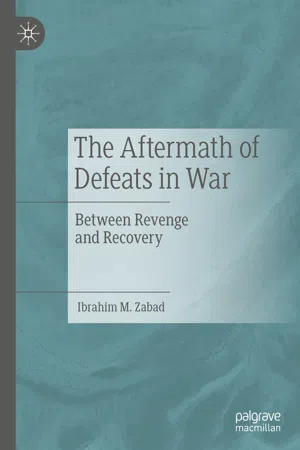
This book sets out to explain the variation in nations' reactions to their defeats in war. Typically, we observe two broad reactions to defeat: an inward-oriented response that accepts defeat as a reality and utilizes it as an opportunity for a new beginning, and an outward-oriented one that rejects defeat and invests national energies in restoring what was lost—most likely by force. This volume argues that although defeats in wars are humiliating experiences, those sentiments do not necessarily trigger aggressive nationalism, empower radical parties, and create revisionist foreign policy. Post-defeat, radicalization will be actualized only if it is filtered through three variables: national self-images (inflated or realistic), political parties (strong or weak), and international opportunities and constraints. The author tests this theory on four detailed case studies, Egypt (1967), Turkey/Ottoman Empire, Hungary and Bulgaria (WWI), and Islamic fundamentalism.
- English
- ePUB (mobile friendly)
- Available on iOS & Android
eBook - ePub
About this book
Information
© The Author(s) 2019
Ibrahim M. ZabadThe Aftermath of Defeats in Warhttps://doi.org/10.1007/978-3-030-13747-2_11. Introduction and Theoretical Framework
Ibrahim M. Zabad1
(1)
Department of Political Science, St. Bonaventure University, St. Bonaventure, NY, USA
1 Introduction
After its defeat at the hands of Prussia in 1864, Denmark turned inward and embarked on a journey of internal reforms, cultural revival, and national education. The Danes transformed their devastating defeat into a ‘moral victory’ based on their motto “what we lost externally, we shall gain internally.”1 Instead of viewing their grave loss as a fatal blow to their national honor, the Danes framed it as a departure point for creating a new national identity and building peaceful relations with their former adversaries. On December 1, 1920—before the birth of modern Turkey, and while the Ottomans/Turks were still struggling against foreign occupation, Greek invasion, and the loss of empire—Mustafa Kemal Atatürk, the founder of modern Turkey, delivered an iconic speech that exemplified what an internally oriented reaction to defeat and loss meant:
The Grand National Assembly and government of Turkey … are very modest, very far from fantasies, and completely realistic… Gentlemen, we are not men who run after great fantasies and present a fraudulent appearance of doing things which in fact we cannot do. Gentlemen, by looking as though we were doing great and fantastic things, without actually doing them, we have brought the hatred, rancour, and malice of the whole world on this country and this people. We did not serve pan-Islamism. We said that we had and we would, but we didn’t… We did not serve pan-Turanianism. We said that we could and we would. There you have the whole problem… Rather than run after ideas which we did not and could not realize and thus increase the number of our enemies and the pressure upon us, let us return to our natural, legitimate limits. And let us know our limits. Gentlemen, we are a nation desiring life and independence. For that and that alone may we give our lives.2
In this speech, Atatürk laid the basic parameters of Turkey’s anti-irredentist foreign policy. He called upon his nation to recognize its limits and specifically mentioned Pan-Islamism and Pan-Turanianism (Pan-Turkism) as two illusory ideologies that brought harm to the Turks and strengthened the hands of their enemies. Leaving behind imperial illusions and turning inward to state- and nation-building were paramount. This was the hallmark of the Turks’ reaction to their defeat.
After their loss in WWI, the Hungarians, on the other hand, became haunted by a defeat syndrome whose most manifest sign was the irredentist cult, “which occasionally reached astonishing proportions.”3 When the Treaty of Trianon was signed, hundreds of thousands demonstrated in protest against this injustice. Newspapers were published in black mourning margins.4 Hungarian church bells tolled and all traffic and work stopped for ten minutes as a gesture of abhorrence and collective sorrow.5 The slogan Nem, Nem, Soha (‘No, No, Never’) was repeated by all societal and political stratifications and in every schoolroom for the entire interwar period. Other slogans that were coined included “Everything back!”, “Thus it was, thus it shall be!” and “Mutilated Hungary is no country; integral Hungary is a heavenly country.” Indeed, slogans were selected through a ‘revisionary competition.’6 Similarly, after their catastrophic defeat, the Egyptians tirelessly repeated the slogan “what was taken by force could only be retrieved by force.” The German case of loss, humiliation and revenge after WWI, and the French attachment to Alsace-Lorraine after their crushing defeat in 1870 are well-known cases of defeats in wars leading to humiliation and generating incentives for revenge and the recurrence of wars.
Thus, we observe two broad reactions to defeat: an inward-oriented response that accepts defeat as a reality and utilizes it as an opportunity for a new beginning and an outward-oriented one that rejects defeat and invests national energies in restoring what was lost—most likely by force. The former suppresses sentiments of humiliation and revenge and refocuses the nation’s attention on more important issues of nation- and state-building. The latter absorbs and internalizes sentiments of humiliation and revenge and focuses the nation’s energy on wars of redemption. The titles of two recent publications explain this variation in national reactions to defeats: Embracing Defeat: Japan in the Wake of WWII and Defeat, National Humiliation and the Revenge Motif in International Politics.7 This variation in national reactions to defeats in war is the subject of this book.
Defeats generate feelings of shame, guilt, humiliation, and desire for revenge on one hand, but on the other, they reveal information about the limits of material capabilities, engender feelings of desperation, and bring to light the futility of adventurism and highlight the utility of shrewdness and humility. Defeat sometimes leads to the creation of radical domestic movements in some countries—with varying effects on foreign policies—but generates prudence, self-examination, and reforms and might even pave the way for democratization in others. This empirical observation prompts us to ask several questions regarding the aftermath of defeats in wars: Why do some defeated states become status quo powers pursuing moderate and cooperative foreign policies while others become revisionist and pursue risky and aggressive foreign policies? How and why did Turkey after WWI leave its imperial legacy behind, forgo revisionist opportunities, and become an example of a status quo power that pursued a strategy of assimilation into the international order? How and why did Hungary, after the collapse of the Austro-Hungarian Empire, become jam-packed with radical political parties and ended up a revisionist state allied with Nazi Germany? Why did defeat put Greece (1974) and Argentina (1982) on the road to democratization? Why did religious and secular radical movements spread in the Arab world in the wake of the 1967 defeat? What, despite domestic radicalization, enabled the Anwar Sadat regime in Egypt to make a rightward shift in foreign policy? What explains this variation in the aftermath of defeats?
The political trajectories that states and societies experience in the wake of defeat diverge widely. The aftermath of defeats has been associated with social and political instability, revolutions, mass rebellions, regime overthrow, revisionism, and radical ideologies. Defeat in many respects is a crucial event in the collective memory of a nation that leaves imprints far beyond the battlefield. Defeats weaken institutions, create a legitimacy crisis, and discredit the dominant ideology and the social order it supports. Most often successful wars unite polities but lost ones divide them. However, defeats could also have beneficial and reformative effects as they create political opportunities for sweeping institutional reforms, both military and civil. They discredit the existing dominant ideologies, but they also lay the groundwork for alternative ideologies and belief systems. They destroy institutions, but alternative institutions must be found. If validation is the hallmark of victory, questioning is the hallmark of defeats; hence, soul-searching begins in earnest: intellectuals and policymakers begin to look deeper into the causes of loss and the means to achieve recovery. As defeats lay to rest the uncertainty of what could or could not be accomplished, the vanquished nation learns the lessons of humility, prudence, moderation, and the benefits of reconciliation.
Defeats force nations to ask serious questions about the future of the polity, its political trajectory, and whether to prepare for another round of wars of revision or to accept defeat and redefine national identity, whether to live in the past and remain captive to the ideas that plunged the nation into war or to move forward and renounce ideas of greatness and expansion and embark on a path of peace and reconciliation. A major question that the vanquished have to grapple with relates to whether defeat could be treated as a new beginning, a point of departure, or whether to reject the reality of defeat and invest the nation’s energies in reversing the calamity; in other words, whether the nation turns inward to renew its vitality and attain redemption or outward to seek reve...
Table of contents
- Cover
- Front Matter
- 1. Introduction and Theoretical Framework
- 2. Egypt: Defeat and the Transformation of State and Society
- 3. Bulgaria: Defeat and Nationalist Demobilization During the Peasant Era
- 4. Hungary: The Cult of Defeat
- 5. The Ottoman Empire/Turkey: Defeat and the Birth of a Nation
- 6. Defeats, Humiliation, Islamic Fundamentalism, and Political Violence
- 7. Conclusion
- Back Matter
Trusted by 375,005 students
Access to over 1.5 million titles for a fair monthly price.
Study more efficiently using our study tools.
Frequently asked questions
Yes, you can cancel anytime from the Subscription tab in your account settings on the Perlego website. Your subscription will stay active until the end of your current billing period. Learn how to cancel your subscription
No, books cannot be downloaded as external files, such as PDFs, for use outside of Perlego. However, you can download books within the Perlego app for offline reading on mobile or tablet. Learn how to download books offline
We are an online textbook subscription service, where you can get access to an entire online library for less than the price of a single book per month. With over 1.5 million books across 990+ topics, we’ve got you covered! Learn about our mission
Look out for the read-aloud symbol on your next book to see if you can listen to it. The read-aloud tool reads text aloud for you, highlighting the text as it is being read. You can pause it, speed it up and slow it down. Learn more about Read Aloud
Yes! You can use the Perlego app on both iOS and Android devices to read anytime, anywhere — even offline. Perfect for commutes or when you’re on the go.
Please note we cannot support devices running on iOS 13 and Android 7 or earlier. Learn more about using the app
Please note we cannot support devices running on iOS 13 and Android 7 or earlier. Learn more about using the app
Yes, you can access The Aftermath of Defeats in War by Ibrahim M. Zabad in PDF and/or ePUB format, as well as other popular books in Politics & International Relations & Comparative Politics. We have over 1.5 million books available in our catalogue for you to explore.