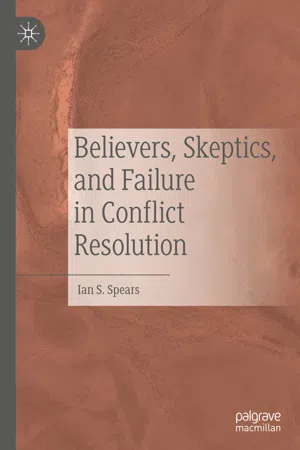
This book discusses the following questions: Why are some conflicts so enduring and why is conflict resolution so hard? The author begins by introducing two conflicting perspectives, Skeptics and Believers, to highlight the lack of consensus on conflict resolution. The book further examines the literature on the sources of violent conflict, including ethnic, economic, environmental, and religious sources, and investigates the claim that an absence of knowledge, power, or political will are at the center of conflict resolution failures. By focusing on the problem of state formation, the author demonstrates the ways in which the nature of the state contributes to violent conflict. In the end, conflict resolution fails because individuals, groups, and external powers choose war and often prefer it over peaceful alternatives.
- English
- ePUB (mobile friendly)
- Available on iOS & Android
eBook - ePub
Believers, Skeptics, and Failure in Conflict Resolution
About this book
Information
© The Author(s) 2019
Ian S. SpearsBelievers, Skeptics, and Failure in Conflict Resolutionhttps://doi.org/10.1007/978-3-030-14144-8_11. Introduction: The Problem of Conflict Resolution
Ian S. Spears1
(1)
Department of Political Science, University of Guelph, Guelph, ON, Canada
An overlooked fact regarding the events prior to the 1994 Rwandan genocide is that the international community was deeply involved in conflict resolution. One scholar described the Arusha effort, which sought to bring an end to two years of civil war in Rwanda, as “an extraordinary story of a sophisticated conflict resolution process.” In fact, according to Bruce Jones, the agreement that was eventually reached was initially held up as an “innovative” model to achieve peace and bring about a new political order.1 “The process,” he said, “was deliberate, inclusive, communicative, informed by cogent analysis, and supported by a range of internal and external parties, many of whom cooperated beyond what might have been expected.” Equally important, the peace process was well resourced and was led by experts with extensive experience in the field and the latest academic literature relating to social conflict. In time, the government had formed a coalition with opposition groups and cooperated with the rebel Rwandan Patriotic Front (RPF). The peace process also provided for an inclusive armed force and established a new power-sharing government; outside of the process, Rwanda experienced a flowering of media pluralism and openness. Despite these efforts, peace was not to be: one or both parties rejected the new dispensation and Hutu hardliners mobilized a killing rampage that resulted in the deaths of an estimated 800,000 Rwandans and ended only when the RPF took power in Kigali in July 1994. Many lamented the failure of the international community to intervene but few acknowledged that a concerted effort at conflict resolution had been tried.
Africa is particularly prone to intractable conflict. From 1996 to 1999, three separate negotiations failed to bring peace between the government and the rebels in Sierra Leone.2 From 1991 to 2007 over a dozen peace agreements had failed to revive the state in Somalia.3 Liberia had 13 peace agreements leading up to the 1996 Abuja peace accords, and still there was no peace.4 And in the Democratic Republic of Congo, the International Crisis Group described the country in terms of its “permanent political crisis.”5 Indeed, the New York Times correspondent Jeffrey Gettleman described the conflict in Congo as a “never-ending nightmare, one of the bloodiest conflicts since World War II, with more than five million dead.”6 Most troubling for Gettleman was that Congo was a country with so much promise in terms of resources and yet had become “one of the poorest, most hopeless nations on earth.” He reflected, “unfortunately, there are no promising solutions within grasp, or even within sight.” Congo was unable to rescue itself in spite of a considerable effort on the part of the international community to provide relief from the violence. “I didn’t always feel this way,” Gettleman writes. “During my first trip, in July 2006, Congo was brimming with optimism. It was about to hold its first truly democratic elections, and … there was this electricity in the air in a city that usually doesn’t have much electricity.” But any hopes for Congo were soon dashed. Despite the elections and a peacekeeping effort that was unprecedented in size and expense, there was little that changed. If anything, the brutality of the conflict continued to reach ever more shocking depths. Six years after his initial trip, Gettleman concluded that “there are few places in Congo today that are rebellion-free.”
In Sudan, too, wrote one American diplomat, “peace in Darfur has been an aberration, conflict the rule.”7 The New York Times observed that Sudan’s “is a war that, despite a peace agreement, has never completely ended. … Sudan, perhaps more than any other country in this region, seems to have a destructive capacity to sink back to the worst days of its past.” The Sudanese, the report concludes, “have essentially been at war with themselves for 56 years, with few respites.”8 Even the most radical approach to conflict resolution—the formation of the new state of South Sudan—merely expanded the number and orientation of the actors and did not lead to a cessation of violence. In the newly created South Sudan, at least eight cease-fires collapsed between the time civil war broke out in December 2013 and August 2014, in some cases within hours of agreements being signed.9 Following the collapse of the August 2015 peace agreement, Festus Mogae, the head of the Joint Monitoring and Evaluation Commission, lamented that “the people of South Sudan are worse off than before.”10
The idea that conflicts like those of Sudan and South Sudan persist in spite of well-intentioned diplomatic interventions by the international community has been detailed by practitioners and scholars alike. Reflecting on the peace-making experience in neighboring Chad, two African scholars write that “our understanding of what makes the transition from insurgency to peace is incomplete—a situation that leaves many lamenting that sometimes, no matter what you do, violence re-erupts.”11 Alex de Waal, too, describes how local actors have taken advantage of the security provided by international intervention to avoid having to cooperate with their adversaries.12 More disturbing still is the idea, documented in Sierra Leone and Liberia, that the mere prospect of foreign intervention can induce rebels to commit the most heinous atrocities as a means of bringing about the much-anticipated intervention from which they hope to benefit materially.13
Even situations that appear to be moving toward peaceful resolution and to be receptive to Western help have the habit of taking turns for the worse. In 2011, the Canadian Foreign Minister, John Baird, arrived in Benghazi to declare that Libya was destined for democracy: “the one thing we can say categorically,” he crowed, “is that [the rebels] wouldn’t be any worse than Colonel Gadhafi.”14 In the early days following Muammar Gadhafi’s overthrow, other commentators shared their confidence that renewed violence would be avoided. “The uncertainties are real,” wrote Nicholas Kristof. “But, after my recent visit to Libya, I’m guardedly optimistic.”15 The new leadership, he pointed out, consisted of American-educated technocrats, and even Islamists were said to appreciate American assistance in averting a massacre and putting Libya on a “track of hope.” Tom Malinowski, the former Washington Director of Human Rights Watch, observed that Libyan rebels were calling for a “country of institutions.”16 Conditions that might have led others to despair—the complete collapse of a totalitarian regime and a lack of existing political structures—were interpreted in positive terms by Malinowski insofar as they provided the opportunity and freedom to create new institutions from scratch. “Just about everyone speaks about establishing the rule of law and checks on state authority,” Malinowski wrote. “They say they want a Libyan Republic, not an Islamic Republic or an Arab Republic,” in recognition of Libya’s ethnic and religious diversity. Malinowski, too, concluded that Gadhafi’s efforts to build a state on ideology and force had instead produced an environment where Libyans craved the opposite: an inclusive government built on rule of law, an explicit rejection of al-Qaeda-inspired terrorism, and institutions that would be accountable to the international community.
The optimism of journalists, human rights specialists, and politicians, however, proved false. When Canada withdrew its embassy staff in July 2014 because of widespread factional fighting, its former ambassador to Libya claimed that “Libya is not a nation; it is a collection of clans,” as if it had been self-evident to everyone all along that Libya had never been a viable state.
Persistent conflict and misplaced optimism exist in regions outside of Africa. In the Ukraine, political commentator Thomas Friedman explained how in 2014 he had confronted revolutionaries about the nature and direction of their democratic movement. Friedman said he remained doubtful, telling the young revolutionaries that Americans ha...
Table of contents
- Cover
- Front Matter
- 1. Introduction: The Problem of Conflict Resolution
- 2. Perspectives on Conflict Resolution
- 3. Sources of Violent Conflict and the Banality of Conflict Resolution
- 4. Problems of Knowledge, Power, and Political Will
- 5. States, Leaders, Governance, and Why Conflict Resolution Fails
- 6. Why Belligerents Choose Conflict over Peace
- Back Matter
Trusted by 375,005 students
Access to over 1.5 million titles for a fair monthly price.
Study more efficiently using our study tools.
Frequently asked questions
Yes, you can cancel anytime from the Subscription tab in your account settings on the Perlego website. Your subscription will stay active until the end of your current billing period. Learn how to cancel your subscription
No, books cannot be downloaded as external files, such as PDFs, for use outside of Perlego. However, you can download books within the Perlego app for offline reading on mobile or tablet. Learn how to download books offline
Perlego offers two plans: Essential and Complete
- Essential is ideal for learners and professionals who enjoy exploring a wide range of subjects. Access the Essential Library with 800,000+ trusted titles and best-sellers across business, personal growth, and the humanities. Includes unlimited reading time and Standard Read Aloud voice.
- Complete: Perfect for advanced learners and researchers needing full, unrestricted access. Unlock 1.5M+ books across hundreds of subjects, including academic and specialized titles. The Complete Plan also includes advanced features like Premium Read Aloud and Research Assistant.
We are an online textbook subscription service, where you can get access to an entire online library for less than the price of a single book per month. With over 1.5 million books across 990+ topics, we’ve got you covered! Learn about our mission
Look out for the read-aloud symbol on your next book to see if you can listen to it. The read-aloud tool reads text aloud for you, highlighting the text as it is being read. You can pause it, speed it up and slow it down. Learn more about Read Aloud
Yes! You can use the Perlego app on both iOS and Android devices to read anytime, anywhere — even offline. Perfect for commutes or when you’re on the go.
Please note we cannot support devices running on iOS 13 and Android 7 or earlier. Learn more about using the app
Please note we cannot support devices running on iOS 13 and Android 7 or earlier. Learn more about using the app
Yes, you can access Believers, Skeptics, and Failure in Conflict Resolution by Ian S. Spears in PDF and/or ePUB format, as well as other popular books in Politics & International Relations & International Relations. We have over 1.5 million books available in our catalogue for you to explore.