This book explores how Edwardian art writing shaped and narrated embodied, performative forms of aesthetic spectatorship. It argues that we need to expand the range of texts we think of as art writing, and features a diverse array of critical and fictional works, often including texts that are otherwise absent from art-historical study. Multi-disciplinary in scope, this book proposes a methodology for analyzing the aesthetic encounter within and through art writing, adapting and reworking a form of phenomenological-semiotic analysis found conventionally in performance studies. It focuses on moments where theories of spectatorship meet practice, moving between the varied spaces of Edwardian art viewing, from the critical text, to the lecture hall, the West End theatre and gallery, middle-class home, and fictional novel. It contributes to a rethinking of Edwardian culture by exploring the intriguing heterogeneity and self-consciousness of viewing practices in a period more commonly associated with the emergence of formalism.
This book investigates how art writing in the long Edwardian period, c.1895–1914, functioned as an active agent in the construction of embodied , performative viewing experiences. Any attempt to trace how spectators encountered and responded to art needs to account for the ways in which this occurred beyond a physical confrontation between a spectator and an art work. Utilizing joint phenomenological-semiotic perspective, this book outlines a methodology for analysing the rhetorical loci of aesthetic encounter, and focuses on how art writing intervenes in the viewer-object exchange, shaping and conditioning the attitudes and behaviors of spectators. It argues for the need to attend to the diversity of such art writing, with a range of works providing the source material for this investigation, often texts that are otherwise absent from art-historical study. The methodology herein has implications for how we understand the conditioned or constructed nature of aesthetic experience more broadly, allowing us to identify its performative qualities: its basis in bodily response; its contingency on social context; and the importance of space and environment in shaping experience.
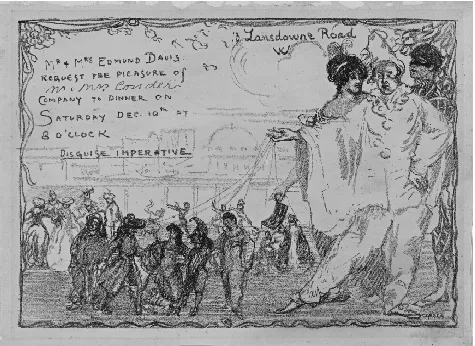
In February 1905, friends and patrons of the artist Charles Conder received an invitation to attend a fancy-dress party at his house in Cheyne Walk, London. The invitation was illustrated by the artist himself, a reworking of a similar design he used for a previous party given at the home of his patron Edmund Davis in 1904 (Fig. 1.1, Invitation to a Dinner Party, 1904, National Gallery of Victoria, Melbourne). The card was decorated with a scene of theatrical decadence: a sumptuous room adorned in the Rococo style enclosing a group of revellers comprising aristocrats in the costume of the Ancien Régime, harlequins and Venetian masqueraders. The invitation stipulated ‘disguise imperative’ and guests attending the event followed its instructions. Reminiscing about the party in his memoirs, the artist William Rothenstein described it as ‘famous, so daring were the dresses in which people came’. The host appeared as Balzac’s Eugene de Rastignac; the aristocrat Olga de Meyer, a friend of the artist, attended as Iago, dressed in tights; writer and journalist Arthur Symonds arrived in the guise of a Venetian domino.1 The design of the invitation draws in part on the ‘carnivalesque’, a common feature in fin-de-siècle Parisian café-concert posters, familiar to Conder from his sojourn in France in the 1890s.2 At the same time, the imagery also speaks of the ongoing interest on the part of fin-de-siècle British artists in the literary culture of nineteenth-century France, in particular the work of writers and playwrights like Balzac.3 In both of these cases, the invite draws forth ideas of performance and theatrically and hints at the revelry and role-playing inherent in Edwardian artistic social events.
Fig. 1.1
Charles Conder, Invitation to a Dinner Party (1904), lithograph 16.4 × 23.4 cm (comp.) 18.4 × 25.2 cm (sheet) National Gallery of Victoria, Melbourne Purchased, 1979 (A43-1980)
Conder’s party and the dramatic scenery of its invitation provides an apt introduction to the salient themes of this book, which comprise the embodied nature of the viewing experience in the Edwardian art world, its theatricality, the imaginative aestheticisation of space, and the notion of the spectator as performer . My central avenue of enquiry considers how art writing in the long Edwardian period, c.1895–1914, conveyed a sense of embodied , performative viewing experiences.4 The intention is not simply to establish the nature of such experiences, but to trace the ways in which art writing functioned as an active agent in their construction, and how we may understand this from a phenomenological perspective.5 I argue that any attempt to trace how viewers encountered and responded to art needs to account for the ways in which this occurred beyond a physical confrontation between a spectator and an art work. This book outlines a methodology for analysing the role of text in aesthetic encounter, and focuses specifically on the manner in which art writing intervenes in the viewer-object exchange, shaping and conditioning the attitudes and behaviours of spectators. This study of the evocation of encountering, the critical discussions it elicits, the space and environment such encounters occupy, the role played by the spectator, all coalesce around an approach that marries semiotic and phenomenological study. The approach of the latter provides a means to address the complex relationships established between reader-viewers and art objects in the moment of aesthetic encounter.6 Aligning this mode of enquiry with semeiotic investigation, this study reflects a propensity in performance studies to see these two fields as ‘inextricably intertwined’, concerned with how ‘meaning reveals itself in experience’.7
The intention is to adapt and rework such an approach from its conventional usage in performance studies and reconfigure it as a means to analyse the aesthetic encounter within and through art writing. By attending to this dual mode of interpreting meaning, it becomes possible to trace both the ways in which texts construct and connote meaning, as well as where and under what conditions meaning is conferred through the experience of encounter and interpretation. As such, this methodology has implications for how we understand the conditioned or constructed nature of aesthetic experience in general. It allows us also to identify its performative qualities: its basis in bodily response; its contingency on social context; and the importance of space and environment in shaping experience. A comparable approach has been deployed in museological studies by writers such as Helen Rees Leahy, with the aim of understanding gallery-based viewing practices across museum history from a phenomenological perspective.8 This text brings the study of art writing into relationship with such scholarship, and contributes towards an assessment of the link between rhetorical commentary on spectatorship and the literal practice of spectatorship in the specialised settings of the gallery, studio or home.
A key outcome of this study is to expand the range of texts that may be identified as art writing. As this book focuses in the first instance on the rhetorical loci of spectatorship : encounters with art that occur in, and are shaped by, art writing, it further argues for the need to attend to the diversity of these texts. A range of works provide the source material for this investigation, often texts that are otherwise absent from art-historical study. These include long-form critical essays and short-form opinion columns; lecture scripts; art writing as creative prose-poetry; essays from exhibition catalogues; the fictional novel whose narrative hinges on artwork; and even the script of a play that features art. The names of familiar writers such as Roger Fry, D. S. MacColl, George Bernard Shaw, Henry James and Max Beerbohm sit alongside the less familiar, such as T. Martin Wood, Robert Ross, and a number of anonymous critics. It is from the art writing of the period that the themes of performance and theatricality emerge. Manifest in art journals, the arts’ columns of the popular press, essays in exhibition pamphlets, monographs and public lectures, Edwardian art writing explored in various ways notions of embodied spectatorship, evoking performative encounters with contemporary art, and essentially acting as a script for the reader-viewer, who, like the guests at Conder’s party, was encouraged to perform and embody an assumed and constructed spectatorial role. The diverse literature considered in this study unites in its concern with ‘affect-orientated’ ekphrasis: an ambition to evoke not a sense of art objects themselves, but a sense of the encounter between a viewer and art object.9
Reflecting on the constructed, performative aspects of such spectatorial experience, this study concurs with Amelia Jones’ and Andrew Stephenson’s assertion that ‘meaning can be understood as enacted through interpretive engagements that are themselves performative’.10 The significance of this claim lies in its tacit acknowledgment of the subjective, variable nature of the viewing experience itself and its means of conveyance. This subjective focus in both performance and phenomenology not only ‘highlights the open-endedness of interpretation’, but actually ‘invites ambiguity’.11 The notion of an unfixed and variable mode(s) of aesthetic encounter points towards the heterogeneous nature of perception, and, more broadly, the heterogeneity of the art-critical field in a given historical moment. This is a particularly apt issue to address in the context of the Edwardian, an era, as I shall demonstrate, marked by a proliferation of diverse visual and visualising practices, and now the subject of a burgeoning wave of multidisciplinary study.12 This project makes an important contribution to such study by highlighting the diversity of spectatorial practice and narration in the period. The following chapters seek to delineate the wide variety of modes of engagement with art, and the heterogeneous nature of dissemination practices, vehicles and spaces. Within this emerges a view of artistic encounter that moves beyond traditional modernist teleology and contributes to the de-prioritising of formalism, a model of aesthetic experience that has preoccupied scholarship on Edwardian art at the expense of other modes of practice.
The methodology proposed in this book, embracing both phenomenological and semiotic analysis, and engaging with the heterogeneity of its...
Table of contents
Cover
Front Matter
1. Introduction: An Invitation
2. Characterising the Audience
3. Spectatorship and Ekphrasis
4. Staging Spectatorship
5. Staging Art
6. Domesticity, Decoration and Role Play
7. Conclusion
Back Matter
Trusted by 375,005 students
Access to over 1.5 million titles for a fair monthly price.
Study more efficiently using our study tools.
Frequently asked questions
Yes, you can cancel anytime from the Subscription tab in your account settings on the Perlego website. Your subscription will stay active until the end of your current billing period. Learn how to cancel your subscription
No, books cannot be downloaded as external files, such as PDFs, for use outside of Perlego. However, you can download books within the Perlego app for offline reading on mobile or tablet. Learn how to download books offline
Perlego offers two plans: Essential and Complete
Essential is ideal for learners and professionals who enjoy exploring a wide range of subjects. Access the Essential Library with 800,000+ trusted titles and best-sellers across business, personal growth, and the humanities. Includes unlimited reading time and Standard Read Aloud voice.
Complete: Perfect for advanced learners and researchers needing full, unrestricted access. Unlock 1.5M+ books across hundreds of subjects, including academic and specialized titles. The Complete Plan also includes advanced features like Premium Read Aloud and Research Assistant.
Both plans are available with monthly, semester, or annual billing cycles.
We are an online textbook subscription service, where you can get access to an entire online library for less than the price of a single book per month. With over 1.5 million books across 990+ topics, we’ve got you covered! Learn about our mission
Look out for the read-aloud symbol on your next book to see if you can listen to it. The read-aloud tool reads text aloud for you, highlighting the text as it is being read. You can pause it, speed it up and slow it down. Learn more about Read Aloud
Yes! You can use the Perlego app on both iOS and Android devices to read anytime, anywhere — even offline. Perfect for commutes or when you’re on the go. Please note we cannot support devices running on iOS 13 and Android 7 or earlier. Learn more about using the app
Yes, you can access Performance and Spectatorship in Edwardian Art Writing by Sophie Hatchwell in PDF and/or ePUB format, as well as other popular books in Media & Performing Arts & Literary Criticism in Drama. We have over 1.5 million books available in our catalogue for you to explore.