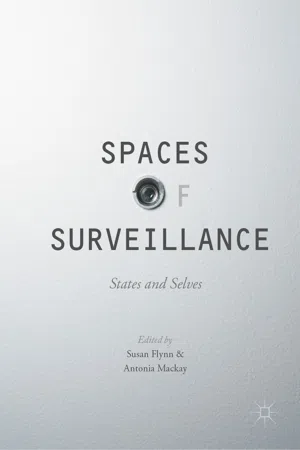
In a world of ubiquitous surveillance, watching and being watched are the salient features of the lives depicted in many of our cultural productions. This collection examines surveillance as it is portrayed in art, literature, film and popular culture, and makes the connection between our sense of 'self' and what is 'seen'. In our post-panoptical world which purports to proffer freedom of movement, technology notes our movements and habits at every turn. Surveillance seeps out from businesses and power structures to blur the lines of security and confidentiality. This unsettling loss of privacy plays out in contemporary narratives, where the 'selves' we create are troubled by surveillance. This collection will appeal to scholars of media and cultural studies, contemporary literature, film and art and American studies.
eBook - ePub
Spaces of Surveillance
States and Selves
- English
- ePUB (mobile friendly)
- Available on iOS & Android
eBook - ePub
About this book
Information
Topic
Ciencias socialesSubtopic
Películas y vídeos© The Author(s) 2017
S. Flynn, A. Mackay (eds.)Spaces of Surveillancehttps://doi.org/10.1007/978-3-319-49085-4_11. Introduction
Susan Flynn1 and Antonia Mackay2
(1)
School of Media, University of the Arts London, London, UK
(2)
Department of English and Modern Languages, Oxford Brookes University, Oxford, UK
Susan Flynn
is a lecturer at the University of the Arts‚ London where she specialises in contemporary media culture‚ digital and body theory and media equality. Her work is featured in a number of international collections and journals such as American‚ British and Canadian Studies Journal and Ethos: A Digital Review of the Arts‚ Humanities and Public Ethics.
Antonia Mackay
is an Associate Lecturer at Oxford Brookes University and Visiting Lecturer at Goldsmiths University of London. She has taught on a wide range of undergraduate and postgraduate modules including: American Theatre‚ American Vistas‚ Critical Theory‚ Narrative and Narratology‚ Special Options in Experimental Avant Gardes‚ Contemporary Literature and Twentieth Century Literature. She has published articles on Manhattan Maleness and Cold War ideology‚ as well as those on space‚ technology and identity. Antonia was the winner of the 2014 and 2016 Nigel Messenger Teaching Award at Oxford Brookes.
In 1948, George Orwell’s Nineteen Eighty-Four portrayed a bleak future for mankind. A future almost entirely filled with surveillance technologies and surveilling practices; one where all seeing eyes and ears threaten to destroy individualism in favour of blind conformity. Orwell’s ominous vision of Big Brother and the control exerted by the Ministries of Oceania, is one premised on the notion of surveillance, and with it, states of selfhood where the system “controls matter because we control the mind” (Orwell 1948, p. 268). The grim reality of Orwell’s Big Brother is not merely the weight of sheer political power, but rather, the effects of surveillance on those who are watched, and thereby, those who are policed. By extension, as the novel’s protagonist Winston Smith informs us, the power of these technologies to maintain the societal system around him, indeed Oceania itself, means this is not only a surveilled space, but a space of surveillance where “BIG BROTHER IS WATCHING YOU” (Orwell 1948, p. 3). The importance of surveillance technology in Nineteen Eighty-Four cannot be underestimated, for here is a system that can both watch and thereby control the masses; and furthermore, by affecting the spaces we inhabit, can manipulate and reshape our selfhood: “who controls the past … control the future; who controls the present controls the past” (Orwell 1948, p. 37).
Orwell’s now recognizable environment is pertinent to this collection of essays on the nature of surveillance; from the manner in which spaces can affect identity; to how the gaze of these technologies can determine individual behaviour and selfhood. Jeremy Bentham’s panopticon (1843) inculcated surveillance within architecture. What Bentham ascertained was the creation of a consciousness solely based on permanent visibility as a form of power; in effect, a space “based on a system of permanent registration” (Foucault 1975, p. 196). Orwell’s urban landscape is not dissimilar in its structure; where “you had to live—did live from habit that became instinct—in the assumption that every sound you made was overheard, and except in darkness, every movement scrutinized” (Orwell 1948, p. 3). Big Brother exhibits the same power as Bentham’s panopticon, constantly observing the bodies of Oceania; only in Orwell’s version, the power of surveillant technologies not only affects behaviour through a system of power, it also creates identity, where “each individual is fixed in his place … the gaze is alert everywhere” (Foucault 1975, p. 195).
Unlike the inmates of Bentham’s prisons, Winston Smith is fully aware of the potential control wielded over him by the all seeing eye of Big Brother, and rather than behave, he merely performs correctly: “he had set his features into the expression of quiet optimism which it was advisable to wear when facing the telescreen” (Orwell 1948, p. 5). Winston, under the gaze of the telescreens, continually shifts his identity in order to reflect a visibly acceptable, and more importantly, conformist identity. What we witness with Orwell’s form of surveillance is not only panopticism, but also how the gaze of surveillant technologies can shift identity within spaces of visibility. However, as readers of Nineteen Eighty-Four will well know, this isn’t a system which can be overcome—it is merely a space of continual identity immobility where acts of individualism are punished, and a life of perpetual performativity upheld. As Michel Foucault’s work on panopticism states: “power has its principle not so much in person as in certain concerted distribution of bodies, surfaces, lights, gazes” (Foucault 1975, p. 202), and for this reason, Winston Smith will never be able to defeat the power of surveillance.
What we can learn from Orwell’s vision is the manner in which technology can impact our understanding of reality, and with that, the ensuing issues of who is surveilled, who has the power of the gaze, and how architectural structures can impact our surveilled potential. Martin Fuglesang and Bent Meier Sorenson’s work on Gilles Deleuze extends this idea further, where identity is marked by spaces and given corporeality by its action (Fuglesang and Sorenson 2006). In Nineteen Eighty-Four, Winston’s identity is almost entirely created by the surveillance of Big Brother and by Winston’s actions—he is both given identity as a body to be watched, and one to be watched as he disobeys the laws of Oceania. However, according to Fuglesang and Sorenson, if we require a frame in order to have an identity (in Winston’s case, his apartment and the telescreen) then it is, rather confusingly, this same frame which allows us to be real—in essence, it is by being watched that we can become real. The potential contained in surveillant technologies is therefore twofold: providing bodies with identities they may not want, but at the same time providing them with an identity that can be determined as real – I am watched, therefore I am. Surveillance technologies may not, therefore, deserve their dystopian image, and as these chapters suggest, may contain the potential for individuals to become more than just a body to be watched.
Orwell’s Oceania is arguably, the most recognisable fictional example of a surveilled state, but the reality of surveillance in the modern world appears to be far more entrenched than the all seeing eye of Big Brother. Salient media discourses remind us that surveillance exists all around us, and in a multitude of forms. In May 2016, artist Laura Poitras exhibited “Astro Noise” at the Whitney owned Hurst Family Gallery in New York. The exhibition consisted of a series of documentary clips, architectural plans and documents, and thermal radiation images on the subject of mass surveillance and the US drone project. Hailed as a form of “political art” which “reveals mass surveillance at home and [the] extensive drone wars abroad” (Cotter 2016a, p. C21), the exhibition exposed Poitras’ involvement with the Edward Snowden files following her collaboration with the documentary film Citizenfour. Some of the exhibition was shaped by the Snowden leaks and featured images of rooftops in Baghdad and slow motion images of New Yorkers staring at Ground Zero. One particular exhibit, “O Say Can You See” featured a two sided video installation of black and white footage of prisoners in Afghanistan cut with the military aftermath of 9/11. As Holland Cotter determines, the exhibit draws attention to the need for survival in the age of mass surveillance, calling it “art of the ‘we shall overcome’ sort” (Cotter 2016b, p. C21). Poitras’ exhibition unveils the impact of surveillance not only on ourselves, but also on our understanding of others. In a similar vein, in June 2016, the International Center of Photography (ICP) in New York unveiled its inaugural exhibition entitled “Public, Private, Secret”. The ICP’s curator, Charlotte Cotton, conceived of the exhibition in an attempt to address timely questions concerning how the images we broadcast communicate something about ourselves, and what happens when others view these images without our knowledge (Budick 2016). Much like Poitras’ exhibition of post 9/11 surveillance, Cotton’s exhibition confronts us with images from webcam stills, Instagram and Twitter in a manner that renegotiates the links between self, viewer and other (Budick 2016). These exhibitions demonstrate, not only the prevalence of surveillance technologies, where real surveillance can be turned into art, but also the many forms surveillant practices can take where, “visual fiction stands in for truth” (Cotter 2016a, p. C21). This collection returns both to 9/11 and to the promise of art in ord...
Table of contents
- Cover
- Front Matter
- 1. Introduction
- Part I. Art, Photography and Film
- Part II. Literature
- Part III. States, Place and Bodies
- Erratum to: Surveilling Citizens: Claudia Rankine, From the First to the Second Person
- Back Matter
Trusted by 375,005 students
Access to over 1.5 million titles for a fair monthly price.
Study more efficiently using our study tools.
Frequently asked questions
Yes, you can cancel anytime from the Subscription tab in your account settings on the Perlego website. Your subscription will stay active until the end of your current billing period. Learn how to cancel your subscription
No, books cannot be downloaded as external files, such as PDFs, for use outside of Perlego. However, you can download books within the Perlego app for offline reading on mobile or tablet. Learn how to download books offline
Perlego offers two plans: Essential and Complete
- Essential is ideal for learners and professionals who enjoy exploring a wide range of subjects. Access the Essential Library with 800,000+ trusted titles and best-sellers across business, personal growth, and the humanities. Includes unlimited reading time and Standard Read Aloud voice.
- Complete: Perfect for advanced learners and researchers needing full, unrestricted access. Unlock 1.5M+ books across hundreds of subjects, including academic and specialized titles. The Complete Plan also includes advanced features like Premium Read Aloud and Research Assistant.
We are an online textbook subscription service, where you can get access to an entire online library for less than the price of a single book per month. With over 1.5 million books across 990+ topics, we’ve got you covered! Learn about our mission
Look out for the read-aloud symbol on your next book to see if you can listen to it. The read-aloud tool reads text aloud for you, highlighting the text as it is being read. You can pause it, speed it up and slow it down. Learn more about Read Aloud
Yes! You can use the Perlego app on both iOS and Android devices to read anytime, anywhere — even offline. Perfect for commutes or when you’re on the go.
Please note we cannot support devices running on iOS 13 and Android 7 or earlier. Learn more about using the app
Please note we cannot support devices running on iOS 13 and Android 7 or earlier. Learn more about using the app
Yes, you can access Spaces of Surveillance by Susan Flynn, Antonia Mackay, Susan Flynn,Antonia Mackay in PDF and/or ePUB format, as well as other popular books in Ciencias sociales & Películas y vídeos. We have over 1.5 million books available in our catalogue for you to explore.