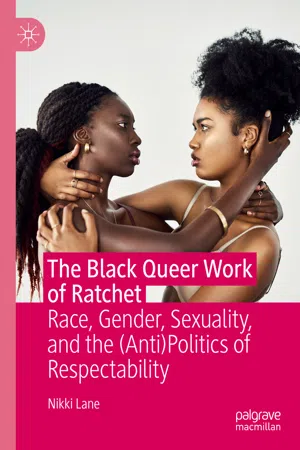
This book enters as a corrective to the tendency to trivialize and (mis)appropriate African American language practices. The word ratchet has entered into a wider (whiter) American discourse the same way that many words in African American English have—through hip-hop and social media. Generally, ratchet refers to behaviors and cultural expressions of Black people that sit outside of normative, middle-class respectable codes of conduct. Ratchet can function both as a tool for critiquing bad Black behavior, and as a tool for resisting the notion that there are such things as "good" and "bad" behavior in the first place. This book takes seriously the way ratchet operates in the everyday lives of middle-class and upwardly mobile Black Queer women in Washington, DC who, because of their sexuality, are situated outside of the norms of (Black) respectability. The book introduces the concept of "ratchet/boojie cultural politics" which draws from a rich bodyof Black intellectual traditions which interrogate the debates concerning what is and is not "acceptable" Black (middle-class) behavior. Placing issues of non-normative sexuality at the center of the conversation about notions of propriety within normative modes of Black middle-class behavior, this book discusses what it means for Black Queer women's bodies to be present within ratchet/boojie cultural projects, asking what Black Queer women's increasing visibility does for the everyday experiences of Black queer people more broadly.
eBook - ePub
The Black Queer Work of Ratchet
Race, Gender, Sexuality, and the (Anti)Politics of Respectability
- English
- ePUB (mobile friendly)
- Available on iOS & Android
eBook - ePub
The Black Queer Work of Ratchet
Race, Gender, Sexuality, and the (Anti)Politics of Respectability
About this book
Information
© The Author(s) 2019
N. LaneThe Black Queer Work of Ratchethttps://doi.org/10.1007/978-3-030-23319-8_11. The Ethnography of Ratchet: Studying Language Practices of the Black (Queer) Middle-Class
Nikki Lane1
(1)
Washington, DC, USA
Nikki Lane
“I Don’t Like Ratchet Music, But I Like This Song”
I conducted ethnographic fieldwork between 2012 and 2016 for my research about what is colloquially referred to as the Scene in DC among Black Queer Women (BQW). The BQW’s Scene is an amorphous, loosely connected set of social networks comprised of BQW and their allies, as well as the spaces those social networks create in order to socialize (Lane 2015). I refer to these spaces, where the Scene was most often instantiated, as scene spaces. Scene spaces included sites such as house parties, book club meetings, social support groups, professional women’s sporting events, semi-private parties at restaurants, lounges, and bars. Additionally, musical performances by queer artists, burlesque shows, one-off Black queer-themed events, and Meetups organized by Black queer people were also scene spaces. During my fieldwork, I made it a point to go to all of the scene spaces that were available to me. And so when I was invited to Timi’s1 birthday celebration at a “Women’s Happy Hour” at a new gay bar just off U Street, I happily accepted. There were five of us, including the “birthday girl,” standing together amongst the crowd. We stood nursing our drinks and, as is customary at happy hours with casual acquaintances, we engaged in small talk and someone asked me, “Oh, so what do you do?”
Scene spaces were often classed in particular ways. The location of the party, the price of admission, or, as was of particular importance to me and my work, language practices within, often served as important indicators of the kind of class performances that were to be expected. On the BQW’s Scene in DC during my research, happy hours were often spaces where upwardly mobile, middle-class women met. Happy hours were typically spaces where the music was at a volume low enough to have a conversation. Asking and answering “what do you do?” was one way of demonstrating one’s cultural and economic capital. Issues of class performance were often of supreme importance in scene spaces, and language practices such as these indicated the way that issues of race, sexuality, and class were inextricably linked within this particular social formation. Music could also serve as an indication of how a space was classed, and discussions about music revealed particular ideological investments in certain kinds of class performances. The DJ at the Women’s Happy Hour played hip-hop from the Top 40 with songs like Kanye West’s “Mercy” that included rapper Big Sean’s lyrical gem, which I mouthed along to the music:The DJ also played one of my favorites from that year “No Lie” (2012) by 2 Chainz featuring Drake who says eloquently:Then the DJ played Tyga’s “Rack City” (2011) whose most memorable lines were its hook:As the song began, Timi turned to the group of us and said, “I don’t like ratchet music, but I like this song.” We all laughed, backed it up,2 and dropped it like it was hot3 to the next few songs. We took a break from dancing and refreshed our drinks, and ended up in a conversation about the kind of hip-hop that had come to be referred to as ratchet music. Curious, I asked everyone “What do you mean when you say ‘ratchet music’?” Everyone, including myself, tried their hand at a definition of ratchet music.
Drop it to the floor, make that ass shake (whoa)
Make the ground move, that’s an ass-quake
Built a house up on that ass, that’s an ass-state
Roll my weed on it, that’s an ass-tray
She came through, she brought food
She got fucked, she knew wassup
She think I’m the realest out
And I say “damn, that makes two of us”
Rack city, bitch
Rack rack city, bitch
Ten ten ten twenties and them fifties bitch
By 2012, ratchet music, generally, had become associated with any contemporary hip-hop song that featured sexually explicit and suggestive themes. Timi and her friends said as much by naming rappers and songs they thought were ratchet. It was not necessarily “new” music. It was simply a subgenre of primarily Southern hip-hop that often referenced drug dealing (oftentimes referred to as its own genre, Trap4 Music) stripping, explicit sexual acts, public drunkenness, and other behavior deemed outside of the notions of respectability. It was the kind of music that revolved around being inappropriate—drunk, angry, loud, and horny. It also revolved around being Black and bad, on purpose. It associated Blackness with badness and the South. It was “non-conformist, daring, [broke] social conventions, [went] against the established (read: White) norms for Black folk,” (Smitherman 2006) and it was as Geneva Smitherman might argue “Bad Nigger5” music. It was the kind of music that Black middle-class people standing around sipping on $12 drinks should not enjoy because it associated Blackness with poor (read: lower-class) behavior.
The word ratchet itself wasn’t a new “made up word,” but a part of the legacy of African American English (AAE) which often stretched and bent the meanings of English words (Alim 2006; Smitherman 2000). In fact, I was certain I heard a mother in my church6 refer to people who were standing around on a street corner drinking out of brown paper bags as ratchet one Sunday evening7 while my family was dropping her off to her retirement home after services. I remember knowing exactly what she meant. They were raggedy, disheveled, and inappropriate. They were the “Bad Nigger.” I had grown up learning, and it was consistently reinforced, that when you behaved as a “nigger” in public, whatever happened to you, you deserved. “Niggers” I learned, growing up as a Black girl in the American South, were not worthy of respect, let alone sympathy. I didn’t learn until I was a young adult that this idea was rooted in an investment in assimilationist racial politics. Black folks who enjoyed leisure time on the street corner, especially on a Sunday, were no less im/moral than church folk who were in the church treating one another with contempt. What was different though was that those on the corner made other Black folk look bad in the eyes of white people. And that seemed to be what Black middle-class folks feared the most.
Iton describes “the nigger” as a kind of non-citizen, haunting America’s promise of democracy. “The nigger” haunts Blackness for “the nigger, the other, must be identified, isolated, and deployed in such a manner as to sustain a viable, marketable, assimilable, and respectable Blackness” (Iton 2008, 181). If the nigger is the specter that haunts Blackness, he does so by disrupting the fiction that Black people could ever have full access to American citizenship. He must be rooted out because he threatens every other Black person in America who is trying to “act right” and prove they’re worthiness. I would argue that ratchet describes the sensibility and, perhaps, the imagination of “the nigger.”
Claiming, acting, and being ratchet, involves an indirect (or direct) political orientation. To be Black and to be ratchet, on purpose, means that you ascribe no value to assimilation into the American “way of life.” It is neither a possibility, nor a goal. Being ratchet makes you an outsider within American cultural politics and being a “nigger” makes you one within assimilationist, Black middle-class politics, but in either case, you’re still Black. That outsider-within positionality, we learn from Collins (1986), produces a great number of possibilities. One such possibility is a new word. According to Smitherman, the nigga (where the -er is replaced by the -a) is an example of African American counter-language where Black folks upend the “White man’s language … transforming bad into good” (Smitherman 2006, 51). Similarly, Southern hip-hop artists upended the potentially invective intent of ratchet—particularly its concern over what is “bad” behavior according to some Black folks—in the process, reanimating debates over respectability (Stallings 2013; Lewis 2013), racialized class politics (Pickens 2014; Brown and Young 2015), and, as I’ll argue, the intersection of each of these within the politics of normative sexuality. As our conversation about ratchet and ratchet music unfolded at happy hour, I immediately recognized that each of us had a different investment in how ratchet was defined.
Consider the words twerk , bling, and swag. African American English words frequently end up in the American lexicon without much attention to what they do when they get there. That is, while many people use these terms, not enough attention is paid to how they operate in the everyday lives of people. But here was Timi, using the word in a discussion about how she understood herself in the world. Timi wanted us to know that, even though she knew some of the songs, it wasn’t the type of music that she listened to at home, nor was it the kind of music that she preferred listening to. During my research, I found that ratchet was sometimes discussed as something that could “rub off” on you. If you spent too much time doing ratchet things, such as listening to ratchet music, then someone might think you were actually ratchet. The fear of being mistaken for ratchet reminded me of the fear of being seen as a lower-class Black person sometimes experienced by Black middle-class folks. Vershawn Young (2011) analyzes Chris Rock’s joke in his comedy special Bigger and Blacker which highlights the anxiety that Black people, particularly Black middle-class people, have about being mistaken for “niggas” who behave in ways that are outside of the boundaries of respectability. Geneva Smitherman, concerned with the broad language practice of Black folks using the n-word, argues that one of the ways Black folks use the word is to describe a “vulgar, disrespectful, anti-social” Black person who “conforms to negative stereotypes of African Americans” (Smitherman 2006, 52). Black women who engaged in ratchet behavior, are seen as suspicious; self-serving and “playing into stereotypes...
Table of contents
- Cover
- Front Matter
- 1. The Ethnography of Ratchet: Studying Language Practices of the Black (Queer) Middle-Class
- 2. Defining Ratchet: Ratchet and Boojie Politics in Black Queer Space
- 3. Being Ratchet: Undoing the Politics of Respectability in Black Queer Space
- 4. Representing Ratchet: Screening Black Lesbian Sex and Ratchet Cultural Politics
- 5. Coming Out Ratchet and Whole: Black Women and the Struggle to Just Be
- 6. “I Said What I Said”: Final Notes on Ratchet/Boojie Politics
- Back Matter
Trusted by 375,005 students
Access to over 1.5 million titles for a fair monthly price.
Study more efficiently using our study tools.
Frequently asked questions
Yes, you can cancel anytime from the Subscription tab in your account settings on the Perlego website. Your subscription will stay active until the end of your current billing period. Learn how to cancel your subscription
No, books cannot be downloaded as external files, such as PDFs, for use outside of Perlego. However, you can download books within the Perlego app for offline reading on mobile or tablet. Learn how to download books offline
Perlego offers two plans: Essential and Complete
- Essential is ideal for learners and professionals who enjoy exploring a wide range of subjects. Access the Essential Library with 800,000+ trusted titles and best-sellers across business, personal growth, and the humanities. Includes unlimited reading time and Standard Read Aloud voice.
- Complete: Perfect for advanced learners and researchers needing full, unrestricted access. Unlock 1.5M+ books across hundreds of subjects, including academic and specialized titles. The Complete Plan also includes advanced features like Premium Read Aloud and Research Assistant.
We are an online textbook subscription service, where you can get access to an entire online library for less than the price of a single book per month. With over 1.5 million books across 990+ topics, we’ve got you covered! Learn about our mission
Look out for the read-aloud symbol on your next book to see if you can listen to it. The read-aloud tool reads text aloud for you, highlighting the text as it is being read. You can pause it, speed it up and slow it down. Learn more about Read Aloud
Yes! You can use the Perlego app on both iOS and Android devices to read anytime, anywhere — even offline. Perfect for commutes or when you’re on the go.
Please note we cannot support devices running on iOS 13 and Android 7 or earlier. Learn more about using the app
Please note we cannot support devices running on iOS 13 and Android 7 or earlier. Learn more about using the app
Yes, you can access The Black Queer Work of Ratchet by Nikki Lane in PDF and/or ePUB format, as well as other popular books in Social Sciences & Sociolinguistics. We have over 1.5 million books available in our catalogue for you to explore.