- English
- ePUB (mobile friendly)
- Available on iOS & Android
eBook - ePub
About this book
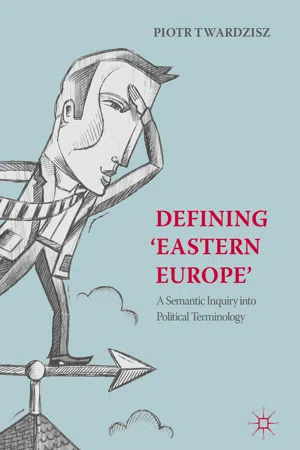
This book offers a linguistic-semantic analysis of the expression 'Eastern Europe' in international English-language media discourse and academic discourse. Interdisciplinary in nature, it provides insights beyond semantics and lexicology, commenting on the politics, history, economy and culture of the region. Its thorough analysis of 'Eastern Europe' as a linguistic entity, surrounded and affected by other linguistic entities, allows for a systematic description of the term's linguistic 'behaviour' in specialist written discourse. The author measures the 'quantity' and 'quality' of 'Eastern Europe' in specialist discourse, painting a holistic picture of how it appears in English-language quality texts published in the last twenty-five years. This book will appeal to students and scholars of cognitive linguistics, semantics, lexicology and lexicography, and to specialists working on history, political theory and international relations as they relate to Eastern Europe.
Information
© The Author(s) 2018
Piotr TwardziszDefining ‘Eastern Europe’https://doi.org/10.1007/978-3-319-77374-2_11. Western Perspectives and Vantage Points
Piotr Twardzisz1
(1)
Institute of Applied Linguistics, University of Warsaw, Warsaw, Poland
While scholars have hailed Eastern Europe1 as “a complicated place” (Okey 1986: 17) and not a place “for the tidy-minded” (ibid. 1992: 104), with the sustained attention it has attracted, its complexity has been on the rise. The intrinsic semantic complexity of Eastern Europe fits in with the view of semantics, which provides access to a limitless expanse of encyclopaedic knowledge (see, e.g., Langacker 1987: 156) . In other words, the semantic description of Eastern Europe and semantic description in general are compatible in fostering descriptive complexity. Some semantic descriptions have grown to enormous proportions, effectively obfuscating their target, which is meaning itself. The expected complexity of semantic description does not help with sorting out the definitional maze of the key concept. It further obscures its meaning. The project undertaken here endeavours to reduce, if not remove, this intricacy.
There is relatively little of Eastern Europe in Eastern Europe itself. There is more of it in Western Europe, or in the West, generally. The point is that the discussion and analyses presented in this book mirror the kind of debate about Eastern Europe conducted in the West, metonymically speaking. Thus, we can talk of some form of westernization of Eastern Europe (see Sect. 7.2). Defining Eastern Europe, which is our ultimate goal, heavily depends on the vantage point assumed when designing the definition. Naturally, the choice of such vantage points is practically limitless. Therefore, to make this project manageable, we will adopt the metonymic cover term of the western vantage point, which constrains the multiplicity of dispersed views.
The dissemination of western academic and media discourse on Eastern Europe has been carried out mostly in/through English. The almost exclusive use of this language carries the danger of entrapment, which results from locating the entire discussion within the confines of the English language (cf. Wierzbicka 2014) . This language is characteristic of Anglo-Saxon culture, which is external to Eastern European culture. The fundamental premise of this project is that the concepts of Eastern Europe and Central Europe will be examined from the western viewpoint . This, in turn, subsumes two types of western discourses—western media and western academic discourses—conducted in the English language. The exploitation of Eastern Europe by these discourses may result from the general assumption that Eastern Europe is a western idea. Conversely, the belief that Eastern Europe is a western idea may be provoked by its proliferation in western public discourse, or, as Pick (2000: 11) puts it, in “the consciousness of the West”.
There are numerous scholarly publications devoted to the topic of Eastern Europe. The problem of this concept is that it is not undefined or underdefined, but that it is overdefined. The majority of scholarly publications in the fields of history, political science, regional studies or international relations theory provide some definitions of this term. These definitions, rather than being unanimously accepted, are concocted by particular authors to serve the goals of their own publications. Virtually every historical or political study of Eastern Europe begins with a proposed definition or some outline of the region in question. It has to be stated that the accounts referred to here are not linguistic investigations and therefore they do not aim at providing a detailed terminological analysis of the key concept. Nevertheless, they all deal in one way or another with it, and their authors feel the urge to provide some account of the term which they make the pivot of their studies. In general, this definitional tug-of-war should not be surprising, as such “terminological debates” tend to be “infertile” for historians (cf. Berend et al. 2013: 6) . For linguists, especially those who treat semantics seriously, such definitional incongruities, though also common, constitute the motivation to act. What is meant here by “acting” is an attempt to rectify the mind-boggling definitional chaos.
1.1 The Linguistification of Eastern Europe
The amount of literature concerning different aspects of Eastern Europe is impressive. Even a fragmentary review of this output would result in a bulging volume. Numerous historians, economists, sociologists, political theorists, culture and literature scholars and others have contributed enormously to the general field of Eastern European (and/or Slavic) studies. There are also authors who seem to steer away from this concept or mention it only in passing. For example, it may be puzzling that the comprehensive lexicon of key concepts in international relations (Griffiths et al. 2008) does not list the term Eastern Europe at all. In fact, it does not provide an entry for Europe. The closest it gets is the morphological root (and another proper name ) Euro and another proper name the European Union. Eastern Europe is mentioned in several different entries as background information only. One might also wonder why Margaret Thatcher , in her (2011) 900-page memoire volume, mentions “eastern Europe” (spelled with a lower-case e) only on two occasions. The late British prime minister, who was in office from 1979 to 1990, witnessed the most critical events happening in this part of the continent and still did not devote much space to any discussion of those in her book. An expert on Eastern Europe, Christopher Hill , mentions the name only twice in his (2003) book, although he makes specific references to countries such as the Czech Republic or Czechoslovakia , East Germany , Hungary , Poland , Romania and Slovakia .
There is some disagreement among scholars about the amount of literature on Eastern Europe written by East European authors. For instance, Marc (2009: 25) expresses the opinion that “so little of the literature on Eastern Europe has been written by Eastern Europeans themselves”. A different opinion is expressed by Ann Applebaum in the introduction to her (2013) book. She enumerates several local authors who have greatly contributed to the political history of Eastern Europe and, to a minor extent, to general histories of the region. Among the names listed are Andrzej Paczkowski , Krystyna Kersten , Norman Naimark , Peter Kenez , László Borhi , Bradley Abrams , Mary Heimann , Karel Kaplan and others. What probably lies at the core of these two apparently opposing views is the undisputed fact that not much of the literature on Eastern Europe has been written by East European scholars in English. In order to plough through local archives, a solid knowledge of regional languages is necessary and many non-East European scholars may not be linguistically competent to do so. This requirement can be satisfied by East European researchers. However, they may not always have the sufficient command of English to publish their findings in the academic lingua franca.
The study of the concept of Eastern Europe involves a detailed analysis of its components, namely Eastern and Europe. The former seems to be sufficiently problematic to eclipse the latter. The relativity of the geographic location has been the target of some deliberations. According to one account, any place in Europe can be either in the south or north, east or west, depending on “the point of observation”, which “can easily be relativized” (Hroch 2000: 22–3) . In order to overcome such relativism, Hroch proposes that we “select an objective observation point and thus determine a centre” (p. 23). It is important to note that north and south do not attract so much attention as east and west. For some reason, the former, though also stigmatized in certain contexts (e.g., the rich north and the poor south), do not stir such heated academic debates. It is the latter, east and west, that cause so much controversy. For Huntington , north and south are unproblematic, as they “have universally accepted fixed reference points in the poles” (2002: 29; fn. 47). However, east and west are “confusing and ethnocentric” (ibid.), without any such reference points as the other two.2 Between these two, west is definitely less controversial or “less difficult to define”, though “not necessarily more logical” (Rollo et al. 1990: 2) . It is the adjective east, or Eastern, that is rather unsettling when combined with the term Europe.
Different authors express roughly the same doubt. For instance, Ágh (1998: 2) states that “[t]he question about the Eastern borders of Europe remains somewhat open”. In a similar vein, Huntington (2002: 158) asks: “But where is Europe’s eastern boundary?”. Not only does Huntington ask about Europe’s eastern limit, but he also provides an answer to this question. In his own words, the answer to this question is “Europe ends where Western Christianity ends and Islam and Orthodoxy begin” (ibid.). He also quite confidently delineates the actual borderline that separates western civilization on the east from non-western civilization, tracing its origin to “the great historical line that has existed for centuries separating Western Christian peoples from Muslim and Orthodox peoples” (ibid.). We can tentatively assume that the borderline drawn by Huntington can be understood as the borderline of Eastern Europe on its eastern end. Europe’s border on the east is needed on condition that Europe is recognized as a separate continent. There is a geographic view under which Europe and Asia are collapsed into one continent, Eurasia, rather than being two separate continents. This joint variant offers some solution to the above borderline dilemma. It creates another problem, though. The new problem is of a political, cultural or civilizational nature. The term can be contested by those who consider themselves European rather than non-...
Table of contents
- Cover
- Front Matter
- 1. Western Perspectives and Vantage Points
- 2. Historical Events and Developments
- 3. Problematic Terms and Concepts
- 4. Dominant Themes and Geographic Components
- 5. Current Data and Statistics
- 6. Meanings and Interpretations
- 7. Semantic Primes and Definitions
- Back Matter
Trusted by 375,005 students
Access to over 1.5 million titles for a fair monthly price.
Study more efficiently using our study tools.
Frequently asked questions
Yes, you can cancel anytime from the Subscription tab in your account settings on the Perlego website. Your subscription will stay active until the end of your current billing period. Learn how to cancel your subscription
No, books cannot be downloaded as external files, such as PDFs, for use outside of Perlego. However, you can download books within the Perlego app for offline reading on mobile or tablet. Learn how to download books offline
Perlego offers two plans: Essential and Complete
- Essential is ideal for learners and professionals who enjoy exploring a wide range of subjects. Access the Essential Library with 800,000+ trusted titles and best-sellers across business, personal growth, and the humanities. Includes unlimited reading time and Standard Read Aloud voice.
- Complete: Perfect for advanced learners and researchers needing full, unrestricted access. Unlock 1.5M+ books across hundreds of subjects, including academic and specialized titles. The Complete Plan also includes advanced features like Premium Read Aloud and Research Assistant.
We are an online textbook subscription service, where you can get access to an entire online library for less than the price of a single book per month. With over 1.5 million books across 990+ topics, we’ve got you covered! Learn about our mission
Look out for the read-aloud symbol on your next book to see if you can listen to it. The read-aloud tool reads text aloud for you, highlighting the text as it is being read. You can pause it, speed it up and slow it down. Learn more about Read Aloud
Yes! You can use the Perlego app on both iOS and Android devices to read anytime, anywhere — even offline. Perfect for commutes or when you’re on the go.
Please note we cannot support devices running on iOS 13 and Android 7 or earlier. Learn more about using the app
Please note we cannot support devices running on iOS 13 and Android 7 or earlier. Learn more about using the app
Yes, you can access Defining ‘Eastern Europe’ by Piotr Twardzisz in PDF and/or ePUB format, as well as other popular books in Literature & Computer Science General. We have over 1.5 million books available in our catalogue for you to explore.