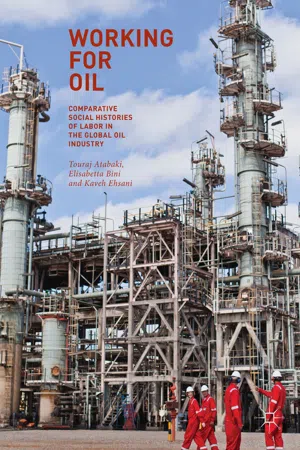
This volume examines the social history of oil workers and investigates how labor relations have shaped the global oil industry during the twentieth century and today. It brings together the work of scholars from a range of disciplines, approaching the social, political, economic and cultural dimensions of oil. The contributors analyze a number of key oil producing regions, including the Americas, the Middle East, Central Asia, the Caucasus, Europe and Africa.
eBook - ePub
Working for Oil
Comparative Social Histories of Labor in the Global Oil Industry
- English
- ePUB (mobile friendly)
- Available on iOS & Android
eBook - ePub
Working for Oil
Comparative Social Histories of Labor in the Global Oil Industry
About this book
Information
© The Author(s) 2018
Touraj Atabaki, Elisabetta Bini and Kaveh Ehsani (eds.)Working for Oilhttps://doi.org/10.1007/978-3-319-56445-6_3The Zero-Sum Game of Early Oil Extraction Relations in Colombia: Workers, Tropical Oil, and the Police State, 1918–1938
Stefano Tijerina1
(1)
University of Maine, Orono, ME, USA
Introduction
The history of early oil extraction operations in Colombia resonates with the experiences of other Latin American nations that found themselves in the middle of an imperial struggle for the control of the precious resource. In the early twentieth century, British and US multinational oil corporations, and to a lesser extent Canadian and Dutch companies, came face to face in Mexico, Colombia, Perú, Venezuela , Argentina, Bolivia, Ecuador, Brazil, and Chile over the control of oil extraction, export operations, and the development of domestic markets, forcing federal governments to reevaluate nationalist land use policies at the expense of local political interests. 1 The implementation and promotion of the Monroe Doctrine would ultimately leave the future of the Western Hemisphere in the hands of the USA, allowing their corporations to take over the control of the majority of the supply of oil in the region by the 1920s, as the outcomes of World War I forced British companies to abandon their interests in the Americas. Companies such as Standard Oil of New Jersey and Canadian subsidiaries such as the International Petroleum Corporation would reengineer the oil extraction business across the hemisphere, in order to implement “self-contained solutions” that allowed them to circumvent the threats that emanated from the internationalization and radicalization of labor; solutions learned from the corporate experiences with oil labor strikes back in Canada and the USA in the early 1910s. 2 This historical research will center on the social and political dynamics that developed between Colombia’s civil society, workers, local politicians, national policymakers, foreign workers and managers, and corporate leadership, as oil extraction operations were set in motion during the early 1920s. The political life of oil workers will be at the forefront of this analysis, and particularly how they reacted to the “self-contained solutions” imported and implemented by Standard Oil of New Jersey through its Canadian subsidiary, Tropical Oil , and in compliance with the permissive and unregulated oil policy structures established by the Colombian government.
In Colombia , the beginning of the United Fruit Company’s banana export operations in 1899 marked the incremental growing presence of US business interests. 3 This was further advanced by the implementation of vertical integration strategies that increased the presence of US interests, capitalizing on the pro-business policies and foreign business incentives designed and implemented by the administration of President Rafael Reyes (1904–1909). Nevertheless, the outreach of the United Fruit Company’s operation would not compare to the magnitude and impact of Standard Oil of New Jersey’s oil operation in Colombia . The vertical integration between Tropical Oil and Standard Oil of New Jersey’s Canadian subsidiary, Andian National Corporation, allowed the US company not only to monopolize the extraction but the transportation and final export of crude oil throughout the first half of the twentieth century. 4
Before the emergence of nationalist policies that followed the Mexican Revolution , large oil corporations had experienced the privileges of assuming “de facto control of national resources” overseas. 5 The incidents and policies that followed the 1910 revolution made it clear that free market competition in Latin American markets was not an effective business strategy, that there was a need for effective government-business cooperation in order to guarantee the defense of business interests abroad, that there was a need for preserving business-friendly governments in the region, that these governments should be willing to use the power of the state in order to control local workers and guarantee free market policies, and that domestic refining capabilities to satisfy local demand should be tightly regulated and controlled by the foreign business interest.
The most significant lesson of US corporations after the Mexico experience was that effective government-business cooperation had to be constructed around the idea of national security. The policies implemented in the 1920s for the management of national reserves were instrumental in keeping prices high back home while keeping them low abroad. In the name of national security, US oil corporations agreed to control the production of their local supply in accordance with federal policies, compensating it with aggressive “investments in overseas areas.” 6 By 1929, US direct investment in oil production zones across the Western Hemisphere had increased 250%, thanks to the government-business partnerships that set the tone in places like Colombia , Peru, and Venezuela . 7 These partnerships would set the foundations for the further expansion of the definition of national security. In efforts to protect their investments in South America, and in order to avoid the mistakes made in Mexico, US oil corporations were able to define their investments and foreign capital as part of the idea of national security. From that point forward, any nationalist movement overseas or any physical threat to US foreign interests became a matter of national security. In the case of oil, labor upheaval became the biggest concern, emphasizing even more the importance of strong government-business partnerships across the region.
Founded in 1918, the National Association for the Protection of American Rights in Mexico (NAPARM) would become the institutional pillar for future government-business partnerships. 8 The lobby organization funded exclusively by US oil companies initially pressured the US government to “take whatever steps were necessary” in order to protect US interests, and although they failed to stop the nationalization of the oil industry in Mexico, they did set the tone in South America. There was resonant support “for vigorous protection of American property rights against ‘radical’ policies” across the Washington circles, and the idea that any nationalist initiative represented an attack against US interests became the norm. 9 The challenge was convincing foreign government to share the same vision.
The effectiveness of the initiative would be tested after the 1920s when US oil companies made their way into the region in order to implement their business strategy. This included transplanting Fordist ideas, capitalizing on the deregulated nature of labor and land use policies, drafting and designing petroleum policies to their liking, securing pro-business normative systems that benefited them as well as the political elites in power, and convincing the local government to favor foreign corporate interests over local worker’s rights. Government needed to buy in on the Fordist principles that breaking oil work into small deskilled tasks was good policy, and that the minimization of labor costs at the expense of constructing a blue collar middle class while maximizing profits for the foreign company was good for nation building and long-term economic development.
Labor uprising remained the biggest threat to corporate interests in South America. The Bayonne strike that had taken place in New Jersey in July 1915 against Standard Oil of New Jersey had prepared management for similar events in South America. 10 In efforts to solve the problems of labor dispute and mitigate the threats, dangers, and destruction experienced that summer, executives from the oil corporation opted to “devise a self-contained solution” that would not only distance workers from unionizing but also allow management to deal directly with workers’ issues, isolating them from the national and international debates that challenged capitalism. 11 These self-contained solutions would then be exported to South American oil fields in the 1920s as part of their business strategy.
Standard Oil of New Jersey and its Canadian subsidiaries transplanted the legislative, judicial, and extralegal means that they enjoyed back in the USA and instituted those same privileges in South America. The same autocratic management strategies that prevailed during the pre-Bayonne era would be replicated across the region, where they found the same “political will” among the local elites.
The frontier-type settlement characteristic of oil operations back in the USA would be replicated. Company towns were constructed with the same intentions of isolating workers from middle and upper management, and exposing them to the same miserable conditions to which American workers were once exposed. With the sweat and hard work of local grunt workers, oil company towns in South America would be constructed in order to create an artificial space between foreigners and locals, a distinctive separation that would also be evident in the worker-management relations that would evolve in places like Barrancabermeja , Colombia . 12
In 1920, while Standard Oil of New Jersey was instituting an unprecedented labor contract that included no discrimination , collective bargaining via the management-worker internal dispute system, grievance resolution, increased wages, and an Eight-hour work day among other benefits, in Colombia they were working out a deal with the local government in order to replicate the inhumane labor conditions that had led to violent confrontations in places like New Jersey, Colorado, and Oklahoma. 13 The effectiveness of the government-business partnership in Colombia would set the tone for further capitalist expansionists efforts across the region.
The Colombian Experiment
By 1905, it was evident that there was crude oil beneath Colombian territory. Colombian policymakers had heard the rumors, Caudillos in the Santander region had seen the crude bubble effortlessly from beneath the earth, and local entrepreneurs were beginning to piece together the lucrative business opportunity behind this new industrial endeavor. British, American, and Canadian investors were also well aware of some of the deposits, but they held the right end of the stick; they had the capital, technology , market, and the “know how” behind the extraction, transportation, refining , and commercialization of oil. This advantage manifested itself during the initial oil concession negotiations. The De Mares concession would be awarded to Tropical Oil Company. 14 Negotiations between the Canadian subsidiary and the Col...
Table of contents
- Cover
- Front Matter
- Introduction
- Disappearing the Workers: How Labor in the Oil Complex Has Been Made Invisible
- Part I. The Political Life of Oil
- Part II. The Productive Life of Oil
- Part III. The Social and Urban Life of Oil
- Back Matter
Trusted by 375,005 students
Access to over 1.5 million titles for a fair monthly price.
Study more efficiently using our study tools.
Frequently asked questions
Yes, you can cancel anytime from the Subscription tab in your account settings on the Perlego website. Your subscription will stay active until the end of your current billing period. Learn how to cancel your subscription
No, books cannot be downloaded as external files, such as PDFs, for use outside of Perlego. However, you can download books within the Perlego app for offline reading on mobile or tablet. Learn how to download books offline
Perlego offers two plans: Essential and Complete
- Essential is ideal for learners and professionals who enjoy exploring a wide range of subjects. Access the Essential Library with 800,000+ trusted titles and best-sellers across business, personal growth, and the humanities. Includes unlimited reading time and Standard Read Aloud voice.
- Complete: Perfect for advanced learners and researchers needing full, unrestricted access. Unlock 1.5M+ books across hundreds of subjects, including academic and specialized titles. The Complete Plan also includes advanced features like Premium Read Aloud and Research Assistant.
We are an online textbook subscription service, where you can get access to an entire online library for less than the price of a single book per month. With over 1.5 million books across 990+ topics, we’ve got you covered! Learn about our mission
Look out for the read-aloud symbol on your next book to see if you can listen to it. The read-aloud tool reads text aloud for you, highlighting the text as it is being read. You can pause it, speed it up and slow it down. Learn more about Read Aloud
Yes! You can use the Perlego app on both iOS and Android devices to read anytime, anywhere — even offline. Perfect for commutes or when you’re on the go.
Please note we cannot support devices running on iOS 13 and Android 7 or earlier. Learn more about using the app
Please note we cannot support devices running on iOS 13 and Android 7 or earlier. Learn more about using the app
Yes, you can access Working for Oil by Touraj Atabaki, Elisabetta Bini, Kaveh Ehsani, Touraj Atabaki,Elisabetta Bini,Kaveh Ehsani in PDF and/or ePUB format, as well as other popular books in Social Sciences & Energy Industry. We have over 1.5 million books available in our catalogue for you to explore.