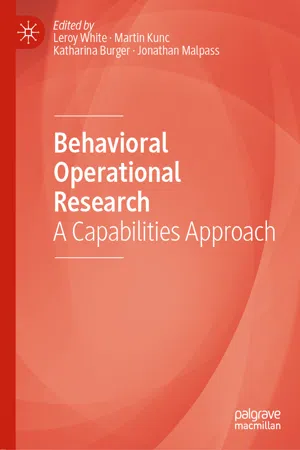
This edited collection addresses the question of which capabilities and competencies enable Behavioral Operational Research to provide sustained improvement to decision processes. The aim is to show how a focus on capability and competency will not only meet short-term requirements for problem solving and decision support, but also build a solid foundation for the future. The contributors present recent advances in Behavioral OR, with a focus on the ways in which users of models deal with incomplete and imprecise information, subjective boundaries and uncertainty. These chapters are structured around three key dimensions of BOR: capabilities, cognition and aspects of practice.
eBook - ePub
Behavioral Operational Research
A Capabilities Approach
- English
- ePUB (mobile friendly)
- Available on iOS & Android
eBook - ePub
Behavioral Operational Research
A Capabilities Approach
About this book
Information
© The Author(s) 2020
L. White et al. (eds.)Behavioral Operational Researchhttps://doi.org/10.1007/978-3-030-25405-6_11. Behavioral Operations and Behavioral Operational Research: Similarities and Differences in Competences and Capabilities
Martin Kunc1
(1)
Southampton Business School, University of Southampton, Southampton, UK
1.1 Introduction
The research focus in Behavioral Operational Research (BOR) is mainly related to facilitation for model building and communication of model results when Operational Research (OR) practitioners are supporting human problem solving by modeling. Research seems to be limited to and for specialists in OR modeling (mainly Soft OR models) and focused on process design and facilitation without understanding the purpose of the approaches within organizational contexts. On the other hand, Behavioral Operations Management (BOM) seems to mostly focus on the impact of behavioral factors on the solutions to problems within organizational contexts. Is there a possibility that BOM can enhance the practice of BOR? This chapter aims to explore this question.
1.2 Behavioral Operations Management : A Short Literature Review
This section presents a brief analysis of the field of Behavioral Operations Management with some interesting insights. For more exhaustive analysis, see Bendoly et al. (2006, 2010), Bendoly and Schultz (2006), and Loch and Wu (2007). Firstly, like BOR, there are different definitions of BOM. On the one hand, Gino and Pisano (2008) define “behavioral operations as the study of attributes of human behavior and cognition that impact the design, management, and improvement of operating systems, and the study of the interaction between such attributes and operating systems and processes.” They assert that BOM should employ concepts from social, which recognize the impact of groups, social norms, and systems as well as organizations on operations, and cognitive and psychology theories, which reflect how the properties of individuals impact on operations. On the other hand, Croson et al. (2013) suggest “behavioral operations as the study of potentially non hyper-rational actors in operational contexts.” They consider the role of bounded rationality within operations, but they do not advocate for specific theories like Gino and Pisano (2008). However, both papers share similar constructs: the importance of the context, operations, and behavioral aspects of decision making.
In more detail, BOM and traditional Operations Management share the same goal: the design, management, and improvement of operating systems and processes. Croson et al. (2013) suggest three criteria characterize the actors in traditional Operations Management: (1) motivated by self-interest expressed in monetary terms; (2) acting consciously and in a deliberate manner; and (3) optimizing a defined objective function. On the other hand, BOM focuses on deviations from any of the three criteria through the application of behavioral theories. However, the application of behavioral theories is not aimed at getting a deeper understanding of leadership, fairness, emotions or motivation (Croson et al. 2013) or modifying cognitive and behavioral theories. The application of behavioral theory originates from the initial consideration of human behavior as a second-order effect, rather than first-order effect, in operations (Gino and Pisano 2008). For example, normative models in traditional Operations Management, such as inventory or scheduling, assume decision makers and agents in the system are rational but operating issues involve groups of people with various skills and organizational responsibilities so cognitive and behavioral aspects shape how people behave differently than hyper-rational actors.
The value of BOM lies in recognizing that almost all contexts studied within Operations Management contain people that do not behave following normative models (Croson et al. 2013). Therefore, BOM starts at a micro-level to make better recommendations of how to design and improve processes. Given the deviation from a mechanistic and rationalistic view of the organization, BOM mostly has an empirical focus testing Operations Management theory for their robustness in laboratory and real world.
However, there are researchers who suggest BOM’s perspective is flawed as they use mainly one view of decision making, where heuristics are liabilities because they lead to deviations from normative models based on economic rationality (Katsikopoulos and Gigerenzer 2013). Katsikopoulos and Gigerenzer (2013) suggest there are situations where heuristics are useful for better decisions. Their program of research called fast-and-frugal-heuristics evaluates heuristics not according to logical norms but according to performance in the ecology of real-world decision problems.
1.2.1 The Focus of BOM Research
BOM has been usually associated with experimental research (Katok 2011) but recent research practices involve a wider set of methodologies and the identification of heterogeneity at individual level, e.g. gender and risk preferences (Croson et al. 2013). Additional methodologies are experiments using games (e.g. the Beer Distribution game in a controlled laboratory setting to evaluate impact of advance warning of disruptions; see Engin and V...
Table of contents
- Cover
- Front Matter
- Part I. Competences Within Models
- Part II. Competences Beyond Models
- Part III. Capabilities Within Models
- Part IV. Capabilities Beyond Models
- Back Matter
Trusted by 375,005 students
Access to over 1.5 million titles for a fair monthly price.
Study more efficiently using our study tools.
Frequently asked questions
Yes, you can cancel anytime from the Subscription tab in your account settings on the Perlego website. Your subscription will stay active until the end of your current billing period. Learn how to cancel your subscription
No, books cannot be downloaded as external files, such as PDFs, for use outside of Perlego. However, you can download books within the Perlego app for offline reading on mobile or tablet. Learn how to download books offline
Perlego offers two plans: Essential and Complete
- Essential is ideal for learners and professionals who enjoy exploring a wide range of subjects. Access the Essential Library with 800,000+ trusted titles and best-sellers across business, personal growth, and the humanities. Includes unlimited reading time and Standard Read Aloud voice.
- Complete: Perfect for advanced learners and researchers needing full, unrestricted access. Unlock 1.5M+ books across hundreds of subjects, including academic and specialized titles. The Complete Plan also includes advanced features like Premium Read Aloud and Research Assistant.
We are an online textbook subscription service, where you can get access to an entire online library for less than the price of a single book per month. With over 1.5 million books across 990+ topics, we’ve got you covered! Learn about our mission
Look out for the read-aloud symbol on your next book to see if you can listen to it. The read-aloud tool reads text aloud for you, highlighting the text as it is being read. You can pause it, speed it up and slow it down. Learn more about Read Aloud
Yes! You can use the Perlego app on both iOS and Android devices to read anytime, anywhere — even offline. Perfect for commutes or when you’re on the go.
Please note we cannot support devices running on iOS 13 and Android 7 or earlier. Learn more about using the app
Please note we cannot support devices running on iOS 13 and Android 7 or earlier. Learn more about using the app
Yes, you can access Behavioral Operational Research by Leroy White, Martin Kunc, Katharina Burger, Jonathan Malpass, Leroy White,Martin Kunc,Katharina Burger,Jonathan Malpass in PDF and/or ePUB format, as well as other popular books in Business & Operations. We have over 1.5 million books available in our catalogue for you to explore.