This book provides a cultural studies analysis of Millennials and their impact on American culture and society. Beginning with an introduction that touches upon which part of the population is described as Millennial, the book also explores the Millennial psyche, marketing to Millennials, Millennials' purchasing preferences, gender and sexuality among Millennials, and Millennials and their relation to postmodernism, among other things. Cultural Perspectives on Millennials is designed for students taking courses in cultural studies, sociology, American studies and related fields. It is written in an accessible style and makes use of numerous quotations from writers and thinkers who have written about Millennials. It is illustrated by the author.
Arthur Asa BergerCultural Perspectives on Millennialshttps://doi.org/10.1007/978-3-319-69685-0_1
Begin Abstract
1. Introduction
Arthur Asa Berger1
(1)
San Francisco State University, San Francisco, California, USA
Abstract
This chapter describes Millennials and asks why they are of interest and whether there are important differences between different kinds of Millennials. It offers statistics about the amount of time Millennials spend with social media as compared to other generations. It offers a number of lists describing the different generations and concludes that Millennials are persons (in 2015) who are between eighteen and thirty-four years of age. Then it discusses the notion that marketers see Millennials as “trailblazers” who may be setting new courses for older generations to follow. It concludes with statistics about Millennials gathered from various sources.
Keywords
MillennialsGenerations Marketing Trendsetters
End Abstract
We begin with two quotations of interest to our concerns. The first quotation deals with the number of Millennials (and there is some debate about how many Millennials there are in the United States) and how Millennials relate to other generations. This material comes from the Pew Research Center Fact Tank.
Millennials have surpassed Baby Boomers as the nation’s largest living generation, according to population estimates released this month by the U.S. Census Bureau. Millennials, whom we define as those ages 18–34 in 2015, now number 75.4 million, surpassing the 74.9 million Baby Boomers (ages 51–69). And Generation X (ages 35–50 in 2015) is projected to pass the Boomers in population by 2028. The Millennial generation continues to grow as young immigrants expand its ranks. Boomers—whose generation was defined by the boom in U.S. births following World War II—are older and their numbers shrinking as the number of deaths among them exceeds the number of older immigrants arriving in the country. Generations are analytical constructs, and developing a popular and expert consensus on what marks the boundaries between one generation and the next takes time. Pew Research Center has established that the oldest “Millennial” was born in 1981. The Center continues to assess demographic, attitudinal and other evidence on habits and culture that will help to establish when the youngest Millennial was bornor even when a new generation begins. To distill the implications of the census numbers for generational heft, this analysis assumes that the youngest Millennial was born in 1997. http://www.pewresearch.org/fact-tank/2016/04/25/mill
The second quotation deals with Millennials and marriage and the reluctance Millennials seem to have about getting married. It is from Meg Murphy ’s “NowUKnow: Why Millennials Refuse to Get Married.”
Millennials are saying no to traditional marriage in record numbers … and that’s not all. In Western culture in the late 18th century, marriage transformed from an economic arrangement into a union based on love. Now it may again be heading toward radical change. The median age at first marriage is now 27 for women and 29 for men—up from 20 for women and 23 for men in 1960. Today an unprecedented portion of millennials will remain unmarried through age 40, a recent Urban Institute report predicted. The marriage rate might drop to 70 percent—a figure well below rates for boomers (91 percent), late boomers (87 percent) and Gen Xers (82 percent). And declines might be even sharper if marriage rates recover slowly, or not at all, from pre-recession levels, according to the report. www.bentley.edu/impact/articles/nowuknow-why-millennials-refuse-get-married
Fig. 1.1
Emulator
As befits a book on Millennials, most of the sources used in this book come from the Internet . Almost every day I receive one or more articles from MediaPost or some other Internet publisher about Millennials. And I’ve used Googl e to search for articles on certain topics related to Millennials. Millennials spend a great deal of time on the Internet so it is only fitting that I found much of the material in this book there.
Who are the Millennials? Are they important? If so, why and in what ways? How did Millennials get to be the way they are? What impact are Millennials having on American culture and society? Are they more or less all the same or are there important differences between male and female Millennials, between the youngest and the oldest Millennials, between American Millennials and Asian, African and European Millennials? Are there significant differences between rich and poor Millennials, between African-American and Caucasian Millennials, and between Christian, Jewish and Muslim Millennials? I will deal with many of these questions, and others, in this book.
American Millennials represent something like two hundred billion dollars in buying power a year and, on average, will check their phones forty-three times a day. And twenty-five percent of them will never get married. Does that tell us anything interesting about them?
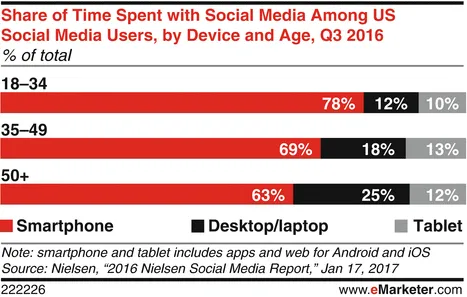
An article by Rimma Kats , Rahul Chadra and Alisa McCarthy that appeared in eMarketer (based on data from Nielsen) shows how the different generations and different genders use smartphones (January 23, 2017):
It’s no surprise that millennials’ social media time is mainly spent on smartphones. But what about older folks—are Baby Boomers and older users mostly mobile when it comes to social? Turns out, the answer is yes, if not quite to the same extent.
Fig. 1.2
Time Spent with Social Media Among Generations
According to Q3 2016 data from Nielsen, even those age 50 and up spend the vast majority of their social media time on mobile devices. Three-quarters of the older users spent most of their social media time on mobile—that includes smartphone and tablet. Not surprisingly, the level was even higher among Millennials. Fully 90% of their social media time occurred on smartphones and tablets. By extension, younger social media users were less likely than older generations to spend social media time on a PC. For example, just 12% of 18–34-year-olds’ social media time takes place on a PC. The study also pointed up a huge gap in social media use between men and women. According to Nielsen, among women, 25% of their overall weekly media time was spent using social media—around 6.5 hours. Among men, 19% of overall weekly time was spent on social, an average 4.2 hours. https://www.emarketer.com/Article/Its-Not-Just-Millennials-That-Tap-Mobile-Social/1015091
We see that there are differences in the amount of time the generations spend with social media and how men and women access social media. I will have more to say about gender and Millennials later in the book.
Wikipedia says the following about Millennials:
Millennials (also known as the Millennial Generation or Generation Y, abbreviated to Gen Y) are the demographic cohort following Generation X. There are no precise dates for when the generation starts and ends; most researchers and commentators use birth years ranging from the early 1980s to around 2000. Pew Research offers the following data about Millennials, those born at the beginning of the new Millennium:
As of April 2016, an estimated 69.2 million Millennials (adults ages 18–35 in 2016) were voting-age U.S. citizens—a number almost equal to the 69.7 million Baby Boomers (ages 52–70) in the nation’s electorate, according to a new Pew Research Center analysis of U.S. Census Bureau data. Both generations comprise roughly 31% of the voting-eligible population. https://en.wikipedia.org/wiki/Millennials
There is some disagreement about when Millennials were born but the Pew report suggests that if they are adults aged 18–35, they were born from around 1980–1998 or, roughly speaking, the year 2000.
Obviously, there’s a big difference between a Millennial aged ...
Table of contents
Cover
Frontmatter
1. Introduction
2. The Mind and Psyche of Millennials
3. A SociologySociology of Millennials
4. Myth and Millennials
5. Millennials and the Media
6. Marketing to Millennials
7. Millennials as Shoppers and Consumers
8. Postmodernism and Millennials
9. PoliticsMillennials
Politics
and Millennials
10. Sexual Identity, Gender and the Millennials
11. Coda
Backmatter
Trusted by 375,005 students
Access to over 1.5 million titles for a fair monthly price.
Study more efficiently using our study tools.
Frequently asked questions
Yes, you can cancel anytime from the Subscription tab in your account settings on the Perlego website. Your subscription will stay active until the end of your current billing period. Learn how to cancel your subscription
No, books cannot be downloaded as external files, such as PDFs, for use outside of Perlego. However, you can download books within the Perlego app for offline reading on mobile or tablet. Learn how to download books offline
Perlego offers two plans: Essential and Complete
Essential is ideal for learners and professionals who enjoy exploring a wide range of subjects. Access the Essential Library with 800,000+ trusted titles and best-sellers across business, personal growth, and the humanities. Includes unlimited reading time and Standard Read Aloud voice.
Complete: Perfect for advanced learners and researchers needing full, unrestricted access. Unlock 1.5M+ books across hundreds of subjects, including academic and specialized titles. The Complete Plan also includes advanced features like Premium Read Aloud and Research Assistant.
Both plans are available with monthly, semester, or annual billing cycles.
We are an online textbook subscription service, where you can get access to an entire online library for less than the price of a single book per month. With over 1.5 million books across 990+ topics, we’ve got you covered! Learn about our mission
Look out for the read-aloud symbol on your next book to see if you can listen to it. The read-aloud tool reads text aloud for you, highlighting the text as it is being read. You can pause it, speed it up and slow it down. Learn more about Read Aloud
Yes! You can use the Perlego app on both iOS and Android devices to read anytime, anywhere — even offline. Perfect for commutes or when you’re on the go. Please note we cannot support devices running on iOS 13 and Android 7 or earlier. Learn more about using the app
Yes, you can access Cultural Perspectives on Millennials by Arthur Asa Berger in PDF and/or ePUB format, as well as other popular books in Social Sciences & Cultural & Social Anthropology. We have over 1.5 million books available in our catalogue for you to explore.