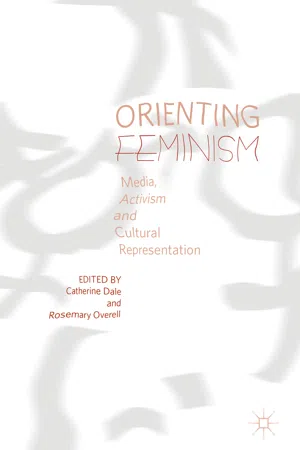
This edited collection explores the meaning of feminism in the contemporary moment, which is constituted primarily by action but also uncertainty. The book focuses on feminist modes of activism, as well as media and cultural representation to ask questions about organising, representing and articulating feminist politics. In particular it tackles the intersections between media technologies and gendered identities, with contributions that cover topics such as twerking, trigger warnings, and trans identities. This volume directly addresses topical issues in feminism and is a valuable asset to scholars of gender, media and sexuality studies.
eBook - ePub
Orienting Feminism
Media, Activism and Cultural Representation
- English
- ePUB (mobile friendly)
- Available on iOS & Android
eBook - ePub
Orienting Feminism
Media, Activism and Cultural Representation
About this book
Information
© The Author(s) 2018
Catherine Dale and Rosemary Overell (eds.)Orienting Feminismhttps://doi.org/10.1007/978-3-319-70660-3_11. Introduction: Orienting Feminism: Media, Activism, and Cultural Representation
Catherine Dale1 and Rosemary Overell2
(1)
Chuo University, Hachiōji, Japan
(2)
The University of Otago, Dunedin, New Zealand
Catherine Dale
This collection examines what feminism means and how it operates in the contemporary moment. What we are calling the “feminist contemporary” is constituted by action and self-reflection as well as by uncertainty and self-criticism. This volume regards these characteristics as integral to the circulation of feminism in the present, specifically in feminist modes of activism, media, and cultural representation. With this in mind, and thinking about feminism’s ongoing self-critique, this volume treats the feminist impulse as an orientation—a tending-towards and for a future without patriarchy. The fact that feminism can never be quite placed or fixed makes it compatible with the idea of orientation. In this book, the authors ask how feminism orients our responses to cultural events, happenings, and representations in recent times.
The chapters in this volume engage with media, activism, and cultural representation—the organising sections for this book—in order to do feminist work. The authors address elements of organising, representing, and articulating feminist politics. Orienting this politics involves locating feminist moments, highlighting feminist responses, and then opening these up for debate. This is not a straightforward process. Because feminism is not an object nor simply a label or a definition, orienting feminism also investigates how feminism moves—how it refuses that “thingification” so often demanded in, and by, academic and political discourse. In other words, one of the best traits of feminism is that it never stays still.
Feminism circulates. It moves through and is moved by academic discussions, popular think pieces, and Twitter storms. Feminism circulates and in its circulation, it materialises in diverse ways: the “lean in” culture of the corporate world, protest marches such as the Women’s March of 2017, and events such as SlutWalk (discussed in Chap. 6). Feminism also appears in social and political collectives that operate on and off-line in meetings, blogs, articles and social-media posts (see Chaps. 4, 5, 6, and 7). And yet, for all its appearances and work, feminism can also be very disjointed and undecided.
While feminism remains compelling and widely discussed—it is in no danger of disappearing—its discourse has also become more and more fragmented, contradictory, and reduced to catchphrases. For instance, feminism turns up as numerous commodities with slogans—“FEMINIST AF,” “I’M A FUCKING FEMINIST,” and “THIS IS WHAT A FEMINIST LOOKS LIKE.” “Feminism” even became a banner to Beyoncé’s performance at the 2014 MTV Music Awards. Feminism is working a double shift here because while feminism circulates, appearing on t-shirts, reality TV, and Instagram, it is also reduced to a catchphrase and in many instances, functions as a fashion accessory.
Double shifts seem to come naturally to feminism. We have heard of the double shift for women who work all day then labour at home in their “leisure” time and of the double shift for the woman at work who not only completes her own job but works as emotional support for colleagues. And now we have another kind of double shift where “shift” is a verb. Here feminism shifts or moves from manifesting in demonstrations and actions, which we might think about at university or discuss in terms of “live politics,” to becoming a commodity (Chaps. 3, 4, and 9). Of course, this other double shift is always part of the entanglement between politics and capitalism. Does one orient the other? Does the upsurge in feminist politics—condemnations of rape on social media (Chap. 7), events like SlutWalk (Chap. 6), and representations of feminine “girl” politics on screen (Chaps. 2 and 3)—orient its reification into a commodity? Of course. Opposing commodity culture to idealised “on the ground” realpolitik can be nostalgic and unhelpful. Instead, it feels important to acknowledge that feminism has always been grounded in the material and the everyday. So, as the chapters here indicate, this material orientation needs to account for and engage with the ubiquity of the commodity in the current context.
On the one hand, this movement into the world of the commodity—the world of the popular—is surely a sign of feminism’s continued relevance and importance. Indeed, with feminism seemingly everywhere—the word, the banner, and the hashtag—the opportunity to view the persistence of patriarchy and gendered violence is growing. However, while this double shift demonstrates feminism’s capacity, this everywhere-ness of feminism also risks flattening the general message: “Been there done that wore the pink pussy hat, got the feminist t-shirt.” This feminist tourism, and the consequent dilution of feminism’s potency, makes analysis, by which we mean an orientation to gendered politics in culture, all the more pressing. Responding to the urgency or now-ness of feminist activity, this collection presents many cultural orientations: from reality television to advertising, from social media to poetry, from self-defence to pornography.
While feminism appears worldwide, we continue to see it most clearly in the West. Similarly, as a movement, feminism is dominated by the middle-class, white, liberal ethos, which we might call mainstream feminism. However, there are multiple feminist voices—discourses running alongside this mainstream feminism—that are testament to feminism’s force and multiplicity. Some of them are represented in this collection.
In response to the dominance of mainstream feminism, this collection does not return to hackneyed unanswerable questions such as what is feminism? Or, can feminism be unified? Instead, it aims to orient multiple voices working as a broad-fronted force on problems of feminist activism, for example, around “feminist” self-defence (Chap. 5) and the demonstrations that took place after the rape of Jyoti Singh (Chap. 7); feminism in and of the media, such as representations of transwomen in reality television (Chap. 2) and of the vagina in fashionable graphic design (Chap. 4); and cultural regulation of women’s bodies in, for example, the creation of feminist pornography (Chap. 9). This collection also spreads out horizontally addressing local, young, and queer concerns that help orient hegemonic modes of liberal feminism in diverse ways.
These kinds of orientations are part of way-finding and way-making. In this sense, to orient feminism means to look for ways to operate and to create ways or paths to follow. Neither way-finding nor way-making are, of course, without obstacles or mistakes. So, yes, feminism circulates, but its multiple uses and expressions are not without contradictions, disagreement, separation, and negotiation from within and without (Chap. 5). This collection tracks some of these contradictions and negotiations. The authors in this book orient feminism in relation to different positions and articulations in contemporary culture. The chapters ask us to consider the intersections among feminist politics, everyday life, and our use of language—whether linguistic, visual, or physical—to place feminism in context.
The areas that Orienting Feminisms unpacks are “Media,” “Activism,” and “Cultural Representations.” The opening section, “Media,” brings together voices that address representations of gender and feminism in popular media. In Chapter 2, Joanna McIntyre discusses the ascent of transnormativity through an analysis of recent representations of transwomen in the docusoaps I Am Cait and I Am Jazz. Kevin Fletcher’s work, in Chapter 3, also turns to televisual representations in his description of My Little Pony in terms of post-feminist politics. Here we see some of the tensions that erupt when commodity culture and feminism share co-ordinates. In Chapter 4, Leigh Paterson considers the ever-proliferating presence of the vagina in graphic design. She tracks the visual representation of vaginas over time considering well-worn sites such as Courbet’s Origin of the World and NASA’s Golden Plaque and more recent instances such as the “snatch grabs” in advertising.
The following section, “Activism,” includes chapters that look at how feminism makes its way through activist spaces. Bell Murphy’s chapter addresses the politics of feminist self-defence. She asks if the seemingly liberal individualist logic of self-defence is at odds with a collective feminist politics and, particularly, what this means in a settler-colonial context such as Aotearoa/New Zealand. In Chapter 6, Jessamy Gleeson tackles the global phenomenon of SlutWalk. She offers an account of SlutWalk Melbourne from her perspective as an activist-organiser, and in so doing she makes palpable the connections between feminist activists’ emotional labour and activist burnout. In Chapter 7, Paula Ray regards “fourth-wave” feminist activism and asks whether the orientation of “waves” is useful for a decolonising feminist movement that accounts for feminists of colour. She discusses Indian activists’ use of social networking sites as a means for organising new and effective modes of feminist action.
The final section of this collection, “Cultural Representation,” considers what is at stake in contemporary feminist culture. This section opens with Siobhan Hodge’s chapter on Sappho. Hodge asks what the stakes are when Sappho, the archaic Greek poet, goes online. In particular, she considers the potential for posthumanism in feminist, lesbian, and bisexual uptakes of the poet on sites like Tumblr and YouTube. In the collection’s ninth chapter, Zahra Stardust considers the orientation of online pornography and its shifts from public to corporate regulation. In particular, she looks at how corporate porn censors non-normative female and queer bodies, and sex practices. Closing the collection, in Chapter 10, is Melanie Beres, who focuses on the concept of sexual consent in visual media campaigns, especially on Canadian university campuses. Her chapter looks at how legal and political issues of consent are challenging to navigate and publicise.
Within this orientation, we do not claim to capture feminism as a stable, solid object. Rather, we hope that the following chapters raise provocations and questions for readers and offer a glimpse of the many lively sites of feminist life today.
© The Author(s) 2018
Catherine Dale and Rosemary Overell (eds.)Orienting Feminismhttps://doi.org/10.1007/978-3-319-70660-3_22. “They’re So Normal I Can’t Stand It”: I Am Jazz, I Am Cait, Transnormativity, and Trans Feminism
Joanna McIntyre1
(1)
University of the Sunshine Coast, School of Communication and Creative Industries, Maroochydore, QLD, Australia
Joanna McIntyre
Transgender representation in mainstream media has recently reached critical mass. At the forefront of public engagement with transgender subjectivities are transgender celebrities—unique celebrities whose transgender identities are key to their public personas. These figures critically influence the ways in which the mainstream understands transgender lives and engag...
Table of contents
- Cover
- Front Matter
- 1. Introduction: Orienting Feminism: Media, Activism, and Cultural Representation
- Part I. Media
- Part II. Activism
- Part III. Cultural Representations
- Back Matter
Trusted by 375,005 students
Access to over 1.5 million titles for a fair monthly price.
Study more efficiently using our study tools.
Frequently asked questions
Yes, you can cancel anytime from the Subscription tab in your account settings on the Perlego website. Your subscription will stay active until the end of your current billing period. Learn how to cancel your subscription
No, books cannot be downloaded as external files, such as PDFs, for use outside of Perlego. However, you can download books within the Perlego app for offline reading on mobile or tablet. Learn how to download books offline
Perlego offers two plans: Essential and Complete
- Essential is ideal for learners and professionals who enjoy exploring a wide range of subjects. Access the Essential Library with 800,000+ trusted titles and best-sellers across business, personal growth, and the humanities. Includes unlimited reading time and Standard Read Aloud voice.
- Complete: Perfect for advanced learners and researchers needing full, unrestricted access. Unlock 1.5M+ books across hundreds of subjects, including academic and specialized titles. The Complete Plan also includes advanced features like Premium Read Aloud and Research Assistant.
We are an online textbook subscription service, where you can get access to an entire online library for less than the price of a single book per month. With over 1.5 million books across 990+ topics, we’ve got you covered! Learn about our mission
Look out for the read-aloud symbol on your next book to see if you can listen to it. The read-aloud tool reads text aloud for you, highlighting the text as it is being read. You can pause it, speed it up and slow it down. Learn more about Read Aloud
Yes! You can use the Perlego app on both iOS and Android devices to read anytime, anywhere — even offline. Perfect for commutes or when you’re on the go.
Please note we cannot support devices running on iOS 13 and Android 7 or earlier. Learn more about using the app
Please note we cannot support devices running on iOS 13 and Android 7 or earlier. Learn more about using the app
Yes, you can access Orienting Feminism by Catherine Dale, Rosemary Overell, Catherine Dale,Rosemary Overell in PDF and/or ePUB format, as well as other popular books in Social Sciences & Gender Studies. We have over 1.5 million books available in our catalogue for you to explore.