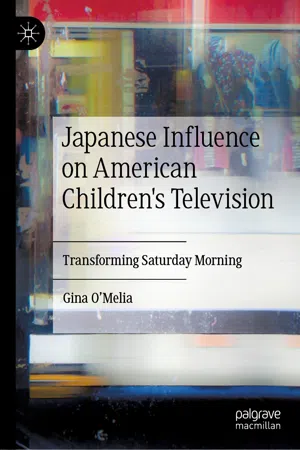
Japanese Influence on American Children's Television examines the gradual, yet dramatic, transformation of Saturday morning children's programming from being rooted in American traditions and popular culture to reflecting Japanese popular culture. In this modern era of globalization and global media/cultural convergence, the book brings to light an often overlooked phenomenon of the gradual integration of narrative and character conventions borrowed from Japanese storytelling into American children's media. The book begins with a brief history of Saturday morning in the United States from its earliest years, and the interaction between American and Japanese popular media during this time period. It then moves onto reviewing the dramatic shift that occurred within the Saturday morning block through both an overview of the transitional decades as well as an in-depth analysis of the transformative ascent of the shows Mighty Morphin Power Rangers, Pokémon,and Yu-Gi-Oh!.
eBook - ePub
Japanese Influence on American Children's Television
Transforming Saturday Morning
- English
- ePUB (mobile friendly)
- Available on iOS & Android
eBook - ePub
Japanese Influence on American Children's Television
Transforming Saturday Morning
About this book
Information
© The Author(s) 2019
Gina O’MeliaJapanese Influence on American Children's Televisionhttps://doi.org/10.1007/978-3-030-17416-3_11. Introductions
Gina O’Melia1
(1)
Division of Social Sciences, Hudson County Community College, Jersey City, NJ, USA
Gina O’Melia
Imagine you are watching television with a child around the age of ten—maybe your own child or a niece/nephew—but you have given this child control over the remote. Unsurprisingly, they switch on Cartoon Network. Perhaps the program is Steven Universe, Regular Show, The Amazing World of Gumball, Ben 10, We Bare Bears or Teen Titans Go, any of them are possibilities on Cartoon Network in 2019. You watch as the main character finds themselves in some sort of conflict and in their anger, they are suddenly surrounded in light as they scream into the sky, their hair goes up in golden spikes, and they are filled with power to defeat their foe. It matters little which show the child chose; all of them have used this scene.1 Later in the evening, Dragonball Super comes on, clearly a dubbed Japanese anime with new, crisp animation, and you see its main character does the exact same thing.
The child likely knew that the action was a display of extreme righteous anger leading to unbeatable power by sheer repetition, even if they had never watched a single episode of Dragonball Z or Super or knew the term “Super Saiyan .” The cartoons themselves do not always mention the source material. More often than not, the character just goes through the motions of the transformation, similar to how in older cartoons a character’s face might turn bright red and steam come out from their ears. It is assumed that the child watching would have the cultural capital to understand the visual shorthand from having the imagery reinforced again and again within American popular culture. The difference is that the latter is from classic American cartoons and the former originates from Japanese anime.
A dramatic shift occurred beginning in 1993 with the debut of Mighty Morphin Power Rangers that integrated Japanese popular media and its conventions in American culture in a way that is unprecedented. Saturday Morning acted as a vehicle to gradually integrate, transition, mainstream, and normalize Japanese programming and its conventions in American culture. The influence of Saturday Morning as a vehicle of American acculturation should not be overlooked. Since the 1960s, Saturday Morning provided American children hours of shared stories, characters, and conventions that not only united them with their peers, but connected them to generations that came before and after them. Yet, in the 1990s, there was a transition that saw the conventions that governed the protagonists, the antagonists, the female characters, the use of violence, tone, and even the general format of these series gradually conform to Japanese norms in American productions. This transition also led to a displacement of American programming that previously aired for decades and the normalization of Japanese content that took the place of these older cultural touchstones.
These Japanese programs—especially the phenomena of Mighty Morphin Power Rangers, Pokémon, and Yu-Gi–Oh ! —gradually transformed the Saturday Morning landscape in less than a decade into something that would have been considered alien and unconceivable previously and maintained that change for years until Saturday Morning ceased to air on broadcast television in 2014. By reflecting already present aspects, touchstones, and conventions airing on Saturday Morning, each successive phenomenon built upon the foundation laid down by the preceding series until the aspects, touchstones, and conventions they reflected were no longer something that were originally from American culture, but from Japanese popular culture. Each of these successes aired at an opportune time on Saturday Morning to achieve their popularity, and in their wake, the programming changed to reflect them. In this way, it was not a novelty like Godzilla or merely a niche product, but something that was able to keep a grasp on American children’s media for almost half of Saturday Morning’s entire airing history. Saturday Morning ended in 2014, but its influence still lingers in these few short years that follow its disappearance. To this day, Yu-Gi-Oh ! continues to trend on Netflix, Detective Pikachu is both a video game and a Hollywood film, and an iteration of the Power Rangers franchise continues to air on Nickelodeon. Japanese styling and narrative structure continue to act as a siren song to American viewers as commercials advertising The Dragon Prince make sure to mention that it is from the writer of Avatar: The Last Airbender as a major selling point.2
Complementary Subversion
American children’s media being transformed by Japanese conventions, traditional American cartoons being displaced, and new foreign touchstones being integrated into the cultural memory of the younger generations are all the result of a chapter in both globalization and media studies that both subverts and compliments expectations. In regards to American cultural imperialism theories, the entire episode feels counterintuitive. Benjamin Barber noted in his “Near Death of Democracy”:
Shrek and Spiderman still go where the First Cavalry Division no longer dares tread. And where the Sixth Fleet no longer can intimidate with its guided missiles, MTV, Starbucks, Google and Coca-Cola win friends and influence people with their global brands and savvy video based cultural marketing.3
In some places this sort of cultural imperialism is alive and well, transforming the native culture into a far more Americanized form. Understandably, other nations have great concerns about the power and influence American popular media may have on their cultures and traditions if imported without limitations. For example, Canada, which is already so geographically and culturally close to the United States, has regulations in place by the Canadian Radio-Television and Telecommunications Commission that sixty percent of aired television content and half of prime-time programming must be Canadian.4 France and other nations have similar laws to attempt to prevent what Barber implies, and Manfred Steger explicitly warns is an “increasingly homogenized global culture underwritten by an Anglo-American value system”.5 Attention, care, and regulation are put in place to avoid an over-consumption of “American culture” that causes communities abroad to begin to lose their personal, group, and class identities—which are often manifested and reinforced by shared religious customs, collective stories, and indigenous iconography—in favor of what is “cool.”6
Herbert Schiller takes these concepts a step further and presents particular tactics American media companies, especially Hollywood but also television studios, utilize in order to reinforce a homogenized American ideal to both the domestic and international markets beyond marketing their content as “cool.” He states that American media companies are “not averse to engaging in tactical maneuvers that could prove disarming to unwary challengers.”7 Schiller asserts that these companies will use tokenism—introducing a storyline or character—that reflects a minority group or foreign identity to bring in audience members outside of the assumed homogeneous Americanized majority. In conceding in this nominal way to diverse groups within the United States or the foreign culture outside of it, the company hopes to both eventually silence and assimilate these groups, allowing them to continue to present programs that offer a homogeneous worldview for maximum profit and influence.8
Yet, there is a sense of ironic dissonance when one looks at the transformation of Saturday Morning and the transition within American children’s media as a whole. Steger and Barber warn that the over-consumption of America media by foreign cultures could cause cultural displacement. Schiller states that by presenting this media with some sort of token element that allows it to resonate with the non-majority audience, American media companies are able to dominate foreign markets. The irony is this is what I propose occurred unintentionally in reverse, that elements in the imports in the 1990s resonated enough with the dominant culture that these programs were accepted and that they grew to dominate the American market, displacing domestic and traditional programs. This outcome also adds unexpected nuance to cases of American cultural imperialism. After all, it is assumed that this imperialism will manifest a homogenized Americanize cultural identity, but American popular culture is far less homogenized than normally assumed due to this transformation.
This concept of possible American imperialism masking actual American domestic cultural change due to foreign imports is not new. Jeffrey S. Miller, in Something Completely Different, begins his observation on British media’s popularity and influence on American popular culture in the 1980s and 1990s by first addressing the same counterintuitive narrative—that it is out of the norm to ascribe to the United States any status other than “imperialist exporter.”9 Much like me, Miller recognizes that scholarship often f...
Table of contents
- Cover
- Front Matter
- 1. Introductions
- 2. Saturday Morning Conquered: How It Occurred
- 3. Foundation: What Were the Rules of Saturday Morning Before the Japanese Imports?
- 4. The Emergence of the Mighty Morphin Power Rangers
- 5. Pokémon: “Gotta Catch All the Success”
- 6. Yu-Gi-Oh!: The Conquering King of Saturday Morning
- 7. The Final Years of Saturday Morning
- 8. Aftermath, Legacies, and Conclusions
- Back Matter
Trusted by 375,005 students
Access to over 1.5 million titles for a fair monthly price.
Study more efficiently using our study tools.
Frequently asked questions
Yes, you can cancel anytime from the Subscription tab in your account settings on the Perlego website. Your subscription will stay active until the end of your current billing period. Learn how to cancel your subscription
No, books cannot be downloaded as external files, such as PDFs, for use outside of Perlego. However, you can download books within the Perlego app for offline reading on mobile or tablet. Learn how to download books offline
Perlego offers two plans: Essential and Complete
- Essential is ideal for learners and professionals who enjoy exploring a wide range of subjects. Access the Essential Library with 800,000+ trusted titles and best-sellers across business, personal growth, and the humanities. Includes unlimited reading time and Standard Read Aloud voice.
- Complete: Perfect for advanced learners and researchers needing full, unrestricted access. Unlock 1.5M+ books across hundreds of subjects, including academic and specialized titles. The Complete Plan also includes advanced features like Premium Read Aloud and Research Assistant.
We are an online textbook subscription service, where you can get access to an entire online library for less than the price of a single book per month. With over 1.5 million books across 990+ topics, we’ve got you covered! Learn about our mission
Look out for the read-aloud symbol on your next book to see if you can listen to it. The read-aloud tool reads text aloud for you, highlighting the text as it is being read. You can pause it, speed it up and slow it down. Learn more about Read Aloud
Yes! You can use the Perlego app on both iOS and Android devices to read anytime, anywhere — even offline. Perfect for commutes or when you’re on the go.
Please note we cannot support devices running on iOS 13 and Android 7 or earlier. Learn more about using the app
Please note we cannot support devices running on iOS 13 and Android 7 or earlier. Learn more about using the app
Yes, you can access Japanese Influence on American Children's Television by Gina O’Melia,Gina O'Melia in PDF and/or ePUB format, as well as other popular books in Social Sciences & Film & Video. We have over 1.5 million books available in our catalogue for you to explore.