This edited volume explores the Israeli-Turkish relations in the 2000s from a multi-dimensional perspective providing a comparative analysis on the subjects of politics, ideology, civil society, identity, energy, and economic relations. The contributors from both countries offer insights on the complex situation in the Middle East which is important for the understanding of the contemporary region. The work will appeal to a wide audience including academics, researchers, political analysts, and journalists.
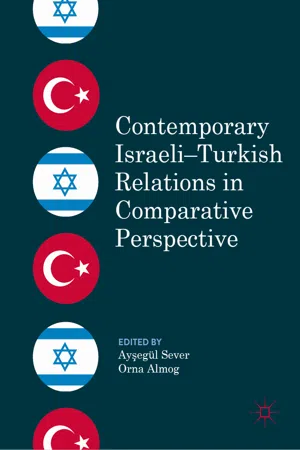
eBook - ePub
Contemporary Israeli–Turkish Relations in Comparative Perspective
- English
- ePUB (mobile friendly)
- Available on iOS & Android
eBook - ePub
Contemporary Israeli–Turkish Relations in Comparative Perspective
About this book
Information
© The Author(s) 2019
Ayşegül Sever and Orna Almog (eds.)Contemporary Israeli–Turkish Relations in Comparative Perspectivehttps://doi.org/10.1007/978-3-030-05786-2_11. Introduction
Ayşegül Sever1, 2 and Orna Almog3
(1)
Political Science and International Relations at Marmara University, Anadoluhisarı, Istanbul, Turkey
(2)
Visiting Scholar, London School of Economics LSE Ideas, London, UK
(3)
Independent Researcher, Politics and International Relations, Kingston University, London, UK
Ayşegül Sever (Corresponding author)
Orna Almog
The relationship between the Republic of Turkey and the State of Israel is unique in the Middle East . The two most prominent military powers in the region, both are close allies of the United States ; and both view themselves as modern, Westernized, advanced countries. Their relationship is central to the stability of the Middle East.
This relationship currently appears much more fragile than in its early decades. In spite of increasing trade relations, long-term intelligence sharing, and military cooperation, each state’s perception of the other has recently suffered serious setbacks.
Since the inception of diplomatic relations between Israel and Turkey in 1949, the relationship has never been an easy one among the region’s conflicts and uncertainties. Although it was relatively friendly for many years—especially during the 1990s—it has transitioned into one of the most fragile and challenging ties in the contemporary affairs of the region. In the past ten years (2008–2018), the number and severity of crises between the two nations has surpassed all their previous problems.
Against this background, we asked a number of Turkish and Israeli scholars to contribute their various perspectives. Taken together, the chapters of our book, each by different authors, constitute a wide-ranging study analyzing many of the internal and external events leading up to and affecting the two countries’ relationship at its current difficult period. Our contributors examine politics and ideologies, national ambitions, military affairs, trade , energy, economics, and tourism .
Relationships with non-Arab states in the region were always important for Israel, which was encircled by hostile Arab states. Close cooperation with Turkey was particularly important to Israeli leaders. As a strategically located Muslim state with a strong army, Turkey was an ideal party in Israel’s constant search for allies. Although their relationship also benefited Turkey, especially in the 1990s, it was Israel that was keener on maintaining it. Although the alliance had its ups and downs, their cooperation, especially in military affairs and intelligence, was considered an Israeli success.
Israeli decision-makers faced a new challenge to cooperation between the two countries soon after the AKP Adalet ve Kalkınma Partisi (Justice and Development Party) came to power in Turkey in late 2002 and Recep Tayyip Erdoğan became Prime Minister in 2003. The dominance of Israel’s right-wing Likud party , strengthened by coalition with the nationalist religious party Habyait Hayehudi (the Jewish Home), and Israel Beyitenu (Israel our Home), a right-wing secular party, did not make things any easier for Turkish leaders.
During the past decade, escalating tensions between the two states can be correlated both with their internal, domestic politics and with their external, regional environment. Ankara ’s harsh criticism of Israel’s Gaza campaign in 2008, Erdoğan’s stormy confrontation with Israel’s President Shimon Peres at the 2009 Davos Economic Forum, and eventually the Mavi Marmara affair in 2010, brought the relationship, already tense with mutual accusations, animosity and hostility, to a diplomatic break.
The Mavi Marmara incident—when an Israeli special commando unit raided a flotilla that aimed to challenge a naval blockade of Gaza , and killed nine Turkish people on board—brought the relationship between the two countries to an all-time low, and led to a temporary break in diplomatic relations, renewed only in November 2016. The episode created a rift that took six years to mend. The healing, as well as the rift (economic relations did not cease) has been imperfect: withdrawal of ambassadors, mutual condemnations, and threatening speeches have become routine.
For decades Turkey remained the only Muslim country to have recognized Israel—which Israel appreciated and valued immensely. Indeed, for many years Israel was the active party in the relationship, viewing it as a cornerstone and a major success of its foreign policy. However, with emerging difficulties between the two states, and with growing challenges in Syria , the Eastern Mediterranean , and the Middle East , the relationship with Turkey no longer holds its initial significance for Israel.
Israel’s position in the region has changed. Despite the ongoing conflict with the Palestinians that clouds its relations with Arab states, Israel maintains good working relations with both Egypt and Jordan , and is building new alliances with Cyprus and Greece . Nevertheless, because of Turkey’s military might and strategic position, Israeli decision-makers still put high value on good relations with Ankara .
Other difficult situations in the region include the growing division between Sunni and Shia Muslims, the addition of non-state actors such as ISIS , and the increasing power and influence of Iran . These important issues are also addressed in this book, which examines the Israeli–Turkish relationship from a multidimensional, perspective. With the Middle East dominating the international agenda—the Syrian civil war , refugees, transnational armed forces, growing external involvements, the Iran nuclear issue, the rise of Kurds in the Middle East, the development of new relationships in the Persian Gulf and the Arab world —we hope to contribute to a better understanding of the relationship between these two prominent countries for anyone interested in world affairs in general, and to anyone involved in Middle Eastern studies in particular.
Most studies to date focus on the historical evolution of the Turkish–Israeli relationship. Amikam Nachmani’s book Israel, Turkey, and Greece : Uneasy Relations in the East Mediterranean ,1 and his article on the significance of Israeli–Turkish relations, especially during the 1990s, “The Remarkable Turkish–Israeli Ties,”2 examine the reasons behind the “Golden Age” of the relationship. Gencer Özcan’s book Türkiye-Israil İlişkilerinde Dönüşüm: Güvenliğin Ötesi (Transformation in Turkish–Israeli Relations: Beyond Security), and Jacob Abadi’s article “Israel and Turkey: From Covert to Overt Relations,” are just a few examples of historical accounts of the relationship up to the late 1990s.3
In the 1990s, several studies dealing with the Israeli–Turkish alignment were published. Ofra Bengio’s research, “The Turkish–Israeli Relationship: Changing Ties of Middle Eastern Outsiders,” Meliha Altunışık’s article “The Turkish–Israeli Rapprochement in the post-cold war era,” and G.E. Gruen’s “Dynamic Progress in Turkish–Israeli Relations,” are valuable examples of the literature about that period.4
In his book, Troubled Triangle: The United States , Turkey, and Israel in the New Middle East ,5 William Quand examines relations among the superpower and its Middle Eastern alliances. Brookings Institute’s reports are especially useful in understanding the impact of the United States vis-à-vis the current crises between Israel and Turkey. For example, Dan Arbel’s “The U.S.–Turkey–Israel Triangle”6 looks at diplomatic ties among all three countries before, during, and after the 1990s. Another contemporary account is given by Efraim Inbar’s articles “Israeli–Turkish Tensions and their International Ramifications” and “Israeli–Turkish Tensions and Beyond.”7
A number of more recent academic articles have added interesting aspects to the understanding of current Israeli–Turkish relations, including İlker Aytürk’s “The Coming of an Ice Age? Turkish–Israeli Relations Since 2011” and Özlem Tür’s article “Turkey and Israel in the 2000s-From Cooperation to Conflict.”8 Civilian aspects of the relationship began to draw attention, as indicated in studies such as Sultan Tepe’s “Beyond Sacred and Secular : Politics of Religion in Israel and Turkey,” and Yusuf Sarfati’s “Mobilizing Religion in Middle East Politics: A Comparative Study of Israel and Turkey.”9
Our book, Contemporary Israeli-Turkish Relations in Comparative Perspective, aims to present the insights of a broader variety of disciplines on the issues and crises in the relationship between Israel and Turkey. Our authors examine both external and internal issues, looking at the chan...
Table of contents
- Cover
- Front Matter
- 1. Introduction
- 2. The New Jew and the New Turk: A Comparative Analysis of Israeli and Turkish Nation-Building Within the Framework of Religion, Modernity and Secularism
- 3. The Shrinking Space of the Third Sector in Israel and Turkey
- 4. The Mavi Marmara: An Embattled Voyage and Its Consequences
- 5. Emerging Alliances, Deteriorating Relations: Turkey, Israel and Greece in the Eastern Mediterranean
- 6. How the Syrian Civil War Shifted the Balance of Power in Turkish–Israeli Relations
- 7. Economic Relations Between Israel and Turkey
- 8. Prospects of Natural Gas in Turkey and Israel
- 9. The Changing Tourism Patterns Between Turkey and Israel: Reflecting a Troubled Relationship
- 10. Conclusions
- Back Matter
Trusted by 375,005 students
Access to over 1.5 million titles for a fair monthly price.
Study more efficiently using our study tools.
Frequently asked questions
Yes, you can cancel anytime from the Subscription tab in your account settings on the Perlego website. Your subscription will stay active until the end of your current billing period. Learn how to cancel your subscription
No, books cannot be downloaded as external files, such as PDFs, for use outside of Perlego. However, you can download books within the Perlego app for offline reading on mobile or tablet. Learn how to download books offline
Perlego offers two plans: Essential and Complete
- Essential is ideal for learners and professionals who enjoy exploring a wide range of subjects. Access the Essential Library with 800,000+ trusted titles and best-sellers across business, personal growth, and the humanities. Includes unlimited reading time and Standard Read Aloud voice.
- Complete: Perfect for advanced learners and researchers needing full, unrestricted access. Unlock 1.5M+ books across hundreds of subjects, including academic and specialized titles. The Complete Plan also includes advanced features like Premium Read Aloud and Research Assistant.
We are an online textbook subscription service, where you can get access to an entire online library for less than the price of a single book per month. With over 1.5 million books across 990+ topics, we’ve got you covered! Learn about our mission
Look out for the read-aloud symbol on your next book to see if you can listen to it. The read-aloud tool reads text aloud for you, highlighting the text as it is being read. You can pause it, speed it up and slow it down. Learn more about Read Aloud
Yes! You can use the Perlego app on both iOS and Android devices to read anytime, anywhere — even offline. Perfect for commutes or when you’re on the go.
Please note we cannot support devices running on iOS 13 and Android 7 or earlier. Learn more about using the app
Please note we cannot support devices running on iOS 13 and Android 7 or earlier. Learn more about using the app
Yes, you can access Contemporary Israeli–Turkish Relations in Comparative Perspective by Ayşegül Sever, Orna Almog, Orna Almog,Ayşegül Sever in PDF and/or ePUB format, as well as other popular books in Politics & International Relations & Comparative Politics. We have over 1.5 million books available in our catalogue for you to explore.