- English
- ePUB (mobile friendly)
- Available on iOS & Android
eBook - ePub
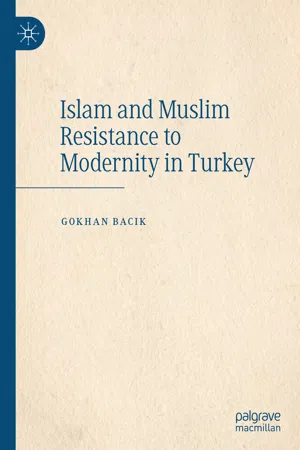
Islam and Muslim Resistance to Modernity in Turkey
About this book
This book explores how traditional Sunni Muslim conceptions have informed or shaped Islamization strategies in contemporary Turkey. In particular, the author proposes to examine the teaching curriculum of the Ministry of Education, which oversees Turkish public religious education; the activities and teachings of Diyanet, the constitutional organ responsible for managing all religious affairs; and the ideas and activities of three Muslim religious groups currently operating in Turkey. The monograph explains how the interpretation and practice of Islam affects various situations in the Muslim world and analyzes the concept of nature in Islam, which has been an indivisible component of Islamic tradition since the beginning.
Information
Subtopic
Globalisierung© The Author(s) 2020
G. BacikIslam and Muslim Resistance to Modernity in Turkeyhttps://doi.org/10.1007/978-3-030-25901-3_11. Introduction
Gokhan Bacik1
(1)
Palacký University Olomouc, Olomouc, Czech Republic
On November 12, 2017, a powerful earthquake rocked northern Iraq. That earthquake also shook the whole population of Turkey, which falls within an active seismic zone. As usual, geologists were quick to appear on television to explain the earthquake. Among them was Professor Ahmet Ercan, who spoke on state television. The channel cut his speech immediately after he made the following comment:
Eighty percent of people who lose their lives in earthquakes are from Muslim countries, because there is neither democracy nor scientific and technological capability in Muslim countries. (Birgün, November 13, 2017)
There is a considerable body of literature on how Islam is interpreted, and it entails the rationalizations of the several problems of Muslim societies. Accordingly, the interpretation and the concomitant practice of Islam are identified as the causes of the various problems that beset Muslim societies. The geologist’s comments are also a reflection of a widely shared understanding that posits a causal link between how Islam is interpreted and the problems that plague various Muslim societies. By referring to the democracy gap in Muslim countries, Ercan called to mind the popular thesis that a democratic and transparent political regime is critical for economic and social development. But he also added that Muslims are performing in various fields without the necessary scientific capability. His comments raise two questions: Why do many Muslim societies lack fully functional democracy? And why do they generally lack scientific capability?
The first question pertains to the well-known literature on democracy and law in explaining various problems in Muslim societies. These studies focus on the effects of Islamic law on the economy and the other spheres of Muslim countries.1 For example, according to Timur Kuran, Islamic law could not produce worldviews that could keep up with the transition from the medieval to the modern economy (characterized by corporations and banking). This failure also inhibited the accumulation of capital in Muslim societies.2 In another vein, François Facchini proposes that the Islamic legal tradition did not provide a basis for strong property rights, which in turn explains economic underdevelopment in Muslim societies.3 Muslims’ economic success in earlier periods of history is attributed to trade-friendly interpretations of Islamic law.4 Later on, the emergence of inflexible regulating institutions and the evolution of Muslim inheritance law discouraged growth values and practices. Accordingly, the state and religious authorities were concerned only with preserving the status quo that emerged in the ninth century and was consolidated by the eleventh century. That period’s law and institutions gradually directed Muslims to be “strongly against competition” and made them anti-market.5
Economic and political institutions in Muslim societies doubtlessly reflect contemporary interpretation and practice of Islam. However, mainstream scholarship assumes too readily that factors such as how Islamic law is interpreted or the current democracy gap are likely to be the major causes of the problems of the Muslim world today. Social and historical developments are also understood as the outcomes of the evolution of Islamic law or Islamic politics. The upshot of this is the projection that a more democratic, gender-friendly, and market-oriented interpretation of Islamic law would ameliorate Islam’s impact on Muslim societies.
The interplay between Islam and Muslims is however complex, and there are also other fields that are highly pertinent in the quest to understand Muslim societies. Analyzing certain problems that have their origin in a lack of scientific and technological capabilities, the second point that geologist Ahmet Ercan raised requires a different analytical perspective in regard to the interplay between Islam and Muslims. In this regard, various problems such as slow technological advancement and low agricultural productivity in Muslim societies can be seen as the result of their failure to understand the relevant causal relations. This brings us to the main purpose of this book: to introduce a new analytical tool, the “idea of nature,” in explaining the interpretation and practice of Islam affecting various situations in the Muslim world by studying selected cases from Turkey. The Islamic idea of nature is the collection of beliefs concerning how nature works that a Muslim acquires during religious socialization. Transmitted from one generation to the next in the continuity of the Islamic faith, the Islamic idea of nature is an observable phenomenon. It occupies a large space in contemporary Islamic socialization. In many Muslim societies, religious socialization therefore entails engagement with the interpretation and transmission of the Islamic idea of nature. Like law, the Islamic idea of nature has serious implications for how Muslims interpret Islam, particularly with respect to key issues like causality, knowledge, and free will.
However, the role of the Islamic idea of nature has received scant attention, and we therefore remain uninformed about this vital historical and intellectual enterprise, which produced some of the foundational postulates according to which all Islamic thought, including legal theory, operates. Instead, scholars of Islamic studies who examine social, economic, and political problems in Muslim societies have favored legal and scriptural-hermeneutic approaches while generally overlooking the role of theology.6
1.1 Framing the Research Questions
Let us attend to some data on how Muslim societies perform in various fields. No Muslim-majority state ranks among the top ten exporters of manufactured goods, according to the World Trade Organization’s statistics. Nor is any one of them on the list of the top ten exporters of chemicals and pharmaceuticals. There is also no Muslim-majority state among the top ten exporters of agricultural products.7 Belgium, which has relatively little natural resources and a small population, performs far better in terms of agricultural production than many larger, more resource-rich Muslim-majority countries. Muslim societies’ poor performances in such fields are direct or indirect reflections of the lack of relevant scientific data and methods. With 57 Muslim-majority states as members, the Organization of Islamic Conference (OIC) represents nearly a quarter of the world’s population but only 2.4% of its research expenditure, 1.6% of its patents, and 6% of its publications. Over half of the world’s gross expenditure on research and development (R&D) comes from the United States and the more advanced economies within the European Union (EU), at 30.6% and 22.6%, respectively, while the OIC’s collective share stands at around 2.4%. Japan alone generates 10.3% of the world’s gross expenditure on R&D, almost five times more than that of the OIC’s 57 Muslims countries combined. Furthermore, between 2000 and 2011, OIC countries were granted only 1.5% of all patents worldwide.8 The knowledge gap is also observable in education. Average year of schooling in Muslim-majority countries is 5.6 years, well below the 7.7-year global average. The average year of schooling among Jews is 13.4 years; among Christians, it is 9.3 years. Yet, based on adults ages 25 years or older, Muslims along with Hindus have the largest shares of adherents with no formal education: 36% and 41%, respectively.9 Nearly four in ten Muslims have no formal schooling.
Two interrelated problems that this knowledge gap creates are a failure to apply scientific methods and knowledge to various fields of life, and the lack of dissemination of scientific thinking among the general population.
How is religion relevant here? Islam as studied and taught in Muslim societies still claims sweeping authority in shaping Muslims’ understanding of nature. As a result, religious ideas on nature, which are acquired during socialization and education, still determine Muslims’ understandings of nature. They bear directly on what the interpretation of religion promotes in significant issues such as human autonomy and the theory of knowledge. They also influence people’s understanding of how nature works in relation to laws of causation. Thus, the Islamic idea of nature, very much like Islamic law, is another level of analysis to observe the impact of Islam on Muslims. Methodologically, working on the impact of Islam on Muslims at this level requires answering two questions:
- What does the Islamic idea of nature promote?
- Does the Islamic idea of nature differ from modern, scientific one,...
Table of contents
- Cover
- Front Matter
- 1. Introduction
- 2. Origins: Sunni Orthodoxy
- 3. The Islamic Idea of Nature
- 4. The Contested Boundaries of Turkish Islam
- 5. Mapping the Cases: Official Islam and Islamic Movements
- 6. The Islamic Idea of Nature in Contemporary Turkey
- 7. Conclusion
- Back Matter
Trusted by 375,005 students
Access to over 1.5 million titles for a fair monthly price.
Study more efficiently using our study tools.
Frequently asked questions
Yes, you can cancel anytime from the Subscription tab in your account settings on the Perlego website. Your subscription will stay active until the end of your current billing period. Learn how to cancel your subscription
No, books cannot be downloaded as external files, such as PDFs, for use outside of Perlego. However, you can download books within the Perlego app for offline reading on mobile or tablet. Learn how to download books offline
Perlego offers two plans: Essential and Complete
- Essential is ideal for learners and professionals who enjoy exploring a wide range of subjects. Access the Essential Library with 800,000+ trusted titles and best-sellers across business, personal growth, and the humanities. Includes unlimited reading time and Standard Read Aloud voice.
- Complete: Perfect for advanced learners and researchers needing full, unrestricted access. Unlock 1.5M+ books across hundreds of subjects, including academic and specialized titles. The Complete Plan also includes advanced features like Premium Read Aloud and Research Assistant.
We are an online textbook subscription service, where you can get access to an entire online library for less than the price of a single book per month. With over 1.5 million books across 990+ topics, we’ve got you covered! Learn about our mission
Look out for the read-aloud symbol on your next book to see if you can listen to it. The read-aloud tool reads text aloud for you, highlighting the text as it is being read. You can pause it, speed it up and slow it down. Learn more about Read Aloud
Yes! You can use the Perlego app on both iOS and Android devices to read anytime, anywhere — even offline. Perfect for commutes or when you’re on the go.
Please note we cannot support devices running on iOS 13 and Android 7 or earlier. Learn more about using the app
Please note we cannot support devices running on iOS 13 and Android 7 or earlier. Learn more about using the app
Yes, you can access Islam and Muslim Resistance to Modernity in Turkey by Gokhan Bacik in PDF and/or ePUB format, as well as other popular books in Politik & Internationale Beziehungen & Globalisierung. We have over 1.5 million books available in our catalogue for you to explore.