DSGSES, University Magna Graecia of Catanzaro, Catanzaro, Italy
Abstract
This chapter provides an overview of the structure of the book, identifying the main themes of any chapters and clarifying the main aims.
Keywords
Sustainable bankingFinancial crisisSustainable development
End Abstract
1.1 Introduction
The consequences of the financial crisis have strengthened interest in sustainable business models, and investors are giving increasing notice to sustainable business management that takes environmental, social, and governance (ESG) criteria into consideration. In recent times, the concept of sustainability has grown in recognition and importance, and has become one of the most talked about topics. Exponential population growth, global warming, and a growing disparity of incomes have all given rise to evermore insistent calls for social justice and environmentally friendly development.
The linkages between finance and sustainable development have been explored by many academics, and recent studies underline that sustainability can be useful in improving the stability of the financial system (Liu 2012; Alexander 2014) and that sustainability and ethical values can play a key role in finance (Lehner 2016). Being capital providers, banks can help address new economic realities linked to environmental and social (E&S) sustainability and can contribute to national sustainable development agendas (IFC 2017).
Sustainable behaviors are gradually becoming more embedded into banking business models and strategies. This signals a radical change of direction in the way that banking industry has approached financial markets in the past. Therefore, this promising approach can be considered as strategic in its intent and purposes, as banks are capable of being “sustainable” while pursuing their profit-making activities. This transformation implies that the banks’ commitment may represent a viable way to add value to the business itself while also adding value to society by promoting sustainable development. Banks are currently involved in national and international sustainability programs, are included in national and international sustainability indices (e.g., Dow Jones Sustainability Index and Financial Times Stock Exchange4Good [FTSE4GOOD]), and participate in national and international business sustainability programs, such as those hosted by the United Nations. The connections between the issue of sustainable development and banking activities can be detected in the 1990s, when banks had increasingly begun to incorporate environmental requirements into their lending decisions, developed risk assessment procedures to offset potential liability for environmental damage caused by their borrowers, and developed many corporate social responsibility and risks agendas (Coulson and O’Sullivan 2013). Banks are becoming aware that their clients’ mismanagement of environmental risks may affect their own business as lenders and their reputational capital (Jeucken 2011; Bouma et al. 2017). Environmental risks influence the counterparty risk; therefore, banks affect sustainable development directly—through their “day-to-day” operational activities (Case 1999; Jeucken 2011)—and indirectly, through the products and services they offer (Thompson 1998; Case 1999; Weber 2012; Bouma et al. 2017).
Actually, several key changes are occurring in the regulation and supervision of banking (and financial) systems at the international level. However, regardless of regulatory regime, several banks have incentives to voluntarily provide information regarding their engagement in sustainable practices (Carnevale and Mazzuca 2014; Carè 2017). What emerges from these conditions is that the way in which banks operate is changing. External and internal pressures are transforming the approach of banking, and in this scenario, banks can gain advantages from the new business opportunities that sustainability offers.
This book provides an exploratory analysis into the field of sustainable banking and is based on the following research objectives: (1) to explore the concept of sustainable banking both in theory and in practice, (2) to understand what the main drivers are that are pushing banks toward a more sustainable business approach, and (3) to determine the main opportunities and challenges that can be derived from this new banking concept.
In pursuing these objectives, this book utilizes the two most important definitions of sustainable banking. In particular, Weber (2012) explains that sustainable banking integrates ESG criteria into traditional banking and sets ESG benefits as a key objective. The authors also summarize the main aspects of sustainable banking as follows: (2) internal environmental management; (2) environmental credit risk management; (3) socially responsible investment; (4) carbon finance; and (5) impact investment.
The second definition is provided by Bouma et al. (2017) and highlights that “sustainable banking” can be considered a dynamic term because its definition changes over time and considered a term without clear borders because the relationship between banks and their stakeholders make the concept relevant to actors other than just the banks themselves. The authors also highlight a series of themes that are fairly central and interrelated, such as (1) the policies of banks, (2) communication and transparency, (3) environmental investments and environmental risks, and (4) the role of governments, nongovernmental organizations (NGOs), and multilateral banks (Bouma et al. 2017).
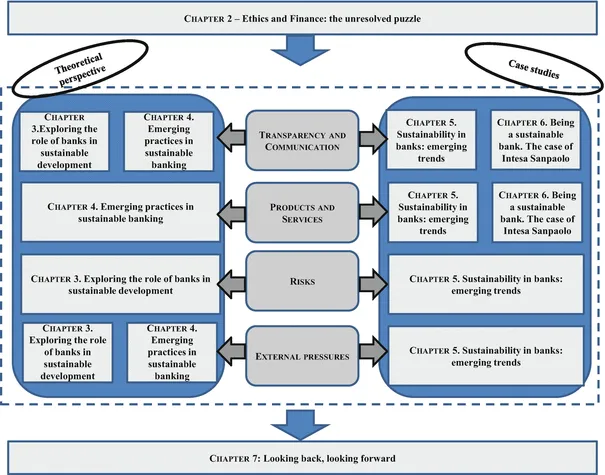
This book is founded upon four major aspects that characterize sustainable banking: risks, products and services, transparency and communication, and external pressures. Overall, the book is organized as depicted in the framework of Fig. 1.1.
Fig. 1.1
Book outline (Source: our elaboration)
In Fig. 1.1, the four aspects shown (transparency and communication, products and services, risks, and external pressures) are the starting point of the entire book and are analyzed both in theory through Chaps. 3 and 4 (on the left side) and in practice through Chaps. 5 and 6 (on the right side). Moreover, to address the main theme of this book, the relationship between ethics and finance has been analyzed by providing some useful insight for the understanding of the main drivers that are moving academia in considering new alternative finance and business practices. Finally, Chap. 7 draws on the previous findings of the entire book and highlights future research directions. In the following, Chaps. 2, 3, 4, 5, 6 and 7 are illustrated in more detail, and the core idea of each chapter is outlined.
1.2 Chapter 2: Ethics and Finance: The Unresolved Puzzle
The chapter moves from recent critiques of mainstream finance and provides an excursus on the role of ethics in finance. By underlining how several scholars have questioned the essence of neoclassical approaches based on rational behaviors and profit maximization, this chapter focuses on the emerging role of alternative approaches and on the themes of social finance and social banking. At the same time, the chapter outlines the new pathway that is affirming academic finance and banking research by focusing on social finance and social banking. Finally, it offers in Appendix 2.1 an analysis of two of the most important social banks and lays the basis for the comparison with sustainable banking in Chap. 7.
1.3 Chapter 3: Exploring the Role of Banks in Sustainable Development
This chapter provides an overview of the role that banks can play in sustainable development and of the major challenges and opportunities that emerge from this new business approach. Environmental and social pressures are linked with sustainability and are the main thread of the entire book. This chapter highlights the contributions of the banking system in the achievement of sustainable development, by underlying the major changes that occurred at the international level. Then, it introduces the role of CSR practices towards sustainability in banking by focusing on the role of the credit risk management process and describes how sustainability issues might create value for banks.
1.4 Chapter 4: Emerging Practices in Sustainable Banking
Environmental concerns are pushing banks towards the development of new products and investment and communication strategies. From the banks’ point of view, sustainable products may be seen as both a strategic and commercial opportunity. At the same time, communicating bank engagement in sustainable approaches may represent a pathway towards new market opportunities in terms of reputation and customer perception. This chapter gives an overview of the...
Table of contents
Cover
Front Matter
1. Overview
2. Ethics and Finance: The Unresolved Puzzle
3. Exploring the Role of Banks in Sustainable Development
4. Emerging Practices in Sustainable Banking
5. Sustainability in Banks: Emerging Trends
6. Being a Sustainable Bank: The Case of Intesa Sanpaolo
7. Looking Back, Looking Forward
Back Matter
Trusted by 375,005 students
Access to over 1.5 million titles for a fair monthly price.
Study more efficiently using our study tools.
Frequently asked questions
Yes, you can cancel anytime from the Subscription tab in your account settings on the Perlego website. Your subscription will stay active until the end of your current billing period. Learn how to cancel your subscription
No, books cannot be downloaded as external files, such as PDFs, for use outside of Perlego. However, you can download books within the Perlego app for offline reading on mobile or tablet. Learn how to download books offline
Perlego offers two plans: Essential and Complete
Essential is ideal for learners and professionals who enjoy exploring a wide range of subjects. Access the Essential Library with 800,000+ trusted titles and best-sellers across business, personal growth, and the humanities. Includes unlimited reading time and Standard Read Aloud voice.
Complete: Perfect for advanced learners and researchers needing full, unrestricted access. Unlock 1.5M+ books across hundreds of subjects, including academic and specialized titles. The Complete Plan also includes advanced features like Premium Read Aloud and Research Assistant.
Both plans are available with monthly, semester, or annual billing cycles.
We are an online textbook subscription service, where you can get access to an entire online library for less than the price of a single book per month. With over 1.5 million books across 990+ topics, we’ve got you covered! Learn about our mission
Look out for the read-aloud symbol on your next book to see if you can listen to it. The read-aloud tool reads text aloud for you, highlighting the text as it is being read. You can pause it, speed it up and slow it down. Learn more about Read Aloud
Yes! You can use the Perlego app on both iOS and Android devices to read anytime, anywhere — even offline. Perfect for commutes or when you’re on the go. Please note we cannot support devices running on iOS 13 and Android 7 or earlier. Learn more about using the app
Yes, you can access Sustainable Banking by Rosella Carè in PDF and/or ePUB format, as well as other popular books in Business & Financial Services. We have over 1.5 million books available in our catalogue for you to explore.