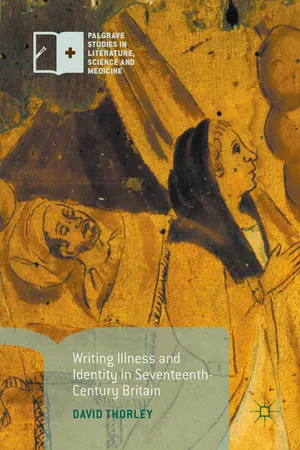
This book is a survey of personal illness as described in various forms of early modern manuscript life-writing. How did people in the seventeenth century rationalise and record illness? Observing that medical explanations for illness were fewer than may be imagined, the author explores the social and religious frameworks by which illness was more commonly recorded and understood. The story that emerges is of illness written into personal manuscripts in prescriptive rather than original terms. This study uncovers the ways in which illness, so described, contributed to the self-patterning these texts were set up to perform.
- English
- ePUB (mobile friendly)
- Available on iOS & Android
eBook - ePub
Writing Illness and Identity in Seventeenth-Century Britain
About this book
Information
Topic
LetteraturaSubtopic
Letteratura generale© The Author(s) 2016
D. ThorleyWriting Illness and Identity in Seventeenth-Century BritainPalgrave Studies in Literature, Science and Medicinehttps://doi.org/10.1057/978-1-137-59312-2_11. Introduction
David Thorley1
(1)
Independent scholar, London, UK
One morning, in the late 1640s, Robert Boyle was sitting quietly in his study. His sister and closest confidante, Katherine Jones, Viscountess Ranelagh, had visited earlier and, since she had left, Boyle had amused himself in the company of ‘an Out-landish Virtuoso’ spinning humorous tales ‘of the several attempts that are either made, or design’d in foreign Parts, to produce Curiosities, and improve Knowledge’. When his second caller left him, Boyle was ‘suddenly surpris’d with a Chilness, and a Shivering, that came so unexpected, and increas’d so fast, that it was heightened into a downright Fit of an Ague, before I could satisfie my self what it was’. 1
It was an explosive onset of illness and Boyle wrote, in a series of meditations addressed to his sister, that, in the few hours since she left him, he underwent ‘so great a change in my Condition, as to be, I doubt not, already visible in my Looks’. 2 The blow might have been softened, Boyle felt, had he prepared himself through philosophical reflection on the nature of the body, confessing, ‘this unwelcome accident had not amaz’d me, as well as troubled me, if I had sufficiently consider’d to what a strange number and variety of Distempers these frail Carcasses of ours are Obnoxious; for, if I had call’d to mind what my Curiosity for Dissections has shown me, and remembred how many Bones, and Muscles, and Veins, and Arteries, and Grisles, and Ligaments, and Nerves, and Membranes, and Juices, a humane Body is made up of, I could not have been surprised, that so curious an Engine, that consists of so many pieces, whose Harmony is requisite to Health, and whereof not any is superfluous, nor scarce any insensible, should have some or other of them out of order’. 3
At first glance, Jonathan Sawday detects a Cartesian mechanism lingering behind this passage, Boyle thinking about his body as a set of working parts in motion. ‘As the disease progressed, so Boyle conjured into his mind his knowledge and understanding of the mechanical body.’ 4 This view, as Sawday quickly acknowledges, is not sustainable for long: Boyle is in fact berating himself for not espousing a consistently mechanistic view of his body. If ‘I had call’d to mind’ the number of connected parts that comprise a body, he writes, then ‘I could not have been surprised’ at occasional malfunctions. As Sawday remarks, Boyle’s ‘triumphant overthrow of body-fear never took place. What Boyle’s text offers us is an idealized view of the scientific conquest of the body. This is how one should feel, Boyle is saying, if the body is no more than a machine.’ 5
Boyle did not feel that way. But his case is not interesting solely because it finds one of the age’s foremost natural philosophers declining to think mechanistically about his body. As well as noting that Boyle’s reflections on his illness were not made from the observational stance we might expect, it is worth considering the frames of reference Boyle does use for thinking about himself in illness. Rather than attempting to work out which bones, muscles, veins, arteries, gristles, ligaments, nerves, membranes and juices were failing, and the cause of the malfunction, Boyle meditated on the spiritual significance of his disease. Unable to sleep, he fell to comparing his lot to that of the damned, considering ‘how insupportable their condition must be, to be cast into outer Darkness, where tormented Wretches lye, not as I do upon a soft Bed, but upon Fire and Brimstone, where no attendance of Servants, or kindness of Friends, is allow’d them, that need it as much as they deserve it little; and, which is worst of all, where no Beam of hope is permitted to Consolate them, as if the Day should Dawn after so Dismal a Night, though protracted to Millions of Ages, each of whose miserable hours appears an Age’. 6 This train of thought led Boyle to a Puritan recognition of his neglected devotional duties (‘How defective we are in point of Gratitude to God’). ‘I now Blush’, he told his sister, ‘that I cannot call to Mind the time, when I ever thought that his having vouchsaf’d me the power of Sleeping, deserv’d a particular Acknowledgment.’ Illness brought a religious lesson: ‘that’ tis our Heedlesness, not their Uselesness, that keeps us from daily being thankfull for a multitude of Mercies, that we take no notice of’. 7 Like many of the Puritan life-writers this book will encounter, illness taught Boyle the value of spiritual self-scrutiny.
But the process of correction did more than simply remind Boyle of his neglected debt of gratitude to God: illness offered an analogy for his essentially sinful nature, providing a jolt to his lapsed devotional practice designed to have lasting effects. Boyle observed that ‘as dangerous Sicknesses do for the most part leave a crasie Disposition behind them, which threatens Relapses, so Sins once prevalent, though afterwards supprest, do yet leave behind them a secret Disposition or Propensity to the Repetition of the same faults’. The analogy between care of his health and of his soul impressed on Boyle the need for a more consistently pious self-scrutiny: ‘as ‘tis less difficult to find examples of Bodily Diseases, than of Spiritual ones, where the Patient is protected from Relapses, so I think we should be more watchfull against falling back into the Sins, than into the Sicknesses, we have once found our selves subject to, unless we would think, that a greater Danger, and of a Nobler part, deserv’d less of our care’. 8 Was this solely an analogy? It is true that Boyle’s illness and recovery provided a framework for thinking about his spiritual condition, but it was also the first point of divine intervention and correction when his devotional consistency wavered. Attending to the physical evidence of his body enabled him to scrutinise his soul. In this, he was no exception.
This book begins from the observation that seventeenth-century life-writing finds relatively little use for the period’s numerous, radical innovations in medical science to help make sense of personal illness. My study is to be of illness and patients rather than medicine and doctors. Work on interconnections between seventeenth-century medical, religious and literary culture has clarified the depiction of a period in which bodily experience helped construe personal identity, in which emotions were experienced physiologically, in which spirit and matter co-existed and commingled, and in which personal illness was as likely to be interpreted in providential as in medical terms. 9 That early modern medicine both wielded cultural influence and was shaped by cultural forces has been well established. 10 Such work provides the backdrop against which I offer my arguments, but I do not propose to add further brushstrokes to that portraiture. I am not contributing to understandings of the way in which early modern ‘literary’ culture understood and approached illness. Indeed, it is a striking feature of many of the materials I will present that they do not share the strong partiality to medical metaphor found in much of the period’s literature. 11 Neither is this a sociological account of seventeenth-century attitudes to illness and patienthood. I offer a study of textual responses to illness, composed or compiled by the sick, restricting my scope to texts that either describe the experience of sickness first-hand or respond to it in other ways (collecting material, we will see, was often as significant a habit as describing illness). Many of the texts I treat cannot reliably be regarded as private or personal works (as I will show), but that does not mean either that they were capable of wielding meaningful influence over their age’s construal of illness (Donne’s Devotions is perhaps an exception). I approach these texts as products of the religious, social and intellectual culture from which they grew, rather than necessarily participants in the creation of a widespread cultural consensus.
I will examine diaries, autobiography, letters and poetry, investigating the ways in which personal illness is described, with attention to the implications of disordered physicality for personal identity and the uses of the material text in registering that relationship. My argument is that, rather than instinctively turning to self-assertion to help understand illness, the writers I will treat are often self-effacing: they fall back on membership of family, professional and community networks; they adhere to textual conventions defined by the practices of financial accounting and social etiquette; they describe themselves according to Biblical types rather than as unique agents; they draw on a lexicon of stock phrases rather than original expressions; and, in many cases, they collect and revise existing texts rather than construct new ones. The contexts in which these arguments need to be set are those of seventeenth-century medicine, selfhood and their interrelations.
The Medical Context
Perhaps it should not be surprising that new medicine struggled to gain traction in the imaginations of the ailing. The seventeenth-century medical profession was riven by doctrinal controversies and professional tensions and, in the 1650s, Britain saw roughly as many medical works printed as in the preceding six decades put together. Although, by the start of the century, Paracelsian chemical theories were the standard in continental medical schools, in England, Oxford and Cambridge (the only institutions licensed to train physicians) were slow to expand their curricula beyond Galenic principles. 12
Even after William Harvey’s description of circulation in 1628, Galen remained vastly popular. New editions of his work continued to appear, though not at the frequency of the previous century when Andrew Wear, using Richard Durling’s information, estimates 590 editions of Galen were published. 13 Seventeenth-century enthusiasm for Galen, while certainly not quenched, was perhaps dampened: the...
Table of contents
- Cover
- Front Matter
- 1. Introduction
- 2. Diaries
- 3. Autobiography
- 4. Letters
- 5. Poetry
- 6. Conclusion
- Back Matter
Trusted by 375,005 students
Access to over 1.5 million titles for a fair monthly price.
Study more efficiently using our study tools.
Frequently asked questions
Yes, you can cancel anytime from the Subscription tab in your account settings on the Perlego website. Your subscription will stay active until the end of your current billing period. Learn how to cancel your subscription
No, books cannot be downloaded as external files, such as PDFs, for use outside of Perlego. However, you can download books within the Perlego app for offline reading on mobile or tablet. Learn how to download books offline
Perlego offers two plans: Essential and Complete
- Essential is ideal for learners and professionals who enjoy exploring a wide range of subjects. Access the Essential Library with 800,000+ trusted titles and best-sellers across business, personal growth, and the humanities. Includes unlimited reading time and Standard Read Aloud voice.
- Complete: Perfect for advanced learners and researchers needing full, unrestricted access. Unlock 1.5M+ books across hundreds of subjects, including academic and specialized titles. The Complete Plan also includes advanced features like Premium Read Aloud and Research Assistant.
We are an online textbook subscription service, where you can get access to an entire online library for less than the price of a single book per month. With over 1.5 million books across 990+ topics, we’ve got you covered! Learn about our mission
Look out for the read-aloud symbol on your next book to see if you can listen to it. The read-aloud tool reads text aloud for you, highlighting the text as it is being read. You can pause it, speed it up and slow it down. Learn more about Read Aloud
Yes! You can use the Perlego app on both iOS and Android devices to read anytime, anywhere — even offline. Perfect for commutes or when you’re on the go.
Please note we cannot support devices running on iOS 13 and Android 7 or earlier. Learn more about using the app
Please note we cannot support devices running on iOS 13 and Android 7 or earlier. Learn more about using the app
Yes, you can access Writing Illness and Identity in Seventeenth-Century Britain by David Thorley in PDF and/or ePUB format, as well as other popular books in Letteratura & Letteratura generale. We have over 1.5 million books available in our catalogue for you to explore.