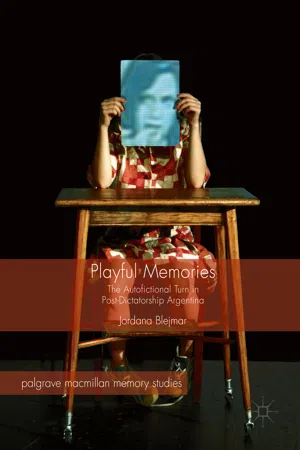
This volume examines the blending of fact and fiction in a series of cultural artefacts by post-dictatorship writers and artists in Argentina, many of them children of disappeared or persecuted parents. Jordana Blejmar argues that these works, which emerged after the turn of the millennium, pay testament to a new cultural formation of memory characterised by the use of autofiction and playful aesthetics. She focuses on a range of practitioners, including Laura Alcoba, Lola Arias, Félix Bruzzone, Albertina Carri, María Giuffra, Victoria Grigera Dupuy, Mariana Eva Perez, Lucila Quieto, and Ernesto Semán, who look towards each other's works across boundaries of genre and register as part of the way they address the legacies of the 1976-1983 dictatorship. Approaching these works not as second-hand or adoptive memories but as memories in their own right, Blejmar invites us to recognise the subversive power of self-figuration, play and humour when dealing with trauma.
Department of Communication & Media, University of Liverpool, Liverpool, UK
End Abstract
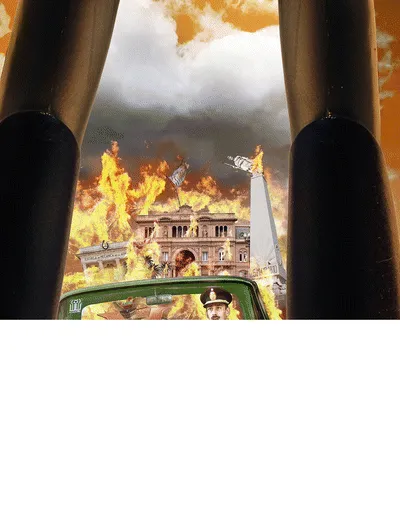
In 2010 a writer (Iván Moiseeff), a visual artist (Lola García Garrido) and a musician (Xoel López), all born between 1975 and 1982, collaborated on the creation of a promotional poster and soundtrack for a non-existent, big-budget film. Borrowing elements from animé and science fiction, the plot summary for Mazinger Z contra la dictadura militar (Mazinger Z against the Military Dictatorship), printed on the reverse of the poster, outlines how a group of young guerrilleros resist the 1976–1983 Argentine military dictatorship with the assistance of the famous Japanese super robot. On the front of the poster an image shows the dictator Jorge Rafael Videla, driving a green Falcon car adorned with a sticker of the 1978 World Cup and carrying a licence plate with the devil’s number (666). He is escaping from a big fire that is destroying three of the most iconic constructions of Buenos Aires: the Casa Rosada (Government House), the Pirámide de Mayo (an obelisk in the central square of Buenos Aires) and the Escuela de Mecánica de la Armada (ESMA, the navy training school that became the most emblematic clandestine centre of torture and disappearance during the dictatorship). But Videla cannot go far. The disproportionately large figure of Mazinger Z, reflected in the front of the car, with his legs wide open as if he were a cowboy, suggests that in this alternative and humorous version of Argentine history the dictator finally gets what he deserves.
Mazinger Z contra la dictadura militar forms part of an ever-growing corpus that reflects a new trend in post-dictatorship Argentine art and literature, one that takes a playful, irreverent, non-solemn and anti-monumental approach to the traumatic past. Similar traits, for example, can be seen in the miniature installation Juguetes (Toys) (2012) by Jorgelina Paula Molina Planas, one of the first granddaughters found by Abuelas de Plaza de Mayo in 1984. In this work, part of the series Geografías interiores (Interior Geographies), the artist reconstructs the abduction of her mother in 1977 using a doll’s house and scary toys (an angry Ninja turtle, GI Joe and a bear) in the role of the military perpetrators, and Barbie and other dolls in the role of members of her broken family (the artist, who was three-and-a-half years old, was in the house when the kidnapping took place). And in the book Las teorías salvajes (Wild Theories) (2008) by Pola Oloixarac, the protagonists create a videogame, Dirty War 1975 (in English in the original), in which the players select the characters that they want to be (e.g. Che I, “with black beret, uniform Sierra Maestra, without cigar,” or Che II, “cigar, bandana with red star and beard”) and win points by carrying out certain militant tasks.1 Moreover, in a blog post entitled “Actividad paranormal en la ESMA” (“Paranormal Activity in the ESMA”) (2008), Oloixarac refers to a series of paranormal phenomena that she experienced in the former ESMA (now converted into the memory site Espacio Cultural Nuestros Hijos) while attending a series of lectures: “four chairs suddenly broke without explanation,” “I had been told that somewhere in the property there is a tree that bleeds” and that “there is constant poltergeist activity.” Visiting the ESMA, she concludes, was like being in the “[fantasy park] Italpark’s ghost train but with content for adults”2 (Fig. 1.1).
Fig. 1.1
Lola García Garrido, Xoel López and Iván Moiseeff, Mazinger Z contra la dictadura militar (poster), 2010
Deploying what I call in this book a “playful memory,” young contemporary artists and writers, many children of disappeared and persecuted parents, often use humor, popular genres, children’s games and visual techniques commonly taught at school to provocatively represent the dictatorship and toy with trauma. Paraphrasing Ernst van Alphen’s comments on post-Shoah practitioners, we can say that with the arrival of the post-dictatorship generation, playing with the Argentine traumatic past is no longer unthinkable.3
This volume addresses precisely that controversial tension between trauma, play and humor, and it accords an unprecedented centrality to contemporary films, photography, literature, plays and blogs that have changed the whole panorama of mourning, remembering and representing trauma over the past decade or so by offering playful accounts of the past and of the self. The majority of the works date from between 2003 (the year when former president Néstor Kirchner, who in 2004 asked for forgiveness on behalf of the Argentine state, won the general elections, when the amnesty laws of Obediencia Debida and Punto Final were overturned, and when Albertina Carri’s groundbreaking film Los rubios was released) and 2015 (the final year of Cristina Fernández de Kirchner’s administration).
By focusing on a select number of representative works of this new memoryscape in Argentina, I approach these productions not as second-hand or adoptive (post-)memories but rather as memories in their own right, related to but also separate from those of the adult survivors. Furthermore, while I recognize the diversity of experiences of the dictatorship and the subsequent ways of addressing them in art and literature, I also suggest that the work of the pioneering practitioners that form my corpus share similar aesthetic choices.
In particular, I focus on two traits that I believe distinguish these narratives from previous accounts of the authoritarian past—namely, the uses of “autofiction” and of “playful aesthetics” in creative accounts of this period. Indeed, the photographic montages, semiautobiographical novels, subjective documentaries, testimonial artworks, blogs and biodramas by the post-dictatorship generation are characterized both by the use of humor and by an original interplay between imaginative investments of the past, the fictionalization of the self, visual collages and artistic modifications of documentary archives. Though instances of this interplay are evident in cultural productions from previous decades, it is my contention that the widespread development of this approach pays testament to a new cultural formation of memory in Argentina.
In this book I thus trace and conceptualize the common preoccupations, motives and strategies of these artists. I show how they look towards one another’s work across boundaries of genre and register, creating an unprecedented “community of post-orphaned artists.”4 These artists, as sociologist Gabriel Gatti puts it, recognize that they are, and always will be, orphans (in the case of those who are children of disappeared parents) but who also want to do something creative and life-affirming with that condition. Even the artists and writers who are not descendants of the victims of the dictatorship studied here share with them a certain generational gaze characterized by a similar (playful) aesthetics and ethics of remembering. As a result, the phrase “arte y literatura de los hijos” (“art and literature of the children”) should be understood here in a broad sense.5
Strictly speaking, although all of the artists I mention here are of a similar age, not all of the artists of the post-dictatorship generations use playful and autofictional devices to address trauma. Nicolás Prividera, son of a disappeared mother and director of the film M (2007), has proposed a way of categorizing the “children of,” which, while controversial, might be useful to understand the novelty of the artists I study here. Using the imaginary of science-fiction films, he has said that children of disappeared parents are, on the one hand, like “replicants,” subjects who merely repeat the discourses and words of their absent parents, and, on the other, what he calls “Frankensteinian” children, who want to escape and deny their paternal legacy altogether. In between there are authors and artists such as Félix Bruzzone, Albertina Carri and Mariana Eva Perez whom he calls “mutant” children, subjects who do not refuse paternal inheritance but who resist being confined in a safe place and instead always reappear in unexpected forms, brought together not so much (or at least not only) by a shared history of trauma but by the necessity to do something constructive with their history. “The ‘mutant’ condition of these artists,” said Prividera on the occasion of the book launch for Bruzzone’s Los topos (The Moles) (2008), “helps them (and us) to escape the labyrinth by going over it instead of through it, and to look for answers in the present (or even in the future) rather than in the past.”6
Ultimately, the use of autofiction, parody and humor, I suggest, allows these artists, especially those who were also young victims of the dictatorship, to present themselves, in the words of Alain Badiou, as “creator bodies” rather than as merely “suffering figures,” replacing the spectacle of victimhood for a more productive and affective memory.7 In June 2004, Badiou presented a series of conferences at the Universidad Nacional de Rosario, Argentina. There he suggested that the transformation of suffering into entertainment (in the mass media or in trials) is one of the most revealing traits of our time. He argued that such entertainment reduces the figure of the victim to a slave-like “suffering body,” making it imperative to recover the body made by ideas: the “creator body.” Rather than regarding them as passive sufferers of the distressing mechanisms of state terror, Badiou’s notion of creator bodies forces us to reconsider children of the disappeared in terms of subjectivity and agency, as artists, filmmakers and writers. In other words, the victim should become, as Badiou put it, “the testimony of something more than itself.”8 A victim should not be defined only by the spectacle of suffering or by the body reduced to its animality. Only then will we be able to found an idea of justice beyond this spectacle and beyond the mere pity and commiseration towards the victims. For this new understanding of justice, concludes Badiou, we need bodies of thought, creativity and ideas, the type of victims that I address in this book.
The volume is divided into nine chapters informed by four hypotheses, which provide the main thread of my analysis and which I return to in both the chapters and the conclusion:
1.
that autofictional and playful accounts access areas of the dictatorial past previously unexplored by more conventional testimonies;
2.
that memory in the expressive and playful practices of the post-dictatorship generation represents a diverse and often contradictory texture of singular versions and accounts that are not brought into any form of conclusive synthesis;
3.
that by admitting autofiction and playful aesthetics as alternative forms of witnessing, these memories can access the point of view of the other (the perpetrator) in ways that previous, testimony-based accounts could not;
4.
that these new memory practices can make us better understand, through their self-reflexivity, the relations between documentary evidence, recall and imaginative investment that are common to all forms of memory.
Chapter 2 discusses what I call the “autofictional turn” in post-dictatorship Argentine culture. I address contemporary debates about the concept of “autofiction,” a term coined by French writer Serge Doubrovsky in 1977 (a year after the coup in Argentina) to describe texts characterized by the establishment of a simultaneous pact with the reader in stories that are based on true events (an autobiographical pact) and have characters with “real” names, but which are presented under the label of “roman/novel” (a fictional pact). The 2001 Encyclopedia of Life Writing defines autofiction as “one of the forms taken by autobiographical writing at a time of severely diminished faith in the power of memory and language to access definite truths about the past or the self.”9 Indeed, rather than professing “to tell the truth as sincerely as possible, autofiction acknowledges the fallibility of memory, and the impossibility of truthfully recounting a life story.”10 The emergence of autofiction is closely linked to the difficulties posed to language by trauma and the extreme experiences of the twentieth century, notably the Shoah. Autofiction is thus based on the premise that to bear witness to past events (especially traumatic ones) we need the obliqueness of fiction.
Notions of ambiguity, fragmentation and distrust in the referential capacity of language, the deconstruction of the biographical illusion and the possibility that autofictions have to imagine different versions of the past are all, I argue, key elements of the cultural memories addressed here. In this chapter I also explore to wh...
Table of contents
Cover
Frontmatter
1. Introduction
2. The Autofictional Turn, Playful Memories of Trauma and the Post-Dictatorship Generations
3. Toying with History in Albertina Carri’s Los rubios
4. Self-Fictionalization, Parody and Testimony in Diario de una princesa montonera—110 % Verdad and Montonerísima
5. Happily Ever After? Guerrilla Fables and Fairy Tales of Disappearance
6. Lucila Quieto’s Ludic Gaze
7. The Defamiliarized Past in Félix Bruzzone’s Comical Autofictions
8. Monstrous Memories
9. Conclusion
Backmatter
Trusted by 375,005 students
Access to over 1.5 million titles for a fair monthly price.
Study more efficiently using our study tools.
Frequently asked questions
Yes, you can cancel anytime from the Subscription tab in your account settings on the Perlego website. Your subscription will stay active until the end of your current billing period. Learn how to cancel your subscription
No, books cannot be downloaded as external files, such as PDFs, for use outside of Perlego. However, you can download books within the Perlego app for offline reading on mobile or tablet. Learn how to download books offline
We are an online textbook subscription service, where you can get access to an entire online library for less than the price of a single book per month. With over 1.5 million books across 990+ topics, we’ve got you covered! Learn about our mission
Look out for the read-aloud symbol on your next book to see if you can listen to it. The read-aloud tool reads text aloud for you, highlighting the text as it is being read. You can pause it, speed it up and slow it down. Learn more about Read Aloud
Yes! You can use the Perlego app on both iOS and Android devices to read anytime, anywhere — even offline. Perfect for commutes or when you’re on the go. Please note we cannot support devices running on iOS 13 and Android 7 or earlier. Learn more about using the app
Yes, you can access Playful Memories by Jordana Blejmar in PDF and/or ePUB format. We have over 1.5 million books available in our catalogue for you to explore.