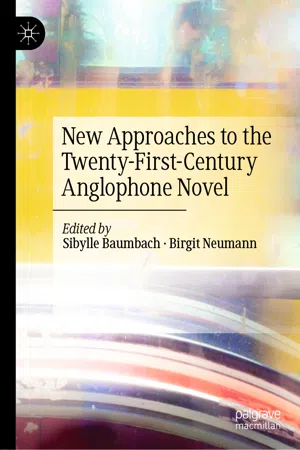
This book discusses the complex ways in which the novel offers a vibrant arena for critically engaging with our contemporary world and scrutinises the genre's political, ethical, and aesthetic value. Far-reaching cultural, political, and technological changes during the past two decades have created new contexts for the novel, which have yet to be accounted for in literary studies. Addressing the need for fresh transdisciplinary approaches that explore these developments, the book focuses on the multifaceted responses of the novel to key global challenges, including migration and cosmopolitanism, posthumanism and ecosickness, human and animal rights, affect and biopolitics, human cognition and anxieties of inattention, and the transculturality of terror. By doing so, it testifies to the ongoing cultural relevance of the genre. Lastly, it examines a range of 21st-century Anglophone novels to encourage new critical discourses in literary studies.
eBook - ePub
New Approaches to the Twenty-First-Century Anglophone Novel
- English
- ePUB (mobile friendly)
- Available on iOS & Android
eBook - ePub
New Approaches to the Twenty-First-Century Anglophone Novel
About this book
Information
© The Author(s) 2019
S. Baumbach, B. Neumann (eds.)New Approaches to the Twenty-First-Century Anglophone Novelhttps://doi.org/10.1007/978-3-030-32598-5_14Temporality in the Contemporary Global South Novel
Russell West-Pavlov1, 2
(1)
Universität Tübingen, Tübingen, Germany
(2)
Department of English, University of Pretoria, Pretoria, South Africa
1 Time After Time
Our early twenty-first-century epoch is one in which many assumptions about time that have governed nineteenth- and twentieth-century Western thinking appear gradually to be losing their purchase upon contemporary global realities. The belief that time runs along linear tracks, in a direction which is forward-looking, not backward-turning, or sideways-sliding, and according to predictable patterns, is becoming less tenable. Notions of economic or political predictability have been eroded by the unforeseen events of the 2008 global economic crisis, Trump’s election to the presidency of the USA and the Brexit referendum in 2016 (cf. Appadurai 2013; Streeck 2017). Predicated upon the unforeseeability of terrorist attacks, the entirety of US foreign and military policy since 2001 is oriented towards dealing with uncertain futures (cf. Massumi 2015). Possible future cataclysms with immense global impact, such as nuclear conflicts on the Indian subcontinent or the Korean peninsula (cf. Toon et al. 2008), may potentially be triggered by totally random causalities. Climate patterns, as meteorologists have predicted, are becoming more and more erratic and extreme; the only aspect of climate change that appears predictable is the notion of an irreversible tipping point with immense and cascading consequences for life on earth—one, however, that we may have already passed (cf. Forzieri et al. 2017; Friedrich et al. 2016; Lee and Kim 2017; Lenton et al. 2008; Scheffers et al. 2016).
The US-Caribbean critic David Scott (2004, 210) has written that we live “[n]ot [in] meaningless times, nor merely dark or catastrophic times, but in times that in a fundamental way are distressingly off kilter in the specific sense that the critical languages in which we wagered our moral vision and our political hope […] are no longer commensurate with the world they were meant to understand, engage, and overcome.” Scott (1–2) notes that “the untimely experience [of our times] have provoked a more acute awareness of time, a more arresting attunement to the uneven topos of temporality […] an accentuated experience of temporality, of time as conspicuous, as ‘out of joint’ (as Hamlet unnervingly put it)” has led to the emergence of “a new time-consciousness […] everywhere in contemporary theory.” It is doubtless this new prominence of temporality in theory, already envisaged at the turn of the century by David Wood (2001, xxxv), when he claimed that “our century-long ‘linguistic turn’ will be followed by a spiralling return to the focus and horizon of all our thought and experience,” that leads to the presence of a chapter on time in a volume such as this.
But if temporal theory has experienced a renewed rush of popularity in the wake of spatiality, manifest in a neo-temporal theoretical moment that supersedes nineteenth-century historicism, a sort of “time after time” (Wood 2007), this is in part because our narrative templates for constructing our experience of time have undergone an unprecedented crisis: “[W]hat is at stake here, clearly, is the problem of narrative, because of the relation between pasts, presents, and futures that is a relation constituted in narrative discourse” (Scott 2004, 7)—the crisis of prediction is of course a crisis of prediction. Contemporary work on temporality in the literary humanities thus seeks to construct a provisional, elusive but urgently necessary “vocabulary of the present” (Burges and Elias 2016). I will go on, in the course of this chapter, to question the exclusively narrative location of temporality. Yet, paradoxically, narrative appears to be one of the prime sites where these new configurations of “time after time” in a sort of collective experience of “lived time” (Bergson 1960) are being negotiated. For this reason, my examples for questioning that narrative basis of “lived time” are themselves narratives about time. These texts suggest that the role of narrative may not be to model or articulate temporality, though that of course is one of its functions. Rather, they intimate, by the work they do, that narratives about time may be peculiarly apt to locate and embody temporality. By performatively indexing new senses and sensibilities of temporality, they point us back to a more elemental temporality than the reified one that has so deeply influenced modernity and, not coincidentally, underpinned imperial conquest, colonial exploitation, and global environmental destruction.
I claim that Global South narratives since the turn of the century, in accordance with the sea-change sensed by theorists such as Scott or Wood, to name only two of many, bring time back to its elemental grounding in space and place. The spatialisation of time, however, is not the terminal point of such narrative developments, for space itself is read together with time, in many Global South narratives, as a conglomerate whose fluid texture is that of material reality itself. Such narratives of a renewed (but in fact not particularly new) understanding of temporality are important in an epoch where, especially under the sign of catastrophic climate change, future horizons appear to be closing down. The material temporalities that these narratives evoke are not linear and thus also elude the aporia of linearity or its negation, thereby opening up new perspectives for life on earth.
An increasingly salient topos in contemporary writing about the Global South reverses the once-fashionable topos of travelling to the colonies or the tropics as “in fact travelling in time […] exploring the past” (Degérando [1800] 1969, 63) or “travelling back to the earliest beginnings of the world” (Conrad [1899/1902] 2010, 77). An alternative and increasingly prominent counter-topos suggests that the Global South does not represent a primitive past that we in the modern West have left behind, travelling following the arrow-like trajectory of progress, but rather, that the Global South is the destination towards which we are all heading. We are all travelling south towards a novel hypermodernity. Such comments are often made in a dystopian, entropic spirit, as the Global South reveals to the rest of the world the terrifying face of unbridled urban growth (cf. Koolhaas qtd. in Nuttall and Mbembe 2008, 4), of lawless capitalism unleashed (cf. Comaroff and Comaroff 2012), or of accelerating climate change (cf. Ghosh 2016)—but also in evoking futuristic promise and potential of unconventional solutions, whether those of the mobility, multiplicity, and relationality that Mbembe (2013) claims as basic tents of an African ethos, or those of time-proven Indigenous knowledges retooled for the coming climate catastrophe (cf. Mishra 2017). I posit that the Global South also harbours another form of futurity: namely, the future of futurity itself, embedded in a transformed sense of temporality. It is in order to excavate this sense of temporality that I turn to two Global South novels published since the turn of the twenty-first century.
Issues of time are central to the contemporary Global South/postcolonial novel as this is one of the primary sites where they mark out a distinct “counter-discourse” of indigeneity that resists the predations of imperial and colonial incursions into the lived spaces of the erstwhile colonised. It is also the site at which they propose an ongoing alternative culture of connectivity and its concomitant “poetics of relation” (cf. Glissant 1998). In this chapter, I read Guyanan Wilson Harris’ The Dark Jester (2001) and Kenyan Yvonne Adhiambo Owuor’s Dust (2013) for the ways they mobilise non-linear narrative strategies to suggest alternative temporalities and thus emergent ontologies from the Global South.
As a theoretical template that allows us to take stock of these contemporary novelistic projects, I follow Harris’ explicit references to quantum theories as a source of inspiration (cf. Harris 2000; Islam 2007). I complement Harris’ rather oblique commentaries by aligning novelistic poetics to be found in his own work and that of Owuor with contemporary Quantum Gravity Theory. Quantum Gravity combines particle-based granularity and wave-based continuities, thus eschewing dichotomies and stressing the relational, the probabilistic, and the creative. Such mobilisations of contemporary physics do not serve to legitimise literary aesthetics via an appeal to scientific objectivity, for such cutting-edge theory is predominately exploratory and speculative. Rather, in accord with many of the topoi of the Amerindian “arc” to which Harris has persistently had recourse since the 1960s, and the “elastic time” that Owuor localises in the arid Kenyan North-West, contemporary physics provides a “bridging” theory that will rejoin long-standing Eurocentric dichotomies and polarities. It is not by chance that literary artists, tellers of stories, are at the forefront of purveying these narrativised notions of alternative, redemptive temporalities. The physicist Lee Smolin, one of the pre-eminent popularisers of quantum gravity theory, claims that “[m]otion and change are primary. Nothing is, except in a very temporary and approximate sense” (2000, 53). Consequently, “when you look around you do not see space – instead, you are looking back through the history of the universe. What you are seeing is a slice through the history of the world” (64). If, as Smolin (54) suggests, “[t]ime and change are not optional, for the universe is a story and it is composed of processes,” then, “whether it is a short story or a long story, the only kind of explanation of a process that is truly adequate is a story” (52). What Smolin is rehearsing here is a remarkable convergence of contemporary quantum physics and narrative studies that aligns the processuality of the universe and the processuality of narrative, and equates the “entanglement” of subjectivity and objectivity (cf. Barad 2007) in scientific observation with that of narrative art. The novel, then, does not merely offer one possible means of depicting the quantum turn in contemporary notions of time. More radically, by virtue of its diegetic affinity with the processuality of the cosmos itself, the novel may be a particularly privileged site, even when it jumbles narrative temporality—indeed, particularly when it jumbles narrative temporality—for exploring, performatively and in participatory fashion, emergent sensibilities of time.
A direct political relevance accrues to such convergences between science and literature. Harris writes that “[t]he divide between West and East [or South and North] is akin to a chasm between Conquest and pre-Conquest ages” (2001, x). Yet he immediately continues: “Such divides, such chasms, are true of the particularity of quantum the...
Table of contents
- Cover
- Front Matter
- The Novel: An Undead Genre
- Human Rights and Transnational Justice in the Contemporary Anglophone Novel: J. M. Coetzee’s Disgrace and Achmat Dangor’s Bitter Fruit
- The Economy of Attention and the Novel
- Twenty-First-Century Fictional Experiments with Emotion and Cognition
- ‘Reality Hunger,’ Documentarism, and Fragmentation in Twenty-First-Century Anglophone Novels
- Cli-Fi: Environmental Literature for the Anthropocene
- The Animal Novel That Therefore This Is Not?
- We Have Always Already Been Becoming Posthuman? Posthumanism in Theory and (Reading) Practice
- What Is ‘the’ Neoliberal Novel? Neoliberalism, Finance, and Biopolitics
- The Novel After 9/11: From Ground Zero to the “War on Terror”
- Post-national Futures in National Contexts: Reading ‘British’ Fictions of Artificial Intelligence
- Anglophone World Literature and Glocal Memories: Chimamanda Ngozi Adichie’s Half of a Yellow Sun and Kiran Desai’s The Inheritance of Loss
- Afropolitanism and the Novel: Mapping Material Networks in Recent Fiction from the African Diaspora
- Temporality in the Contemporary Global South Novel
- Beyond the Written Word
- The Limits of Fictional Ontologies in Bret Easton Ellis’ American Psycho and Kazuo Ishiguro’s Never Let Me Go
- The End of the Novel
- Back Matter
Trusted by 375,005 students
Access to over 1.5 million titles for a fair monthly price.
Study more efficiently using our study tools.
Frequently asked questions
Yes, you can cancel anytime from the Subscription tab in your account settings on the Perlego website. Your subscription will stay active until the end of your current billing period. Learn how to cancel your subscription
No, books cannot be downloaded as external files, such as PDFs, for use outside of Perlego. However, you can download books within the Perlego app for offline reading on mobile or tablet. Learn how to download books offline
Perlego offers two plans: Essential and Complete
- Essential is ideal for learners and professionals who enjoy exploring a wide range of subjects. Access the Essential Library with 800,000+ trusted titles and best-sellers across business, personal growth, and the humanities. Includes unlimited reading time and Standard Read Aloud voice.
- Complete: Perfect for advanced learners and researchers needing full, unrestricted access. Unlock 1.5M+ books across hundreds of subjects, including academic and specialized titles. The Complete Plan also includes advanced features like Premium Read Aloud and Research Assistant.
We are an online textbook subscription service, where you can get access to an entire online library for less than the price of a single book per month. With over 1.5 million books across 990+ topics, we’ve got you covered! Learn about our mission
Look out for the read-aloud symbol on your next book to see if you can listen to it. The read-aloud tool reads text aloud for you, highlighting the text as it is being read. You can pause it, speed it up and slow it down. Learn more about Read Aloud
Yes! You can use the Perlego app on both iOS and Android devices to read anytime, anywhere — even offline. Perfect for commutes or when you’re on the go.
Please note we cannot support devices running on iOS 13 and Android 7 or earlier. Learn more about using the app
Please note we cannot support devices running on iOS 13 and Android 7 or earlier. Learn more about using the app
Yes, you can access New Approaches to the Twenty-First-Century Anglophone Novel by Sibylle Baumbach, Birgit Neumann, Sibylle Baumbach,Birgit Neumann in PDF and/or ePUB format, as well as other popular books in Literature & European Literary Criticism. We have over 1.5 million books available in our catalogue for you to explore.