eBook - ePub
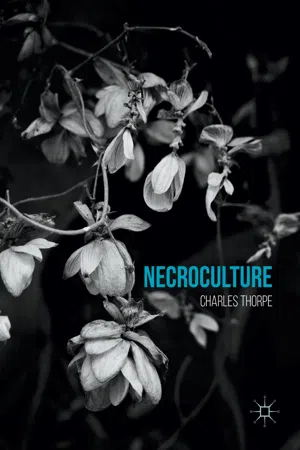
Necroculture
About this book
In this book, the author draws on Karl Marx's writings on alienation and Erich Fromm's conception of necrophilia in order to understand these aspects of contemporary culture as expressions of the domination of the living by the dead under capitalism. Necroculture is the ideological reflection and material manifestation of this basic feature of capitalism: the rule of dead capital over living labor. The author argues that necroculture represents the subsumption of the world by vampire capital.
Information
© The Author(s) 2016
Charles ThorpeNecroculturehttps://doi.org/10.1057/978-1-137-58303-1_11. The Necroculture of Capitalism
Charles Thorpe1
(1)
University of California, San Diego, California, USA
The Living and the Dead
In the television series The Walking Dead, survivors of an apocalypse take shelter in a prison, while zombies circle the fences looking for a way in.1 The zombies are shadows cast by a past to which the survivors cannot return but which they cannot escape. The living dead represent the past that, as Karl Marx wrote, “weighs like a nightmare on the brains of the living.”2 The prison that holds us today is what right-wing philosopher Francis Fukuyama called “the end of history,” a predicament in which “we cannot picture to ourselves a world that is essentially different from the present one, and at the same time better.”3 Fukuyama welcomed the end of history as the victory of capitalism and liberal democracy. But the end-of-Cold-War triumphalism that Fukuyama’s book emblematized has disappeared as global capitalism piles crisis upon crisis, and the thinning veneer of democracy reveals callous class rule. This system’s continued existence is an imposed end of history, achieved by suppressing humanity’s creative ability to “picture” a better world, to make history, and to remake itself in the process. The end of history is the enforced stasis of a decaying system stubbornly resisting its slow death. Its life support is imperialist war, ecological destruction, police-state surveillance and brutality, the degradation of culture by corporate mass media, and a mass psychology of hopelessness.
The chaos of war, want, and despoliation today is so gratuitous because it stands in such immense contrast to the level of productive, scientific, technological, artistic, and intellectual accomplishment that the human race has achieved. The destructiveness contrasts so painfully with the well-being and creative flourishing of all that our level of economic, technological, and cultural development places within humanity’s grasp. The resources and capabilities produced by today’s globally integrated productivity are locked up as financial wealth possessed and controlled by a narrow class layer. According to the Credit Suisse Global Wealth Report for 2015, the bottom half of the global population own less than 1 % of total household wealth, while the top 1 % of wealth holders own half of the world’s wealth.4 The mass of dead wealth piled up at the top is the denied potential of humanity and the barrier between present and future. The denied future is a system in which the fruits of human productivity are shared equally, society’s creative and productive capacities are consciously applied for the benefit of all humanity, and living human need, not dead mammon, is the goal of production.
Capitalist culture is necroculture—a culture that aggrandizes the dead and non-living over the living. Necroculture is the culture of a social world subsumed by capital, one in which relations between human beings have been thoroughly colonized by, and subordinated to, the reproduction of capital. The concept of necroculture, as I use it, draws together Marx’s concept of alienation, as the domination of living labor by its dead products, with Erich Fromm’s psychoanalytic conception of necrophilia as the love of death over life.
Fromm interprets Marx’s theory of alienation to be essentially about the relationship between the living and the dead. Fromm argued:
Capital is the power of the dead and of the past. It is dead, but draws sustenance, energy, and power from its exploitation of the living. It becomes living dead by appropriating the life of the worker. Marx wrote, “Capital is dead labour which, vampire-like, lives only by sucking living labour, and lives the more, the more labour it sucks.”6 Living death describes the occult power of what Marx called the “animated monster” of capital and the degradation and suffering endured by labor caught in its jaws.7 As it is drained of its energy, creativity, and vitality, labor is transformed from the living into the living dead. The condition of alienation within capitalism is one of living death.For Marx, capital and labor were not merely two economic categories. Capital for him was the manifestation of the past, of labor transformed and amassed into things; labor was the manifestation of life, of human energy applied to nature in the process of transforming it. The choice between capitalism and socialism (as he understood it) amounted to this: Who (what) was to rule over what (whom)? What is dead over what is alive, or what is alive over what is dead?5
The subsumption of life by capital is culturally expressed in fetishistic interest in artificial things—technology and consumer products—to the exclusion and detriment of the living world of nature and human relationships. Obsessed with commodities and technological applications, necroculture treats with indifference the ongoing degradation of the richness of human life and the diversity of the natural world. It combines apocalyptic resignation and apocalyptic longing. It is increasingly evident that the wasteful and exploitative consumer-capitalist way of life must come to an end. But along with avoidance, anxiety, and mute despair, and in the ideologically enforced absence of a conscious alternative, there is a cultural undercurrent of attraction to apocalyptic scenarios as wish-fulfillment fantasy, offering release from the impersonal oppression that weighs on people.
Capitalism gains ideological support from the notion that the “free market” sets the individual free from external constraint (providing freedom in a purely negative sense). However, Fromm argues that this freedom from constraint made the individual “alone, isolated,” and therefore powerless before “overwhelmingly strong forces outside of himself.” With the rise of capitalism, man “became an ‘individual,’ but a bewildered and insecure individual.”8 Capitalist relations subject the individual to the anonymous demands of the market, and these demands are translated into personal forms of domination, submission, exploitation, and competition.9 The business owner aims to annihilate the competition; the manager subjugates and exploits the worker, but, in turn, must meet his performance targets and fears his own superiors; the worker is forced to compete against his fellows. Personal relations infected with envy, resentment, aggression, and contempt are overdetermined by an economic system that makes life a struggle of all against all and turns all increases of productive power into human powerlessness.
The negative freedom of the individual under capitalism, therefore, produces insecurity and subjugation to impersonal forces that are hard for the individual to identify and comprehend. Fromm writes, “Aloneness, fear, and bewilderment remain; people cannot stand it forever. They cannot go on bearing the burden of ‘freedom from’; they must try to escape from freedom.”10 The fear of freedom may be temporarily assuaged by amassing objects. Fromm writes that in capitalist culture, the individual’s self “was backed up by the possession of property. ‘He’ as a person and the property he owned could not be separated… The less he felt he was being somebody the more he needed to have possessions.”11 Objects become, under capitalism, not only material security but security of the self. Being is subordinated to having, and life made dependent on non-living things. The spontaneity of life is subordinated to the discipline of the market, and the range of human creativity and desire is narrowed down to the drive to accumulate. The flight from negative freedom also, Fromm argues, is the root of the psychological attraction of fascism and other forms of authoritarianism. These forms of politics express the psychological need to submerge the self in a powerful entity.12
The “escape from freedom” is linked to a psychology of lifelessness. In his later work, Fromm came to see the fundamental social–psychological problem facing modern society as the choice between biophilia and necrophilia, or the love of life versus the love of death. Necrophilia, as Fromm uses the term, is “the passionate attraction to all that is dead, decayed, put...
Table of contents
- Cover
- Front Matter
- 1. The Necroculture of Capitalism
- 2. Artificial Life on a Dead Planet
- 3. Speed and Stasis
- 4. The Pornography of Information
- 5. The Tyranny of Negative Freedom
- Back Matter
Trusted by 375,005 students
Access to over 1.5 million titles for a fair monthly price.
Study more efficiently using our study tools.
Frequently asked questions
Yes, you can cancel anytime from the Subscription tab in your account settings on the Perlego website. Your subscription will stay active until the end of your current billing period. Learn how to cancel your subscription
No, books cannot be downloaded as external files, such as PDFs, for use outside of Perlego. However, you can download books within the Perlego app for offline reading on mobile or tablet. Learn how to download books offline
Perlego offers two plans: Essential and Complete
- Essential is ideal for learners and professionals who enjoy exploring a wide range of subjects. Access the Essential Library with 800,000+ trusted titles and best-sellers across business, personal growth, and the humanities. Includes unlimited reading time and Standard Read Aloud voice.
- Complete: Perfect for advanced learners and researchers needing full, unrestricted access. Unlock 1.5M+ books across hundreds of subjects, including academic and specialized titles. The Complete Plan also includes advanced features like Premium Read Aloud and Research Assistant.
We are an online textbook subscription service, where you can get access to an entire online library for less than the price of a single book per month. With over 1.5 million books across 990+ topics, we’ve got you covered! Learn about our mission
Look out for the read-aloud symbol on your next book to see if you can listen to it. The read-aloud tool reads text aloud for you, highlighting the text as it is being read. You can pause it, speed it up and slow it down. Learn more about Read Aloud
Yes! You can use the Perlego app on both iOS and Android devices to read anytime, anywhere — even offline. Perfect for commutes or when you’re on the go.
Please note we cannot support devices running on iOS 13 and Android 7 or earlier. Learn more about using the app
Please note we cannot support devices running on iOS 13 and Android 7 or earlier. Learn more about using the app
Yes, you can access Necroculture by Charles Thorpe in PDF and/or ePUB format, as well as other popular books in Social Sciences & Media Studies. We have over 1.5 million books available in our catalogue for you to explore.