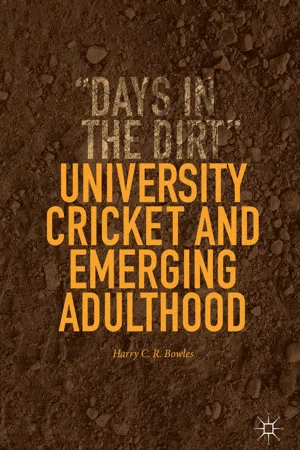
- English
- ePUB (mobile friendly)
- Available on iOS & Android
eBook - ePub
About this book
Information
Print ISBN
9783319762814
Subtopic
Developmental Psychology© The Author(s) 2018
Harry C. R. BowlesUniversity Cricket and Emerging Adulthoodhttps://doi.org/10.1007/978-3-319-76282-1_11. Introduction: A Day in the Dirt
Harry C. R. Bowles1
(1)
Cyncoed Campus, Cardiff Metropolitan University, Cardiff, UK
The Indoor Cricket Centre is a white, metal clad building on the grounds of a county and international cricket stadium. This purpose-built, box-like structure, with its elevated roof and synthetic floor, plays host to cricketers of all age groups servicing the local community and elite athlete populations. Cricketers as young as 8 years old can learn to play here with access to all the facilities that international cricket stars use to fine-tune their skills. It was inside this lofty space, amid bats, pads and sweaty kit, that my association with a group of university cricketers began, and the observational fieldwork upon which this book is based started in earnest.
Armed with an A5 Black ‘n’ Red notebook, and rubber tipped pencil, I watched from a respectful distance; my vision obscured by netting that hung from the ceiling separating me from twenty or so young men going through their paces. Caught up in my own self-consciousness, ears filled by the sound of cricket balls hitting their targets, I stood still, afraid to disturb the natural order of things, wondering what the hell I should be doing.
If truth be told, I was little prepared. I had read the handbooks and ‘how-to texts’ and understood some of the principles, but the process of ethnography was not a technical procedure that I could simply roll out. The sights and sounds of cricketers practising in the nets was a scene with which I was familiar. As an insider to the context, I was not put off by the particularities of the cricketing rituals taking place in front of me. I was, however, unsure of my purpose and whether my investigations would get off the ground—familiar territory for those who have attempted this type of research. So, I picked up a bat that lay on the ground next to me and started to shadow a few shots, comforting myself with each swing of the blade.1
It was January 2011 and preparations for the season were well underway. By the end of March I would be taken further out of my comfort zone as gymnasiums and sports halls were replaced with pavilions, dining tables and motorway service stations. It would take a while for players to let me into their lives and for me to develop the confidence to pry. But cricketers spend a lot of time together helping to spark relationships where there once were none. In sixty cricket-related days that would follow the players’ last indoor practice, I would spend twenty-two nights away with them, staying in ten different hotels and travel more than four thousand miles up and down the country. Like getting to know the players, it would take time for me to piece together the meaning of their everyday experiences, and draw a connection between their lives and the cricketing environment of which they were a part. What, for example, could be learned from watching a game of first-class cricket in a thirteen thousand seat stadium with no one in it? Or by witnessing the reactions of eleven young cricketers come off the field at the close of play with their county opponents 447 for 1,2 and groan at the prospect of spending another “day in the dirt.” This is, after all, what they wanted to do, right?
The Research Context
There is an inevitability about the start of the English cricket season. Rain will stop play and a team of teens and early 20 somethings will get roundly beaten by their professional opponents causing somebody to whinge about the ‘first-class’ status of university cricket.3 First-class cricket has a longstanding association with higher education (HE) in the United Kingdom (UK). The relationship dates back to June 1827 and the first recorded two-day match between Oxford and Cambridge University at Lord’s Cricket Ground, St. John’s Wood, London.4 After the first day’s play, the game was abandoned due to bad weather with Oxford in a commanding position over their rivals. Regardless of the result, the match was still one to be savoured for the student-cricketers who participated in the fixture, whose destinations in life and sport were only beginning to unfold. Out of the twenty-two students who played, fourteen registered their first-class debuts of which six also registered their last.
The Varsity Match, as it is known, is a game that remains to this day, and a fixture from which ‘first-class’ cricket’s affiliation with British Universities has grown. It is a tradition of the English cricket season to begin with first-class games ‘against the students’. This was once the privilege of Oxford and Cambridge University Cricket Clubs, but is now in the remit of six university centres of cricketing excellence spread regionally across England and Wales. Founded in 2000 by the England and Wales Cricket Board (ECB), the six university centres incorporate thirteen separate HE institutions that offer a range of degree courses to match the interests and academic abilities of the aspiring cricketers they hope to attract.5 Individually and collectively the academies are said to provide:
Between October 2010 and June 2013 when the majority of this research was conducted, each centre received a financial stipend from the Marylebone Cricket Club (MCC),6 who took over the sponsorship of university cricket from the ECB in 2005, of £82,400 per annum.7… an alternative pathway into professional cricket for young players who might be unsure of their abilities or plans, or for those unwilling to make an early choice between academia and sport, or simply for those who are late developers. (Atherton 2013, p. 58)
The model upon which the university centres of cricketing excellence (UCCEs) were based pre-dates the existence of the ECB as the national governing body for cricket in England and Wales. The idea behind ‘the scheme’ came from the former England, Lancashire and Durham opening batsman Graeme Fowler who received the support of the Test and County Cricket Board (TCCB), and a Prime Minister with a soft spot for cricket, to start the first centre of excellence at Durham University in September 1996. According to Fowler (2016, p. 196), the aim was pure and simple. The centre of excellence at Durham was about giving young players the chance to “finish their education and progress their game into first-class cricket and beyond”. The priorities, he describes, were “education first, cricket second, social third” in an environment built not just on bricks and mortar, but on an “attitude” of excellence, and thus the centre at Durham set itself apart from traditional university sport in its organisation and focus. As the former Middlesex batsman and England captain, Andrew Strauss, recollects in his autobiography (2013, p. 31), “overnight, the Durham University CC had gone from a ramshackle organisation of talented students … to a highly professional set-up.” While Oxford and Cambridge University had a long history of producing first-class cricketers and future England captains, the centre at Durham was a forerunner to the start of a new high-performance sport culture that was set to emerge amid a fast expanding HE sector.
A year after the centre of ...
Table of contents
- Cover
- Front Matter
- 1. Introduction: A Day in the Dirt
- 2. Mr Cricket: The Story of a Cricket Aficionado
- 3. The Cricket Bubble: Notes on a Cricketing Lifestyle
- 4. Lady Cricket: From Flirtation to Cohabitation
- 5. Finding Their Level: Trial and Repudiation of a Cricketing Identity
- 6. Conclusion: University Cricket and Emerging Adulthood
- Back Matter
Trusted by 375,005 students
Access to over 1.5 million titles for a fair monthly price.
Study more efficiently using our study tools.
Frequently asked questions
Yes, you can cancel anytime from the Subscription tab in your account settings on the Perlego website. Your subscription will stay active until the end of your current billing period. Learn how to cancel your subscription
No, books cannot be downloaded as external files, such as PDFs, for use outside of Perlego. However, you can download books within the Perlego app for offline reading on mobile or tablet. Learn how to download books offline
Perlego offers two plans: Essential and Complete
- Essential is ideal for learners and professionals who enjoy exploring a wide range of subjects. Access the Essential Library with 800,000+ trusted titles and best-sellers across business, personal growth, and the humanities. Includes unlimited reading time and Standard Read Aloud voice.
- Complete: Perfect for advanced learners and researchers needing full, unrestricted access. Unlock 1.5M+ books across hundreds of subjects, including academic and specialized titles. The Complete Plan also includes advanced features like Premium Read Aloud and Research Assistant.
We are an online textbook subscription service, where you can get access to an entire online library for less than the price of a single book per month. With over 1.5 million books across 990+ topics, we’ve got you covered! Learn about our mission
Look out for the read-aloud symbol on your next book to see if you can listen to it. The read-aloud tool reads text aloud for you, highlighting the text as it is being read. You can pause it, speed it up and slow it down. Learn more about Read Aloud
Yes! You can use the Perlego app on both iOS and Android devices to read anytime, anywhere — even offline. Perfect for commutes or when you’re on the go.
Please note we cannot support devices running on iOS 13 and Android 7 or earlier. Learn more about using the app
Please note we cannot support devices running on iOS 13 and Android 7 or earlier. Learn more about using the app
Yes, you can access University Cricket and Emerging Adulthood by Harry C. R. Bowles in PDF and/or ePUB format. We have over 1.5 million books available in our catalogue for you to explore.