- English
- ePUB (mobile friendly)
- Available on iOS & Android
eBook - ePub
About this book
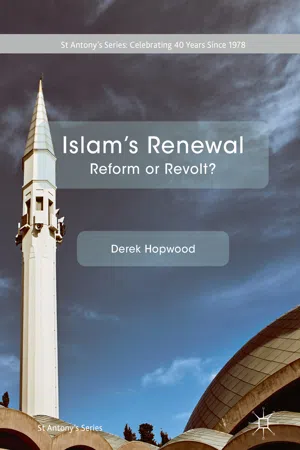
The book considers some of the solutions proposed by Muslim activists and thinkers in their attempts to renew (tajdid) their ways of life and thought in accord with the demands of the age in which they lived. The two ways of reacting are studied – the movements led by men of action and inspiration, and the thoughts of quietist scholars who laid greater emphasis on calm continuity. These two streams have often collided and particularly so in the contemporary age of greater violence. Other related problems are also considered: how a non-Muslim should regard the religion of the 'other'; the ways modernization have been dealt with; and the two root causes of Muslim 'rage' today – the invasions of the West and the failure to reach an equitable solution to the problem of Palestine. Building on the author's sixty-year experience researching the history of Islam, the book will appeal to students and scholars across the fields of Islamic studies, religious history and Middle Eastern politics.
Information
Topic
Theology & ReligionSubtopic
Middle Eastern Politics© The Author(s) 2018
Derek HopwoodIslam's RenewalSt Antony's Serieshttps://doi.org/10.1007/978-3-319-75202-0_11. Libya: First Experience of the Arab World and Islam
Derek Hopwood1
(1)
St Antony’s College, University of Oxford, Oxford, UK
I first set foot in the Arab world in September 1957, after walking down the gangway of the ancient but elegant Italian steamship onto the dockside of Tripoli harbour. It had sailed across the Mediterranean from Naples via Sicily and Malta. Tripoli and Libya were familiar names from the Second World War; the heat, noise and colour of the waiting crowds were not. I was about to take up my first job as a British Council officer. I had wanted to work in the Middle East after reading Arabic at Oxford and was offered the choice of a post in Libya or Lebanon . For no obvious reason and on the basis of no knowledge I had chosen Tripoli. Perhaps Beirut would have been a better introduction to the restless Arab world with its position as the centre of culture and nationalism. Some experts didn’t even consider Libya in North Africa to be part of the Arab world and certainly not a centre of culture or of any kind of nationalism apart from localized feuding. Next door, to the west, Tunisia had been independent from the French for only a few months and further along the same French were beginning a lunatic war to try to prevent the Algerians from gaining their freedom. Being in Libya, I was introduced to a very different kind of Arab from the sophisticates of Cairo and Damascus . Few Libyans were educated; there was one very new university, no tradition of poetry and literature and a religious heritage that was unique to the area. So perhaps Libya was an indirect and gentler way in.
But there was something in the air. Something had changed. The Libyans had known the British for 15 years as the fairly benevolent army that had expelled the hated Italian colonizers with their German allies. The British had stayed on to help in post-war development. It was known that they had imperial interests in the Arab world and they seemed pretty invincible until the young and charismatic ‘Abd al-Nasser had apparently halted the pathetic British attempt to re-enter Egypt during the 1956 Suez invasion. The humiliating withdrawal had hinted at a new world and the young men of Libya saw a possible liberator in the Egyptian colonel. His picture was carried through the streets and hung in shops next to or instead of that of the Sanusi King Idris.
For better or worse, I was now standing on the harbour front, being hassled and harangued in Arabic and Italian. I wondered where our luggage was and whether we would see it again, but all was good-natured and finally we found it and a cooperative gharry driver (gharry, Hindi for a one-horse two-wheeled carriage, famous or infamous for the decrepit hangdog condition of the horses) who drove us through the sultry heat along the Italianate sea front, rather ironically populated with white-cloaked women and men—the first clear sign of an ex-Western colony implanted on African soil. To my inexperienced eye it was all rather confusing, Italian, exotic, hot and Arab—perhaps like a play in which the characters had wandered onto the wrong scene. It seemed colonial but the colonizers no longer ruled and the country was struggling through the early stages of independence.
We reached the offices of the British Council and I started work on a very enjoyable two-year contract. The premises were in a large Italian villa near the seafront and the British embassy was just further along (itself housed in an ex-colonial building).
Many young Libyans were keen to learn English after the years of Italian domination—the British were welcome (to a certain degree as expellers of the colonialists) and their language was seen as key to a rewarding career. The Council had just opened its office and apart from teaching English and hosting the usual cultural events was engaged in establishing schools and a university. Some of the expatriate teachers there had recently been expelled from Egypt after Suez and a lifetime of service there. They were not too happy with Anthony Eden but had been away from home too long to start a career back in Britain . They did not have the same interest in Libya that I had and their life centred very pleasantly on the beach club and cocktail parties. The British Ambassador was the kindly, eccentric old-time diplomat Sir Eugene Millington-Drake who had been British Minister in Montevideo during the Battle of the River Plate. I myself taught large classes of young Libyans eager to add knowledge of English to that of Arabic and Italian so that they could enter a world wider than that of their traditional background.
The United Nations had voted for Libyan independence in 1949 and when I arrived the country was trying to find its feet, rather torn between its relations with Europe and America and the rowdy nationalists of the Middle East. At independence it had had no government institutions or civil service and, it is said, only 20 university graduates. It was a country stitched together from three separate and rival areas—Tripolitania, Cyrenaica and Fezzan—the latter largely desert. The total population was estimated at just over one million, 80–90% illiterate, inhabiting an area of 680,000 square miles. Its natural resources—before the discovery of oil —were meagre and it was kept afloat by foreign donations. Many of the expatriates of the time were there working on development and training projects.
Libya on independence faced enormous problems which had to be tackled if it was to improve even minimally the lives of its people. It had one of the lowest living standards in the world and the bulk of the population lived at subsistence level. The Bedouin way of life was mostly based on the camel and dates, and while it had for centuries sustained the nomad it could never have provided the calories needed for a Western way of life. It was anyway probable that life at subsistence level was not seen as a hardship until pointed out by someone. The poorer settled people survived on a diet of couscous (millet) to which, when lucky, vegetables and meat were added. Most of the land was arid, uncultivable desert with the productive areas lying in two narrow strips on the coast in Tripolitania and Cyrenaica. The climate was unkind to crops, with sparse rain in the winter and largely running to waste, while during most other seasons of the year the hot desert wind (ghibli) could cause serious damage. A lack of alternative resources meant that Libya’s economy was chiefly agricultural. (There were several theories flying around as to how fertile the land had been in Greek and Roman times and whether it was possible to recreate a similar fertility.) It was estimated that 80% of the population gained a living (however meagre) from the land, through both pastoral and arable farming. There was, as in most countries, a steady movement away from the land into the towns, with young men seeking work not in industry but on foreign military bases, in the oil companies or the development agencies. Housing could not keep pace with the influx and many new immigrants had to squeeze into a large slum area (bidonville) in Tripoli, where dwellings were cobbled together from old crates, flattened petrol tins and other leftovers from the war.
There were few towns of various sizes, the largest being Tripoli in the west untouched by war damage, and Benghazi in Cyrenaica almost totally destroyed as it changed hands in the Second World War, one remaining monument being the twin-domed Italian cathedral, known to the disrespectful British soldiery as Mae West. In the desert, settlements were few and far between. One interesting feature was the small Italian colonial villages, built to a pattern around a square, with government offices and a church. Identical small houses had been constructed nearby for the Italian peasants who had been encouraged to immigrate and farm the inhospitable land. Many of these abandoned houses had been given to Libyan farmers who preferred to keep their animals in the houses and to pitch their tents in the gardens.
The legacy of problems that the newly independent country inherited was grim. Without foreign assistance it could barely have survived the early years or made much progress thereafter. (It was no less than fair that the outside world should have to some extent made good the damage caused by its having fought in and partially destroyed a totally innocent third party’s country.) Given Libya’s lack of trained personnel in all fields, some dozen UN and other agencies had been sent to the country to offer technical assistance. The Libyan Public Development and Stabilization Agency supported by British contributions helped to finance economic and social development and support the budget, and the Libyan-American Reconstruction Commission oversaw US financial aid. It was said there were too many fingers in the pie and there was some Libyan resentment at the number of foreign cooks stirring the broth. But that said there were a number of British experts with long colonial experience working there who were determined to try to make Libya work.
This was particularly obvious in the field of agriculture —Libya’s only means of livelihood. Attention was paid to improving farming methods, irrigation and strains of seeds and to introducing new breeds of sheep and cattle. An agricultural farm near Tripoli founded under the Ottomans was enlarged as a centre of experimentation. Farmers were shown how to improve cultivation methods and were given large quantities of improved seeds. In seven short years some progress was made. Water management improved, which led to more beneficial methods of farming. In this poor peasant economy, tradition looked askance at innovation and it was difficult to get farmers to persist in new methods. In a harsh climate with poor soil, where a desert wind could decimate crops and rainfall could fail, ample fatalism and inertia were perhaps inevitable. In addition, migration towards the towns was more attractive to young men than hard work on the land. The future (especially with the hint of oil ) was elsewhere. Yet at the time any improvement of living standards for the majority of the population did depend on consistent improvements in sowing, harvesting and marketing.
There was no heavy industry which was not seen to be really viable with so few natural resources and no working class. Some light and home industries were being developed, such as date processing, carpet making and flour milling, as well as local crafts which had a long tradition in some oases and souks including brightly coloured materials and rugs, baskets and metal wares. The kinds of things that were popular with tourists in Tunisia and Morocco, it was hoped, would become available in Libya.
In 1959 the Libyan economy was heavily dependent on spending by foreign communities and employers. The British and American forces and the oil companies employed a large proportion of the working population, the largest indigenous employer being the government . There was widespread underemployment and of course half the population—the female half—did not work outside the home. At the time there was a shift ...
Table of contents
- Cover
- Front Matter
- Part I. Revolt
- Part II
- Part III
- Back Matter
Trusted by 375,005 students
Access to over 1.5 million titles for a fair monthly price.
Study more efficiently using our study tools.
Frequently asked questions
Yes, you can cancel anytime from the Subscription tab in your account settings on the Perlego website. Your subscription will stay active until the end of your current billing period. Learn how to cancel your subscription
No, books cannot be downloaded as external files, such as PDFs, for use outside of Perlego. However, you can download books within the Perlego app for offline reading on mobile or tablet. Learn how to download books offline
Perlego offers two plans: Essential and Complete
- Essential is ideal for learners and professionals who enjoy exploring a wide range of subjects. Access the Essential Library with 800,000+ trusted titles and best-sellers across business, personal growth, and the humanities. Includes unlimited reading time and Standard Read Aloud voice.
- Complete: Perfect for advanced learners and researchers needing full, unrestricted access. Unlock 1.5M+ books across hundreds of subjects, including academic and specialized titles. The Complete Plan also includes advanced features like Premium Read Aloud and Research Assistant.
We are an online textbook subscription service, where you can get access to an entire online library for less than the price of a single book per month. With over 1.5 million books across 990+ topics, we’ve got you covered! Learn about our mission
Look out for the read-aloud symbol on your next book to see if you can listen to it. The read-aloud tool reads text aloud for you, highlighting the text as it is being read. You can pause it, speed it up and slow it down. Learn more about Read Aloud
Yes! You can use the Perlego app on both iOS and Android devices to read anytime, anywhere — even offline. Perfect for commutes or when you’re on the go.
Please note we cannot support devices running on iOS 13 and Android 7 or earlier. Learn more about using the app
Please note we cannot support devices running on iOS 13 and Android 7 or earlier. Learn more about using the app
Yes, you can access Islam's Renewal by Derek Hopwood in PDF and/or ePUB format, as well as other popular books in Theology & Religion & Middle Eastern Politics. We have over 1.5 million books available in our catalogue for you to explore.