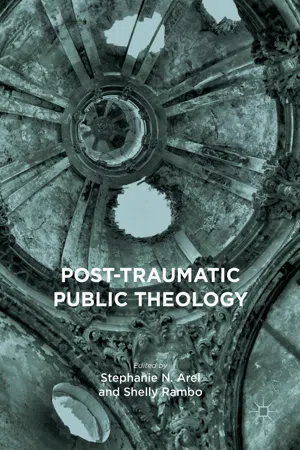
This book imagines new modes of religious response to trauma, moving beyond simple answers to the 'why' of human suffering toward discussions of profound expressions of faith in the aftermath of trauma. Engaging current realities such as war, race, and climate change, chapters feature specific locations from which theology is done and draw on the resources of Christian faith in order to respond. This volume recognizes religious leaders as first-responders to trauma and offers theological reflections that can stand up in the current realities of violence and its aftermath. The writings provide models for how to integrate the language of faith with the literature of trauma.
eBook - ePub
Post-Traumatic Public Theology
- English
- ePUB (mobile friendly)
- Available on iOS & Android
eBook - ePub
Post-Traumatic Public Theology
About this book
Information
Topic
Theology & ReligionSubtopic
Christian Theology© The Author(s) 2016
Stephanie N. Arel and Shelly Rambo (eds.)Post-Traumatic Public Theology10.1007/978-3-319-40660-2_11. Introduction
Shelly Rambo1
(1)
Boston University School of Theology, Boston, USA
In the immediate aftermath of the Boston marathon bombings, representative religious leaders across the city gather in an interfaith service to mark the tragedy. They offer carefully crafted words of comfort and guidance, as they situate the traumatic event and subsequent suffering within their traditions. They draw from the imagery of their sacred texts and reach for the promises and visions of their traditions: God heals the brokenhearted. Light will shine in the darkness. We are not alone. God is in our midst. The marathon events are placed within a wider story of God’s relationship to the world. Some appeal to God’s control and sovereign hand over history, while others point to the works of mercy extended in the midst of the horror, turning our eyes to the “Good Samaritans” and to the power and resiliency of the human spirit. 1 Many point to the counter-logic of faith traditions as the source of healing. The words offered are tokens of the theologies operative in the aftermath, the attempts to make meaning out of the chaos.
In nearby hospitals, chaplains gather in units to provide spiritual care. Disaster teams mobilize. The vicinity is locked down and armored vehicles move in. The two prominent local mosques receive a media barrage of camera and calls, as the religious identities of the suspects are revealed. The mosque in Cambridge comes under particular scrutiny, as leaders are now labeled “radical” and “anti-Western.” Teachers at nearby Latin Rindge High School recall images of Dzhokhar Tsarnaev in their classrooms, as they try to reconcile the teen they knew with the named perpetrator. Talk of the death penalty is quick to follow Tsarnaev’s imprisonment. What can render justice to such events, and what are the limits of justice? The quick links between immigration, citizenship, religious identity, and terrorism are made—the tremors of 9/11 can be felt. The soaring eagles of the MLK Jr. Statue in the background, the Boston University community gathers on Marsh Plaza in honor of Lu Lingzi, a Chinese student killed in the bombings; the cities of Shenyang and Boston are linked. The term “Boston Strong” emerges as makeshift memorials spring up, marking a space of mourning and reverence for the loss of life. Narratives begin to form about Boston’s resiliency after the blast.
This snapshot account of the aftermath of trauma reveals the multi-layered dimensions of tragedies like the one in Boston. Although the scene is particular to Boston, the dynamics of the aftermath and the search for meaning are shared across contexts. In her opening to the interfaith service three days after the bombing, Rev. Liz Walker notes that while the questions of evil and suffering are perennial, the events that spark our inquiry come “far too often these days.” 2 Traumatic events seem more like an epidemic of culture, a norm rather than an exception. While great wisdom traditions provide long histories of inquiry, particular situations shape the questions. In our current context, the inquiries are shaped by the discourse of trauma. David Morris writes: “Over the past four decades, post-traumatic stress disorder has permeated every corner of our culture.” 3 The frequency of the events is also coupled with a growing awareness that trauma can often blur the lines between one event ending and another beginning. Increasingly, when these events happen, the question of whether it was religiously motivated has also become a mark of our times, a product of the terrorist attacks on September 11, 2001. With the rise of religious fundamentalisms, religion is often not thought of as a source of healing but, instead, as a source of great harm.
This collection invites readers into the broader work of what we are calling post-traumatic public theology. As religions offer frameworks of meaning for living in the world, theologians continually examine those frameworks with the aim of bringing them to life in the present moment. Questions about the meaning of suffering surface. But the landscapes in which these questions arise present new challenges for religious traditions and call for new configurations of faith in the aftermath. The landscapes call for the theological work of unearthing the organic resources for healing and for identifying the points at which the logic of religious claims can be mobilized as tools for healing and harm.
This volume argues that the work of theology offers something distinctive in the aftermath. The essays in this collection map this post-traumatic religious territory. The theologian diagnoses the contemporary moment, interpreting “the present-day world and its pressing concerns.” 4 But theology is also a meaning-making enterprise, a constructive and visionary endeavor. Exploring the inner life of peace-builders who work in intractable situations of conflict, Marc Gopin describes them as living in two worlds. 5 The first is the world of enmity, hatred, impasses, and division. We could call this the world as it is. The other is what Gopin calls the “special world,” in which people reach across divisions and imagine the world otherwise. The special world is not separate from the first, but, rather, located within it. Gopin is interested in how persons are able to envision otherwise—how they develop this capacity when others are not able to see beyond the violence.
Here, we position the work of theology as a two worlds practice. It is the work of transfiguring the world—working between the as is and the otherwise. The visions and practices of religious traditions can assist us in this transfiguration, offering not simply the counter-logic, but the counter-movements to bring about peace: movements of compassion and justice, of resistance and resilience. What are the spiritual muscles needed to live according to the counter-logics referenced in the interfaith service? The authors in this collection operate between these worlds. They share commitments to justice and to cultural analysis as part of the work of theology. But they also unearth the resources within religious traditions to address the suffering of our times. Eyes wide open to the suffering, they propose multi-sensory engagements for transfiguring it.
Post-Traumatic
Trauma is the suffering that remains. 6 This simple definition speaks to the problem of integration that lies at the heart of traumatic experience. While definitions of trauma differ, one common denominator is the notion that traumatic experiences overwhelm human processes of adaptation. Because of the force of violence, symptoms emerge that reflect an inability to integrate that occurrence in the aftermath. The challenge of healing, then, is to incorporate that experience into a framework of meaning—to make sense of it, in the full-orbed meaning of sense. As intrusive memories and sensory triggers represent the difficulties of orienting oneself to life, the vision of integration is one of befriending the world again, of restoring trust and connections, and of finding avenues by which that experience can be placed in the fuller arena of one’s life. Thus, the post-traumatic is the challenging territory of this work of integration.
The study of trauma is a little over a century old, with its origins in the neurological studies conducted by Jean-Martin Charcot and Sigmund Freud at the turn of the twentieth century. 7 Now a century later, the phenomenon of trauma has traveled off the psychoanalytic couch and extended into an interdisciplinary study of the effects of violence. Since the insertion of post-traumatic stress disorder (PTSD) in the Diagnostic and Statistical Manual of Mental Disorders (DSM-3) in 1980, the phenomenon of “overwhelming” experience has become a way of identifying the violent effects of living in the aftermath of violence. Cathy Caruth refers to this traumatic aftermath as the “enigma of suffering.” 8 Something distinctive about traumatic response and reception emerges long after the traumatic event occurs, confounding notions of time, experience, and language. Trauma shatters interpretive frameworks. For the psychologist, historian, philosopher, and theologian interpreting experience and existence, trauma presents serious challenges to assumptions at the heart of these disciplines. If theology is a meaning-making enterprise, how does the shattering of meaning in trauma impact religious claims about lived existence?
Much of the theorizing about trauma emerged within the context of post-Holocaust studies, and analysis was often accompanied by vocabulary such as catastrophe, impossibility, ineffable, and rupture. Defined largely in terms of precipitating large-scale events, trauma was framed in terms of negations, and the emphasis was on the sheer inaccessibility of the traumatic event. As the term “trauma” became increasingly part of our working societal vocabulary, the limitations of the definition began to emerge as well. Trauma was generally marked by an event and its aftermath. But questions arose about whether situations of ongoing violence are considered traumatic. Because definitions of trauma were also generated from within a western European context, questions about whether the term translated across cultures also emerged. Along with these challenges, the symptomology of individual trauma accounted for in psychoanalysis, became recognizable outside of the psychological sphere and extended into an interdisciplinary study of suffering.
As the field of trauma studies continues to expand, the post-traumatic brings several key emphases to the “age-old” inquiries of religion. First, the post-traumatic points to a deepened awareness of the fragility of the human. There is an increased sense of the vulnerability of human persons to violence. One of the enigmatic aspects of trauma is the way in which the effects of violence transmit between human persons. Studies of the children of Holocaust survivors show that children can manifest symptoms of their parent’s experience, even when the parent has not verbally communicated that experience to them. This intergenerational transmission of a traumatic experience exceeds explanation. It also suggests a kind of traumatic interdependence. We carry not simply the experiences that are unique to us but also the experiences of others. Judith Butler examines this phenomenon in her exploration of extreme suffering; she uses the term “precarity” to describe the constitution of persons as interdependent in how we bear suffering. She writes: “Loss and vulnerability seem to follow from our being socially constituted bodies, attached to others, at risk of losing those attachments, exposed to others, at risk of violence by virtue of that exposure.” 9 Trauma studies confront us with the notion that we are constituted by the pain of others. This language of vulnerability also extends to the fragility of the earth and the planetary, as the realities of climate change and energy resourcing provide images of our wounded environment. We can speak about violence done to the earth and the consequences of exploiting resources differently when placing trauma within a broader picture of human and planetary interdependence. 10
Robert Eaglestone notes that trauma theory draws our attention to “both our terrible strength and our utter weakness.” 11 Who are we that we can wound and be so wounded? As John Thatamanil notes, each of the religions provides an analysis of the human predicament. Each outlines the human condition, posing the questions of suffering and harm and generating a path to healing. 12 In the Christian tradition, analysis of suffering is often quickly linked to the discourse of sin, guilt, and fault. Wendy Farley notes in The Wounding and Healing of Desire, “Classical theology and reform liturgy justifies rather than encounters suffering. Before suffering can speak or cry out, it has been steamrolled by an aggressive theology of sin and guilt.” 13 She contends with the alignment of sin with suffering that is so central to the Western Christian tradition; to unhinge sin from suffering is not a rejection of Christianity but, in fact, an expression of certain strains of the Christian tradition that have often been relegated to the margins. The contemplative aspects of both the Christian and Buddhist traditions approach suffering as inherent in human life. Farley’s theological work demonstrates how the practice of theologizing can yield a different view of the human—one that asserts the beauty and fragility of creaturely life.
Second, the post-traumatic signals a deepened awareness of the limits of human cognition and language to account for experience. Studies in trauma display a rupture in a person’s ability to access memories of traumatic experience—essentially to bring experience to language, the story experience. While much emphasis had been placed on “recovering the story” of trauma, studies in trauma reveal the degree to which experiences could not be captured in language. The emerging attention to the somatic dimensions of trauma emphasizes the limits of language and points to rituals and expressions of healing that target the body. Bessel van der Kolk, a forerunner in pointing to the neurobiological studies of trauma and their implications for treatment, recognizes the body as storing past trauma. Studies of the brain signal that traumatic experiences are processed differently than others, bypassing cognitive processes and lodging in the limbic system. The effect of this is that trauma cannot be accessed primarily through recovering the story of what happened, because trauma is not processed via the frontal lobe, the linguistic part of our brain. Eaglestone comments: “we have to feel our way around, find out the shape of things.” 14 This move beyond the primacy of language in trauma studies has opened up to a study of affects, what is often referred to as affect theory. 15 The focus on affects allows theorists ...
Table of contents
- Cover
- Frontmatter
- 1. Introduction
- 2. War Bodies: Remembering Bodies in a Time of War
- 3. Trauma, Reality, and Eucharist
- 4. Running the Gauntlet of Humiliation: Disablement in/as Trauma
- 5. The Trauma of Racism and the Distorted White Imagination
- 6. “Serving the Spirit of Goodness”: Spiritual and Theological Responses to Affliction in the Writings of St. John of the Cross and Louise Erdrich
- 7. Elegy for a Lost World
- 8. The Virtual Body of Christ and the Embrace of those Traumatized by Cancer
- 9. Examining Restorative Justice: Theology, Traumatic Narratives, and Affective Responsibility
- 10. 9/11 Changed Things: The (Post-Traumatic) Religious Studies Classroom
- 11. “La Mano Zurda with a Heart in Its Palm”: Mystical Activism as a Response to the Trauma of Immigration Detention
- 12. Taking Matter Seriously: Material Theopoetics in the Aftermath of Communal Violence
- 13. Traumas of Belonging: Imagined Communities of Nation, Religion, and Gender in Modernity
- Backmatter
Trusted by 375,005 students
Access to over 1.5 million titles for a fair monthly price.
Study more efficiently using our study tools.
Frequently asked questions
Yes, you can cancel anytime from the Subscription tab in your account settings on the Perlego website. Your subscription will stay active until the end of your current billing period. Learn how to cancel your subscription
No, books cannot be downloaded as external files, such as PDFs, for use outside of Perlego. However, you can download books within the Perlego app for offline reading on mobile or tablet. Learn how to download books offline
Perlego offers two plans: Essential and Complete
- Essential is ideal for learners and professionals who enjoy exploring a wide range of subjects. Access the Essential Library with 800,000+ trusted titles and best-sellers across business, personal growth, and the humanities. Includes unlimited reading time and Standard Read Aloud voice.
- Complete: Perfect for advanced learners and researchers needing full, unrestricted access. Unlock 1.5M+ books across hundreds of subjects, including academic and specialized titles. The Complete Plan also includes advanced features like Premium Read Aloud and Research Assistant.
We are an online textbook subscription service, where you can get access to an entire online library for less than the price of a single book per month. With over 1.5 million books across 990+ topics, we’ve got you covered! Learn about our mission
Look out for the read-aloud symbol on your next book to see if you can listen to it. The read-aloud tool reads text aloud for you, highlighting the text as it is being read. You can pause it, speed it up and slow it down. Learn more about Read Aloud
Yes! You can use the Perlego app on both iOS and Android devices to read anytime, anywhere — even offline. Perfect for commutes or when you’re on the go.
Please note we cannot support devices running on iOS 13 and Android 7 or earlier. Learn more about using the app
Please note we cannot support devices running on iOS 13 and Android 7 or earlier. Learn more about using the app
Yes, you can access Post-Traumatic Public Theology by Stephanie N. Arel, Shelly Rambo, Stephanie N. Arel,Shelly Rambo in PDF and/or ePUB format, as well as other popular books in Theology & Religion & Christian Theology. We have over 1.5 million books available in our catalogue for you to explore.