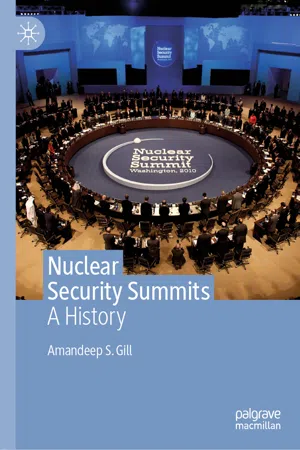
This book describes the four Nuclear Security Summits held over 2010-2016 at the initiative of U.S. President Barack Obama. The author draws upon his unique vantage point as a participant in the Summits, exclusive interviews with practitioners, and access to primary documents, to write an engaging history of the NSS and of nuclear security in general. The story of the NSS is also in part the story of multilateral nuclear forums, which have sprung up regularly since the dawn of the nuclear age to address perceived nuclear dangers. The success of these Summits in addressing the threat of nuclear terrorism holds important lessons for the design and work of nuclear forums today and into the future. The author presents a new approach to assessing 'international learning' that has important implications for the design of multilateral forums and updates the Cold War areas of nuclear knowledge being 'learnt' in the light of the NSS experience and other recent developments. This work willbe of interest to scholars and practitioners in security studies, nuclear history, and International Relations.
- English
- ePUB (mobile friendly)
- Available on iOS & Android
eBook - ePub
About this book
Information
© The Author(s) 2020
A. S. GillNuclear Security Summitshttps://doi.org/10.1007/978-3-030-28038-3_11. Introduction
Amandeep S. Gill1
(1)
Graduate Institute of International and Development Studies, Geneva, Switzerland
How did an obscure technical issue become the subject of the biggest gathering of leaders in the United States since the 1945 San Francisco meeting on the Charter of the United Nations? This book answers that question and tells the story of the idea of nuclear security and of the four Nuclear Security Summits held over 2010–2016 at the initiative of U.S. President Barack Obama. The NSS—as the Summits got to be known within the community of nuclear experts—were the latest in a series of multilateral forums, which have sprung up since the nuclear age began in 1945 to address nuclear dangers. The success of these Summits in addressing the threat of nuclear terrorism holds important lessons for the design and work of nuclear forums today and into the future.
Fears about nuclear terrorism focus primarily on three threats. First, the fabrication by terrorists of an Improvised Nuclear Device (IND) using High-enriched Uranium (HEU) present, for instance, as fuel in research reactors around the world. 1 Even an elementary gun-type Uranium device with a low yield could have catastrophic consequences in an urban area. Second, the use of highly radioactive spent fuel or a high activity radiological source such as Caesium 137 in a Radiological Dispersal Device (RDD) to cause contamination and mayhem in the centre of a city or in a busy port. Finally, the sabotage of a nuclear facility such as a nuclear reactor or a fuel storage pond through malicious physical or cyber action to cause damage to people, property and the environment. In addition to the death and destruction caused by a nuclear security breach, the ripple effects of nuclear terrorism on world trade, economic growth and on public confidence in the peaceful uses of nuclear energy could be considerable.
The atomic bomb that was tested in the New Mexico desert on 16 July 1945 and that later flattened Nagasaki on 10 August used an orange-sized piece of Plutonium at its core. A lens of conventional explosives compressed the Plutonium core till it turned critical. The explosive power of this design—called ‘Fat Boy’—was equivalent to around 21 kilotons of TNT. 2 The ‘Little Boy’ design that was deployed in Hiroshima on 6 August used Uranium enriched in the isotope U-235 to achieve an explosive power of about 13 kilotons of TNT. Its simple gun-type construction in which a ‘bullet’ of U-235 was shot into a block of U-235 to achieve a critical mass meant that it did not even have to be tested.
The Hiroshima bomb killed perhaps 75,000 people instantly by blast and fire and 200,000 within 5 years by the effects of ionising radiation. A similar gun-type U-235 device smuggled into the port area of New York City aboard a cargo container could kill 62,000 through blast, burn and direct radiation; radiation from the fallout could kill another 200,000 people. 3
Manufacturing Plutonium by separating it from spent nuclear fuel or enriching Uranium using centrifuges requires an industrial scale effort possible only for states or state-backed terror groups. Even though the post-Soviet Union scare about ‘loose nukes’ and fissile material in the hands of smugglers and impoverished scientists remains so far only an outlandish thought, stealing or diverting radioactive material from civilian facilities and rigging it with conventional explosives in a ‘dirty bomb’ would not be an impossible feat for a determined group of terrorists. A cask of spent fuel rods stolen from a nuclear reactor and dispersed in Manhattan at midday could cause more than 2000 immediate and long-term deaths and billions of dollars in property damage. 4 Physically attacking a nuclear facility or cyber-hacking the control room of a modern reactor is also not out of the realm of the possible. As the example of the Fukushima accident shows, the impact on human lives of a runaway reactor near an urban conglomeration could be devastating even without direct casualties. 5
The International Atomic Energy Agency (IAEA), the world’s nuclear ‘watchdog’ in common parlance, defines nuclear security as the “prevention and detection of, and response to, theft, sabotage, unauthorised access, illegal transfer or other malicious acts involving nuclear material, other radioactive substances or their associated facilities.” 6 Nuclear security is thus different from nuclear non-proliferation, which aims at preventing the spread of nuclear weapons and related materials and technologies, as well as nuclear arms control and disarmament, which aim at reducing and eventually eliminating nuclear weapons and related facilities and delivery systems. It is obvious that even when nuclear proliferation by States has been successfully stemmed and complete nuclear disarmament achieved, nuclear and radiological material would continue to be used around the world for the foreseeable future. 7 The risk therefore of such material and associated facilities becoming a tool of terror in the hands of non-state actors with demonstrated intent for inflicting mass casualties such as Al Qaeda or the Islamic State would remain. Preserving and strengthening nuclear security is thus an enduring mission.
1.1 The Origins of Nuclear Security
These fears were hardly felt during the first two decades and a half of the nuclear age. The idea of nuclear security gradually precipitated out of the broader area of nuclear command and control and non-proliferation over three distinct phases. These phases were preceded by a period in the 1960s when concerns about accidental detonations, sabotage or unauthorised use by a rogue commander first made their appearance; the Cuban missile crisis in particular sharpened focus on nuclear command and control.
In the first phase (1972–1977), nuclear security was synonymous with physical protection of nuclear material and facilities. In the IAEA, a semi-formal set of recommendations for physical protection of nuclear material were formulated by a group of experts in 1972. In the U.S., the Energy Reorganisation Act of 1974 split the Atomic Energy Commission into two entities and the new Nuclear Regulatory Commission (NRC) began to focus exclusively on regulatory requirements for safety and for safeguarding materials and facilities against theft, loss, diversion, sabotage and criminal intrusion. Acts of international terrorism such as the 1972 Munich Olympics attacks and speculation in books such as John McPhee’s The Curve of Binding Energy about improvised nuclear explosive devices helped consolidate the idea in the policy sphere. Policy learning began to be reflected in IAEA guidance and resolutions as well as guidelines for nuclear suppliers. The U.S. led the way and it was an American suggestion of 1974 that led to a two-year negotiation over 1977–1979 in the IAEA on a draft Convention on the Physical Protection of Nuclear Facilities, Materials and Transports.
However, it took the collapse of the Soviet Union for nuclear security to emerge out of the narrow confines of physical protection and capture publicly the attention of leaders. A policy initiative in the U.S. Congress (the Nunn-Lugar Act) propelled practical engagement between Moscow and Washington on enhancement of nuclear safety and security measures, which then spiralled up into a multilateral forum at the Moscow Summit on Nuclear Safety and Security in April 1996. The next big leap in knowledge construction took place after the 9/11 attacks in 2001 and the revelations about the A Q Khan proliferation network in 2002. The policy fields of international terrorism and counter-proliferation extended into the existing field of policy measures on physical protection and illicit trafficking; and nuclear security emerged as a distinct area of nuclear policy. New legal instruments such as the UN Security Council Resolution 1540, the 2005 International Convention on the Suppression of Acts of Nuclear Terrorism and the 2005 amendments to the 1980 Convention on the Physical Protection of Nuclear Material (CPPNM) filled the normative gaps exposed by these developments. Practice too adjusted; for one, the community of practitioners became more diverse as the field expanded. Moreov...
Table of contents
- Cover
- Front Matter
- 1. Introduction
- 2. A History of the Idea of Nuclear Security: 1945–2006
- 3. The 2010 Nuclear Security Summit at Washington
- 4. The 2012 Nuclear Security Summit at Seoul
- 5. The 2014 Nuclear Security Summit at The Hague
- 6. Coming Full Circle: The 2016 Washington Summit
- 7. Conclusion: The NSS as a Learning Forum
- Back Matter
Trusted by 375,005 students
Access to over 1.5 million titles for a fair monthly price.
Study more efficiently using our study tools.
Frequently asked questions
Yes, you can cancel anytime from the Subscription tab in your account settings on the Perlego website. Your subscription will stay active until the end of your current billing period. Learn how to cancel your subscription
No, books cannot be downloaded as external files, such as PDFs, for use outside of Perlego. However, you can download books within the Perlego app for offline reading on mobile or tablet. Learn how to download books offline
Perlego offers two plans: Essential and Complete
- Essential is ideal for learners and professionals who enjoy exploring a wide range of subjects. Access the Essential Library with 800,000+ trusted titles and best-sellers across business, personal growth, and the humanities. Includes unlimited reading time and Standard Read Aloud voice.
- Complete: Perfect for advanced learners and researchers needing full, unrestricted access. Unlock 1.5M+ books across hundreds of subjects, including academic and specialized titles. The Complete Plan also includes advanced features like Premium Read Aloud and Research Assistant.
We are an online textbook subscription service, where you can get access to an entire online library for less than the price of a single book per month. With over 1.5 million books across 990+ topics, we’ve got you covered! Learn about our mission
Look out for the read-aloud symbol on your next book to see if you can listen to it. The read-aloud tool reads text aloud for you, highlighting the text as it is being read. You can pause it, speed it up and slow it down. Learn more about Read Aloud
Yes! You can use the Perlego app on both iOS and Android devices to read anytime, anywhere — even offline. Perfect for commutes or when you’re on the go.
Please note we cannot support devices running on iOS 13 and Android 7 or earlier. Learn more about using the app
Please note we cannot support devices running on iOS 13 and Android 7 or earlier. Learn more about using the app
Yes, you can access Nuclear Security Summits by Amandeep S. Gill in PDF and/or ePUB format, as well as other popular books in Politics & International Relations & Diplomacy & Treaties. We have over 1.5 million books available in our catalogue for you to explore.