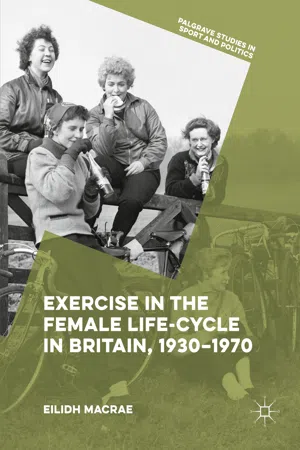
This book examines how adolescence, menstruation and pregnancy were experienced or 'managed' by active women in Britain between 1930 and 1970, and how their athletic life-styles interacted with their working lives, marriage and motherhood. It explores the gendered barriers which have influenced women's sporting experiences. Women's lives have always been shaped by the socially and physically constructed life-cycle, and this is all the more apparent when we look at female exercise. Even self-proclaimed 'sporty' women have had to negotiate obstacles at various stages of their lives to try and maintain their athletic identity. So how did women overcome these obstacles to gain access to exercise in a time when the sportswoman was not an image society was wholly comfortable with? Oral history testimony and extensive archival research show how the physically and socially constructed female life-cycle shaped women's experiences of exercise and sport throughout these decades.
- English
- ePUB (mobile friendly)
- Available on iOS & Android
eBook - ePub
Exercise in the Female Life-Cycle in Britain, 1930-1970
About this book
Information
© The Author(s) 2016
Eilidh MacraeExercise in the Female Life-Cycle in Britain, 1930-1970Palgrave Studies in Sport and Politicshttps://doi.org/10.1057/978-1-137-58319-2_11. Introduction
Eilidh Macrae1
(1)
University of the West of Scotland, Hamilton, UK
Betty was born in Glasgow, Scotland, in 1932 and had a very active early life during which she enjoyed cycling, swimming, badminton, and tennis. She recalled the ways in which her involvement in these activities was enhanced or curtailed by various factors throughout her life, such as her social circle; the connections she had in her community; her access to local facilities; and the stage of the life-cycle that she was going through:
Muriel, born in Paisley, Scotland, in 1937, also remembered her physical activity altering as she went through life, particularly during her years of marriage and motherhood:I also learned to swim because [my school] had its own pool and that’s where I learned to swim. And em, so therefore myself and a group of friends, we went swimming sort of ye know, once a week over at the Baths. Em, so really it was school, high school that started me off ye know, sort of thing. Um and then em, well, when I left school eh and I went to the City Assessors, they had a badminton club and em I joined the badminton club and eh played, oh a lot of badminton! Once again I got into the team and they were in a league, so as well as your ordinary club night you were here, there, and everywhere playing the other clubs that were in your league, eh, so as I say I was out at badminton, ye know, a lot. Um, took up tennis, we used to joke and say we played tennis in the summer and badminton in the winter. We cycled every Sunday too. It needed to be really bad weather for us not to go, we went even if it was raining ye know, and eh it was always, we went to the coast, ye know we’d go to Troon, we would go to West Kilbride, we would go to Ayr, we would go, we did all the sorta coastal places, ye know. And it was eh, it was great eh, it was great fun. When we got to wherever we decided we were going we, em, we didn’t just rest at that, the first thing you did was you undressed and went in for a swim in the sea! (laugh) And then you had yer ‘eats’, you, we took our own eats with us, ye know, that’s what we used to say, that was the only thing that kept us going, knowing that like after we’d done the cycling and after we’d done the swimming, ye know, we can get our food now! Ye know (laughing) Gosh it was great … And then what happened was eh, ye know, couple of the boys met up with some girl, ye know, and they were ‘a couple’ sort of idea, so they weren’t doing the cycling on a Sunday they were away with their girlfriends, sorta thing, ye know? So, as I say, it petered out, but it was because people were pairing off with other people and that kind of thing, ye know … And, well, once I was married, there was a gap of doing things.1
Margaret, B., an interviewee born in 1948 in Huddersfield, England, similarly saw her own physical recreation come to a halt in her early twenties:But I don’t remember actually being very, being able to be very active, after [I started work] because … then of course I got married in ’61 … so that’s, and then once the kids came along it … the opportunities were just not there to join clubs and be sociable at that. I didn’t find it. Cause they [the children] were all quite close together.2
The life stories of the interviewees who contributed to this research reveal the complex ways in which women interacted with exercise and sport throughout their lives in the twentieth century.I can remember being able to play out, without really, with very little supervision. So I can remember, probably, several hours playing out, adventure in fields, in gardens, edges of rivers (laugh) this sort of thing, unsupervised play, and returning home for the next meal. There was no sort of, um, danger about playing out unsupervised and going beyond the garden, that was okay. Um, primary school, physical education I can remember regular activities and that was things like country dancing, gymnastics, rounders, games outside, eh, athletics, and I can remember really enjoying that sort of activity. … Just a local primary school on the outskirts of Huddersfield, a brand-new school actually, that primary school was a brand-new build, so that would be in the 1950s, eh, so it was well-equipped. […] I did join a hockey club, in Lancashire, and I did go for county trials in Yorkshire and I was selected to play for Yorkshire at county level. I only made it through one season and I thought I can’t do this seven days a week without any other, anything else going. And, much to my father’s disappointment, I gave up the hockey completely … [I was] 22. […] By then I’d met my future husband and if I’d been doing all physical education [teaching] and all hockey I wouldn’t have been able to see him.3
Gendered social and medical discourses framed women’s experiences of exercise at each stage of the socially and physically guided female life-cycle between 1930 and 1970. When we look at exercise experiences in Britain from the perspective of the female life-cycle it is clear to see that there were barriers toward female participation at every stage. Educational and public exercise facilities were often largely unsuited to the physical and practical needs of women and girls who wished to make exercise part of their lives. Young adolescent girls—coping with physiological changes and the practicalities of managing their bodies in their early years of menstruation—were seldom practically accommodated within British schools, making exercise participation an uncomfortable experience. Many adult women found that they had to have crucial workplace connections, disposable income, a network of sporty friends, and childcare support if they hoped to make physical recreation part of their lives as wives and mothers. But despite these practical restrictions on female exercise, there was certainly space for individuals to direct their personal choice and determination to overcome barriers within these discursive and practical frameworks. As will be shown throughout the following chapters, ideas of the naturally ‘fragile female body,’ unsuited to vigorous exercise, did not match the strong, competitive sporting selves which many of the female interviewees in this study projected through their interview narratives.
Fashions, Femininities, and Fitness
Skillen has argued that the emergence of the ‘modern woman’ or ‘flapper’ girl in the inter-war years—and the changing fashions and ideals which accompanied the arrival of this ‘modern woman’—had a substantial impact on the way in which women’s sport and exercise was able to develop.4 Flappers popularised new fashions which showed more of the female body than earlier clothing styles, with shorter hemlines and material which draped to reveal the female body and the way it moved.5 These modern fashions encouraged a fresh ideal female body shape—a slim, ‘boyish’ figure—which in turn meant that many women wished to sculpt their bodies and their lives to fit with this particular femininity ideal of the young, fun, and active girl. It has been argued that through the rise of this new modern ‘beauty culture’ and the work of female-friendly fitness groups such as the Women’s League of Health and Beauty (WLHB) and the Keep Fit Movement, a ‘modern definition of femininity’ was established in the 1930s which married the terms health and beauty and championed the slender physique: this had major repercussions for women’s exercise.6 For decades medical professionals had looked on women’s bodies primarily as reproductive vessels, and a woman’s role—or future role—as a mother took precedence over all other life aspirations she might have had. Matthews argues that this ‘uterine tradition’, where women were viewed principally for the reproductive contribution they could make to the race, was gradually being broken down by the 1930s.7 She suggests that beauty-culture trends helped to promote and legitimate the idea that modern women had a right to take pride in and take care of their health and beauty for themselves personally, and not just so that they were fit enough to bear children.
Similarly, Zweiniger-Bargielowska’s research into the mass phenomenon of female fitness, which was witnessed in England in the 1930s and headed by the Keep Fit and WLHB classes, has shown that the ideal woman of this decade was a ‘modern, emancipated race mother’.8 Zweiniger-Bargielowska has argued that the ideal 1930s woman was physically healthy and certainly fit to bear healthy children, but also in control of her own fertility and not simply a ‘breeding machine’.9 Simultaneous with the rise of beauty culture and its accompanying ideology was a growing official awareness of the nation’s general lack of physical fitness. This culminated in a 1937 fitness campaign which was implemented throughout England, Wales, and Scotland and geared to both men and women.10 The campaign was based around the Physical Recreation and Training Act of 1937 and was an attempt to awaken the nation’s moral obligation to keep fit. Fitness propaganda was developed by the newly established National Fitness Councils of England and Scotland and distributed throughout the country in the form of posters, leaflets, and short films.11 With these developments it appeared that access to and experiences of sport for all British people would be enhanced over the coming years. However, the Second World War halted the fitness campaigns and, crucially, reduced the steady flow of grant funding which was supposed to help improve the poor standards of British fitness through the development of local and national sports facilities. The 1930s aspirations of government officials to inspire and financially support the path to a fitter and healthier Britain were obstructed over the following years by war, modified national priorities, and increasingly complex post-war social relations. As will be shown in Chap. 5, it wasn’t until the 1960s and 1970s that there was any evidence of real state interest in and support for sport and physical activity in Britain. In the early 1970s the British ‘Sport for All’ campaign was launched in an effort to reach those groups of people whose lives were still untouched by sport. Women, and particularly mothers with children, were outlined as one of the target groups of this campaign.12 This book will track sport and physical activity experiences between 1930—when this modern, healthy femininity ideal was apparently developing—and 1970, in order to investigate some of the reasons why women were still identified as one of the ‘target groups of non-participants’ at the 1972 launch of ‘Sport for All’.13
The reference to ‘Sport for All’ is perhaps misleading, as the word sport conjures images of team games and competitive sport which are not necessarily the primary focus of this research, and certainly were not the key focus of the 1970s campaign which urged British citizens to take up physical recreation more generally. The terms physical recreation, sport, leisure, and exercise will all be used throughout the following chapters as we look into women’s general exercise experiences and the ways women interacted with physical activity throughout their lives. As we look at the many and varied ways women were able to access exercise, certainly some of these experiences did involve organised sport, but other experiences had to be more informal to allow these women access. For example, some women spoke of having to shift the regular swimming club schedule of their youth to an occasional swim with their young children once they became mothers; but they still found a way to access physical activity. Many of the exercise experiences could not be categorised...
Table of contents
- Cover
- Front Matter
- 1. Introduction
- 2. Physical Education Experiences
- 3. Experiencing Exercise as a Young Woman
- 4. Pregnancy, Menstruation, and Active Women
- 5. Exercise During Marriage and Motherhood
- 6. Conclusion
- Back Matter
Trusted by 375,005 students
Access to over 1.5 million titles for a fair monthly price.
Study more efficiently using our study tools.
Frequently asked questions
Yes, you can cancel anytime from the Subscription tab in your account settings on the Perlego website. Your subscription will stay active until the end of your current billing period. Learn how to cancel your subscription
No, books cannot be downloaded as external files, such as PDFs, for use outside of Perlego. However, you can download books within the Perlego app for offline reading on mobile or tablet. Learn how to download books offline
Perlego offers two plans: Essential and Complete
- Essential is ideal for learners and professionals who enjoy exploring a wide range of subjects. Access the Essential Library with 800,000+ trusted titles and best-sellers across business, personal growth, and the humanities. Includes unlimited reading time and Standard Read Aloud voice.
- Complete: Perfect for advanced learners and researchers needing full, unrestricted access. Unlock 1.5M+ books across hundreds of subjects, including academic and specialized titles. The Complete Plan also includes advanced features like Premium Read Aloud and Research Assistant.
We are an online textbook subscription service, where you can get access to an entire online library for less than the price of a single book per month. With over 1.5 million books across 990+ topics, we’ve got you covered! Learn about our mission
Look out for the read-aloud symbol on your next book to see if you can listen to it. The read-aloud tool reads text aloud for you, highlighting the text as it is being read. You can pause it, speed it up and slow it down. Learn more about Read Aloud
Yes! You can use the Perlego app on both iOS and Android devices to read anytime, anywhere — even offline. Perfect for commutes or when you’re on the go.
Please note we cannot support devices running on iOS 13 and Android 7 or earlier. Learn more about using the app
Please note we cannot support devices running on iOS 13 and Android 7 or earlier. Learn more about using the app
Yes, you can access Exercise in the Female Life-Cycle in Britain, 1930-1970 by Eilidh Macrae in PDF and/or ePUB format, as well as other popular books in History & British History. We have over 1.5 million books available in our catalogue for you to explore.