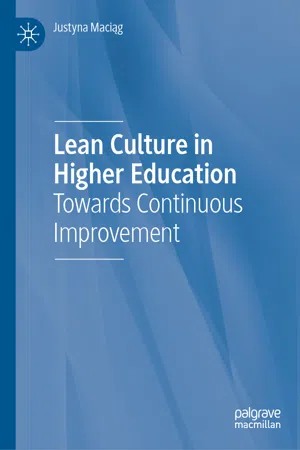
This book deepens the understanding of cultural conditions for implementing organizational and process changes in higher education institutions. Developing the humanistic and critical trend in Lean management research, it aims to define the notion and maturity of a Lean culture in higher education institutions as well as to determine its key dimensions and descriptions in the light of adopted ontological and epistemological assumptions. This book defines the notion of Lean Culture, proposes a model to assess its maturity, determines conditions for its implementation, and presents the tools of the Lean management model in a university. It supplements the issues related to the implementation of the Lean concept by adopting a humanistic approach.
- English
- ePUB (mobile friendly)
- Available on iOS & Android
eBook - ePub
About this book
Information
© The Author(s) 2019
Justyna MaciągLean Culture in Higher Educationhttps://doi.org/10.1007/978-3-030-05686-5_11. Research on Lean Culture in Higher Education—A Theoretical Framework
Justyna Maciąg1
(1)
Institute of Public Affairs, Jagiellonian University, Kraków, Poland
1.1 Reasons for Undertaking Research on Lean Culture in Higher Education
The contemporary university is an organisation full of tensions (Geppert and Hollinshead 2017), “suspended” between tradition and modernity (Leja 2013; Kwiek 2015; Antonowicz 2015; Sułkowski 2016). Some researchers are of the opinion that in the globalising economic, cultural, and social environment, the mission of the university as an institution dedicated to the education of the nation for the purpose of strengthening the state is being exhausted (Kwiek 2001). The severance of the strong connections between knowledge and power causes a change in the nature of knowledge and the process of its creation, accumulation, and transfer. Knowledge becomes the subject of commercialisation, a mainly private product/service provided based on competitive conditions and in the quasi market conditions. The market viewpoint manifests itself through the shared conviction of the adequacy of the concepts of New Public Management (NPM) and the enterprising university for the understanding of the nature of the contemporary university and the manner of its management. Universities implement process management concepts coming from manufacturing enterprises (Maciąg 2016). It is assumed that these two concepts will be as effective in universities as they are in business organisations, despite the fundamentally different character of the former. However, it may be problematic to maintain the continuity and permanence of introduced changes. This may result from the fact that universities often implement pseudo-changes in order to appear more attractive to stakeholders (Alvesson 2013). Their lethargy, inertia, and focus on self-recreation are explained by compulsive isomorphism (Santana et al. 2010), conflicts of values (Lenartowicz 2016), strong organisational identities (Sułkowski 2016) or traditional organisational culture (Balzer 2010; Emiliani 2015).
An analysis of the literature on the subject indicates that universities turn away from process approaches popular at the end of the twentieth century such as Total Quality Management (TQM) or Business Process Reengineering (BPR), opting for the concept of Lean Management in the belief that its implementation would contribute also to changes in organisational culture . In order to stress the specificity of the Lean Management concept in higher education researchers use such terms as Lean Higher Education (Balzer 2010), Educational Lean for Higher Education (Waterbury 2011), Lean University (Emiliani 2015).
There are more and more publications on Lean Management in higher education. Conducted research indicates that Lean Management generates positive effects in the organisational and technical system, but there are doubts about the permanence of such results (Radnor and Bucci 2011; Balzer 2010; Emiliani 2015; Antony 2014; Hines and Lethbridge 2008; Yorkstone 2016; Francis et al. 2017; Balzer et al. 2016). Resistance and a lack of continuity of introduced changes are explained by too little attention being paid to the development of an organisational culture of Lean Management —a Lean Culture (LC) (Francis et al. 2017).
An analysis of the literature of the subject shows that the issue of cultural conditions for implementing Lean Management in higher education has not been discussed sufficiently enough. There is a lack of definitions, theoretical models, concepts, methodologies of building a Lean Culture and assessing its maturity as a higher education organisational culture . Furthermore, in the functionalist paradigm used currently to assess the effects of cultural changes, which is based on superficial “production-oriented” measures, it is impossible to understand fully the essence and maturity of the university for the implementation of Lean Management . The objectivist approach causes researchers to study organisational culture from the outside, similarly to how representatives of natural sciences do this (Jo Hatch and Schultz 1997). Therefore many authors propose broadening the research perspective based on the functionalist approach with a humanistic approach based on the interpretative-symbolic paradigm (Jo Hatch and Schultz 1997; Kostera 2003; Alvesson 2009; Czarniawska 2010; Sułkowski 2012; Zawadzki 2014; Weick 2016). In such an approach, Lean Culture is defined as an epistemological metaphor of an organisation (Kostera 2003). It is considered at the level of people’s relationships and personal experiences (Sikorski 2009, p. 13). Sharing this opinion, the author decided that adopting this ontological approach would allow her to acquire a deeper understanding of the sense of implementing Lean Management in higher education.
The main reasons for writing this book were the author’s need to discover in what way the concept of Lean Management chan...
Table of contents
- Cover
- Front Matter
- 1. Research on Lean Culture in Higher Education—A Theoretical Framework
- 2. Lean Management as a Concept of Management in Higher Education
- 3. Lean Culture in Higher Education—A Model Approach
- 4. Maturity of Lean Culture in Higher Education—Research, Assessment, and Improvement
- 5. Summary, Conclusions, and Directions of Further Research on Lean Culture in Higher Education
- Back Matter
Trusted by 375,005 students
Access to over 1.5 million titles for a fair monthly price.
Study more efficiently using our study tools.
Frequently asked questions
Yes, you can cancel anytime from the Subscription tab in your account settings on the Perlego website. Your subscription will stay active until the end of your current billing period. Learn how to cancel your subscription
No, books cannot be downloaded as external files, such as PDFs, for use outside of Perlego. However, you can download books within the Perlego app for offline reading on mobile or tablet. Learn how to download books offline
Perlego offers two plans: Essential and Complete
- Essential is ideal for learners and professionals who enjoy exploring a wide range of subjects. Access the Essential Library with 800,000+ trusted titles and best-sellers across business, personal growth, and the humanities. Includes unlimited reading time and Standard Read Aloud voice.
- Complete: Perfect for advanced learners and researchers needing full, unrestricted access. Unlock 1.5M+ books across hundreds of subjects, including academic and specialized titles. The Complete Plan also includes advanced features like Premium Read Aloud and Research Assistant.
We are an online textbook subscription service, where you can get access to an entire online library for less than the price of a single book per month. With over 1.5 million books across 990+ topics, we’ve got you covered! Learn about our mission
Look out for the read-aloud symbol on your next book to see if you can listen to it. The read-aloud tool reads text aloud for you, highlighting the text as it is being read. You can pause it, speed it up and slow it down. Learn more about Read Aloud
Yes! You can use the Perlego app on both iOS and Android devices to read anytime, anywhere — even offline. Perfect for commutes or when you’re on the go.
Please note we cannot support devices running on iOS 13 and Android 7 or earlier. Learn more about using the app
Please note we cannot support devices running on iOS 13 and Android 7 or earlier. Learn more about using the app
Yes, you can access Lean Culture in Higher Education by Justyna Maciąg in PDF and/or ePUB format, as well as other popular books in Business & Business Strategy. We have over 1.5 million books available in our catalogue for you to explore.