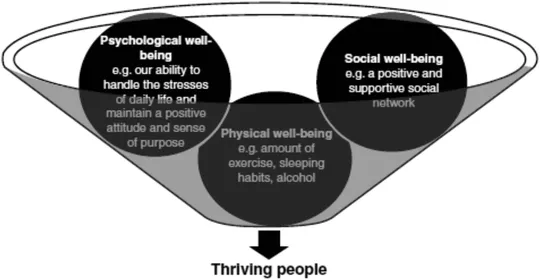
Work can make you sick—and work can make you happy. Which one happens depends on who you are, what you do and how you are treated at work. Work that is rewarding, involving good relationships with colleagues and opportunities to feel a sense of achievement on a regular basis is a key factor in psychological well-being (PWB) . Good PWB , as we shall see later in this chapter, is linked to good physical heath. Dull and monotonous work, difficult relationships with others and work that is impossibly demanding ‘or lacks meaning’ damages resilience , PWB and physical health. Later chapters will explain how PWB can be damaged or enhanced by work and will also cover the key workplace factors that influence PWB. This chapter sets the scene for what follows by explaining why PWB at work matters and how it is linked to overall sickness and health .
Overall, well-being includes three main parts: physical, social and PWB (Fig.
1.1). This book focuses on psychological (mental) well-being in particular. That does not mean that the other forms of well-being are less important than PWB.
In the workplace however, when industrial accidents and dangerous working conditions are set to one side, PWB is most important—and (apart from accidents, etc.) work has more direct impact on PWB, rather than the physical or social aspects of well-being.
At the most basic level, PWB is quite similar to other terms that refer to positive mental states , such as happiness or satisfaction, and in many ways it is not necessary, or helpful, in a book like this to worry about fine distinctions between such terms. If I say that I’m happy, or very satisfied with my life you can be pretty sure that my PWB is quite high! It is important though to explain that some other popular terms such as “job satisfaction ” or “motivation” are not the same as PWB. Job satisfaction is about how satisfied someone feels with their current job; this is certainly a factor in PWB but, for example, it is perfectly possible for someone to be satisfied with their specific job but be very unhappy about relationships with some colleagues, or the quality of management and supervision that they receive. The same goes for motivation . I could be very energized by a work task and work very hard at it because I feel it’s important and I don’t want to let people down, but the workload involved and lack of resources available could make me frustrated and unhappy. Although we will look more closely at the specific meaning of PWB later in this chapter, for the moment we can say that good PWB is more or less the same as being happy at work. Later in this chapter we will also look at the specific evidence showing how PWB at work has an impact on physical health, job performance and things such as career success. To place the role of work in context we begin by reviewing how PWB is associated with overall success in life, with physical illness and other related factors.
PWB Is Linked to Success and Health
Research studies have shown that higher levels of PWB are linked to higher levels of income, more successful marriages and friendships and better health and, as we shall see later, better work performance. Of course, talking of a link between PWB and success in life immediately raises an important question—which comes first? In other words, does success come before higher levels of PWB, bringing the (obvious) outcome of increased happiness, or might it be that higher levels of PWB actually lead to successful outcomes? In fact, it seems quite likely that both of these effects happen. It is self-evident that doing well at something that matters to us brings psychological benefits, including increased PWB but it does also seem to be the case that people who develop higher levels of PWB are better equipped to deal with life and are more likely to make a success of things. What is the evidence for this?
Some research on this topic involves looking at happiness scores for a group of people and also looking at how these people fare on the types of life factors that have been mentioned above—marriage, friendships, income and so on. In practice there are quite a lot of studies of this kind (referred to as “cross-sectional” studies) and they generally produce the same conclusion: that greater happiness is associated with better results on the life factors. For example, studies have shown that in three primary life domains (work, relationships and health) people higher on PWB come out better (Lyubomirsky et al. 2005) . As well as these primary life domains the cross-sectional research also shows that PWB is linked to many other characteristics that are seen by our culture and society as desirable, such as positive views of self and others, popularity with other people, coping with distress and better immune system functioning.
Although this type of research shows overwhelming support for the link between PWB and life success, it cannot tell us for certain whether PWB leads to success or vice versa. Longitudinal studies are needed to answer this question properly. In longitudinal studies data on PWB are collected at one point in time and then at a later point data on the life factors are collected. These types of studies make it more possible to draw conclusions about cause and effect. Such studies are especially powerful if the effect of the starting position on the life factors is also taken into account. For example, if two groups who are similar in terms of immune system functioning at the beginning, but with different levels of PWB, are compared over time. Sonja Lyubomirsky and her colleagues, Laura King and Ed Diener , looked at all of the longitudinal studies that they could find. Broadly, although the evidence was less extensive, they found the same conclusions as the cross-sectional studies. They found that “Study after study shows that happiness precedes important outcomes and indicators of thriving, including fulfilling and productive work, satisfying relationships and superior mental and physical health and longevity” (Lyubomirsky et al. 2005, p. 834). More recent research has confirmed their findings. Yoichi Chida and Andrew Steptoe (2008) looked at 35 separate longitudinal studies examining the relationship between PWB and mortality . They found that positive PWB had a protective effect . Overall, the research that they examined showed that positive well-being was associated with reduced mortality rates for healthy people and reduced mortality for patients with specific illnesses, such as immune system viruses and kidney failure. They concluded that “… positive PWB has a favourable effect on survival in both healthy and diseased populations” (Chida and Steptoe 2008, p. 741) . Data from the English Longitudinal Study of Ageing also reveals well-being is linked to longer survival (Steptoe et al. 2015). The study found just under thirty percent of people in the lowest well-being quartile died in the follow up period of 8.5 years, compared to just over nine percent of people in the highest well-being quartile. A two way relationship between well-being and health was also reported, with poor health leading to poorer well-being, and high levels of well-being helping to reduce physical health impairments. The direction of the relationship between happiness and poor health was also reported on the following year by Liu et al. (2016). They proposed that poor health can cause unhappiness and poor health is linked to mortality but they did not find a direct link between unhappiness and other measures of PWB and mortality. This study only looked at middle aged women though and so may not be generalizable despite a very large sample of over 700,000 women. Research investigating the links between well-being, health, mortality and other life outcomes continues but it is clear well-being has an important role to play in our lives.
Actually, PWB has two important facets that are reported on in studies on well-being such as Steptoe et al’s ageing research described above. The first of these refers to the extent to which people experience positive emotions and feelings of happiness. Sometimes this aspect of PWB is referred to as subjective well-being (Diener 2000) . Subjective well-being is a necessary part of overall PWB but on its own it is not enough. To see why this is so, imagine being somewhere that you really enjoy, perhaps sitting on a yacht in the sunshine, with your favorite food and drink and some good company—or alone if that’s how you’d prefer it! For most people that would be very enjoyable for a week or two but imagine doing it not just for a week but forever! There are very few people who would find that prospect enjoyable. The old saying may be true, you can have too much of a good thing. What this example brings home is that to really feel good we need to experience purpose and meaning, in addition to positive emotions . So, the two important ingredients i...