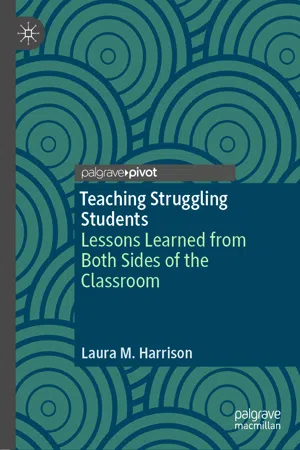
eBook - ePub
Teaching Struggling Students
Lessons Learned from Both Sides of the Classroom
- English
- ePUB (mobile friendly)
- Available on iOS & Android
eBook - ePub
About this book
This book tackles the phenomenon of limited learning on campuses by approaching it from the point of view of the author, an educator who writes about the experience of being, simultaneously, a college student and a college professor. The author lays out her experience as a student struggling in an introductory linguistics class, framing her struggles as sites ripe for autoethnographic interrogation. Throughout the book, the author melds her personal narratives with the extant research on college student learning, college readiness, and the interconnectedness of affect, intellect, and socio-cultural contexts. This book poses a challenge to the current binary metanarrative that circles the college student learning conundrum, which highlights either the faculty or student perspective, and unfolds this unnecessary binary into a rich, nuanced, and polyvocal set of perspectives.
Information
Topic
EducationSubtopic
Educational Psychology© The Author(s) 2019
Laura M. HarrisonTeaching Struggling Studentshttps://doi.org/10.1007/978-3-030-13012-1_11. Introduction
Abstract
This chapter provides an overview of the book’s themes and organization. I introduce my experience as a struggling student and contextualize it in the current discourse on limited learning in higher education. I highlight key literature on the student learning crisis and situate my analysis in this scholarship. I identify the audience for my current work, namely college educators who care about struggling students, but find it difficult to reach them. I argue that researchers have successfully studied student struggle in the big picture, but miss insights that can only be discovered by delving deeply into the details of the student experience. I offer this book as an attempt to fill the gap in our collective understanding of student struggle.
Keywords
Student experienceLimited learningAcademic struggleCollege teachingHigher educationWe’re in a strange moment in higher education. Both scholarly and popular press books on higher education’s failings proliferate. There are countless commissions by professional organizations and governmental agencies about what is variously called the student learning crisis, undervaluing of college teaching , and misplaced priorities in higher education. Whether the shortcomings are real or perceived, anxiety about what goes on in college classrooms seems to be at an all-time high.
It is against this backdrop that I became an undergraduate student in January, 2017. I did not set out to study the student experience. My goal was to earn certification to teach English as a Foreign Language (TEFL) in order to be of greater service to international and/or immigrant students. Trump’s recent election inspired me to reflect on ways I could be a better ally to those most threatened by his ethnocentric policies. I decided I would capitalize on my teaching skills in response to the general feeling that we all need to “do something” to combat the xenophobia heightened by the last election.
In both my research and experience working with international students, language challenges emerged as one of the biggest roadblocks to their success (Su & Harrison, 2016). Having moved from the San Francisco Bay Area to Southeastern Ohio, I found myself missing the cultural diversity that comes from living in a major metropolitan area. I gravitated toward our international students, whose research interests and lived experiences began informing my own scholarship in new ways. I was already becoming interested in language learning as the result of helping students to write dissertations in their non-native language. My goal was to gain the formal knowledge I needed to be of greater service to both my university’s EFL learners and to set myself up to teach abroad if the opportunity arose.
I achieved this goal to some extent. I did earn the certificate, which I proudly framed and hung in my office. I learned some things that have made me a better teacher to EFL learners now that I can identify patterns and troubleshoot challenges more effectively. I made some meaningful connections and now have three EFL conversation partners with whom I meet regularly.
The process of achieving this goal afforded some surprise learning that I hope will be useful to readers. While I did not intend to study the experience I had as a student, it became evident to me fairly early on that this could be potentially insightful material. While other faculty have gone undercover to study the student experience (for example, Nathan [2006] in My Freshman Year), I signed up for my Linguistics classes purely to learn the material. I had no intent to use these classes for research purposes , which allowed me to gain a more authentic student experience since I was there as a student, not as a researcher.
I didn’t just gain an authentic student experience, I gained an authentic struggling student experience. By struggling, I don’t mean I got an A- on one assignment because I was too busy with important professorial work to do my homework perfectly. By struggling, I mean I got a 67% on my first Linguistics test. I was tempted to tell a story about blowing off the test, but the truth is that the 67% was what I earned with my full intellectual effort. I didn’t tell my wife (also an academic) about the 67% for two weeks. After I had decided to write about this experience, I shared the 67% grade with a colleague whose jaw dropped a little in response. I thought about students, both mine and the ones I’ve read about struggling with imposter phenomenon . I understood their experience more fully after this one grade than in all the reading, thinking, and speaking I’ve done on the topic. Second-hand knowledge, no matter how good, only gets you so far. Talking about struggling students means a lot more now that I actually became one.
Purpose
Scholars, pundits, politicians, employers, and other leaders have been raising concerns about what Arum and Roksa (2011) termed the limited learning taking place on college campuses. There is little consensus as to the cause of this lack of learning. Some scholars emphasize the faculty side of the issue by focusing on factors like inadequate training to teach (Robinson & Hope, 2013) and/or institutional undervaluing of teaching as opposed to research and grant writing (Boyer, Moser, Ream, & Braxton, 2015). Other researchers focus on student side of the issue, highlighting the role college readiness (DeAngelo & Franke, 2016), inequities in the K-12 school system (Darling-Hammond, 2015), and/or millennial students’ short attention spans (Mokhtari, Delello, & Reichard, 2015) play in the phenomenon of limited learning on college campuses.
It is likely that all of the aforementioned factors (and more) contribute to this phenomenon of limited learning on today’s college campuses. I caution against overstating the problem; deep and meaningful learning frequently occurs in university settings. I detailed many examples of successful higher education initiatives in my second book, Alternative Solutions to Higher Education’s Challenges: An Appreciative Approach to Reform (Harrison & Mather, 2015). More personally as a professor who has taught more than 50 classes at 3 institutions, I’ve had many occasions to witness my students’ growth over the semesters we’ve spent together.
Hence, I do believe the student learning crisis is sometimes overstated and yet, I also know that many faculty and students struggle for some of the reasons surfaced in the aforementioned scholarship. Issues like limited training in teaching and college student readiness are daunting. The research is helpful in naming the problems, but the “recommendations for practice” sections of these articles tend to leave readers feeling overwhelmed. If, for example, I have to wait for the inequities in the K-12 system to be ironed out before my students arrive on campus “college ready,” I’m unsure of what I can do in the meantime. So the scholarship is useful in diagnosing some of the issues, but offers little in terms of what we can actually do right now to reach the students sitting in front of us this semester.
The other body of literature which addresses the experience of college teaching is of the inspirational flavor. Parker Palmer (2017) is the most famous of these authors, offering wisdom and motivation based on his experience as a teacher. I find his work very useful for articulating the value of teaching as well as the ideal attitude from which to approach education. Like the more empirical scholarship on teaching , however, this literature views teaching from the 30,000 feet up perspective without much guidance about what to do in the here and now. Also, this work tends to promote student-centeredness ; yet, it is written largely from the perspective of teachers.
This issue of perspective is another limit in the current scholarship on teaching . While some authors focus on students and others focus on faculty , few dig deeply into the dynamic interplay between the two. The likely reason is that there are not many opportunities to view the issue from this angle because people are rarely faculty and students at the same time. Here is where I believe that this book makes a unique contribution to our collective desire for more insight into what it would take to truly teach struggling students more effectively.
Audience
One of the more bizarre aspects of academic life is that so much of it happens behind closed doors. I’ve had the same colleagues for many years, but I’ve only seen a couple of them teach. Although observation and feedback have been shown to improve teaching , faculty are sometimes reticent to access these resources due to self consciousness. The fact that faculty receive little to no pedagogical training is likely a cause of this anxiety. The consequence is a vicious cycle where it’s difficult to engage in continuous self-improvement. This is particularly true in the current climate where professors face constant criticism, resulting in an understandable level of defensiveness.
Part of what I hope to offer an audience is a path toward improving their teaching practice from the position of an ally. I reject the characterization of professors as cold, uncaring people who kick up their feet once they achieve tenure. Yet, I also know that many faculty struggle with teaching . Teaching is such a complex enterprise that it might be more accurate to say all faculty struggle with some aspect of teaching . My goal is to offer the reader some insight into how the student experience might inform potential strategies for responding to teaching challenges.
I’ve written three books prior to this one and have to confess that I did not think of the audience as much as I probably should have. With this book, I imagined the audience frequently in the writing process. I imagined people who teach well, who care about their students and are contentious in developing meaningful educational experiences for them. I imagined people who loved school themselves, which is often a powerful motivator for pursuing an academic career. I imagined people who had a hard time understanding why a student would disengage from class, turn in substandard work, or otherwise fail to achieve course objectives. In short, I imagined an audience very much like who I was before I experienced life as a struggling student.
Gloria Steinem asserted that we teach what we need to learn; I would extend that to we write what we need to read. Like most faculty , I was good at teaching good students. These were people I could understand because they were like me as a student. They participated in class and completed assignments correctly. On the rare occasion that they were confused, they aske...
Table of contents
- Cover
- Front Matter
- 1. Introduction
- 2. Privilege as a Blind Spot to Understanding Struggle
- 3. What Struggle Feels Like
- 4. Success Through Connection
- 5. Floundering Online
- 6. Making College Better
- Back Matter
Trusted by 375,005 students
Access to over 1.5 million titles for a fair monthly price.
Study more efficiently using our study tools.
Frequently asked questions
Yes, you can cancel anytime from the Subscription tab in your account settings on the Perlego website. Your subscription will stay active until the end of your current billing period. Learn how to cancel your subscription
No, books cannot be downloaded as external files, such as PDFs, for use outside of Perlego. However, you can download books within the Perlego app for offline reading on mobile or tablet. Learn how to download books offline
Perlego offers two plans: Essential and Complete
- Essential is ideal for learners and professionals who enjoy exploring a wide range of subjects. Access the Essential Library with 800,000+ trusted titles and best-sellers across business, personal growth, and the humanities. Includes unlimited reading time and Standard Read Aloud voice.
- Complete: Perfect for advanced learners and researchers needing full, unrestricted access. Unlock 1.5M+ books across hundreds of subjects, including academic and specialized titles. The Complete Plan also includes advanced features like Premium Read Aloud and Research Assistant.
We are an online textbook subscription service, where you can get access to an entire online library for less than the price of a single book per month. With over 1.5 million books across 990+ topics, we’ve got you covered! Learn about our mission
Look out for the read-aloud symbol on your next book to see if you can listen to it. The read-aloud tool reads text aloud for you, highlighting the text as it is being read. You can pause it, speed it up and slow it down. Learn more about Read Aloud
Yes! You can use the Perlego app on both iOS and Android devices to read anytime, anywhere — even offline. Perfect for commutes or when you’re on the go.
Please note we cannot support devices running on iOS 13 and Android 7 or earlier. Learn more about using the app
Please note we cannot support devices running on iOS 13 and Android 7 or earlier. Learn more about using the app
Yes, you can access Teaching Struggling Students by Laura M. Harrison in PDF and/or ePUB format, as well as other popular books in Education & Educational Psychology. We have over 1.5 million books available in our catalogue for you to explore.