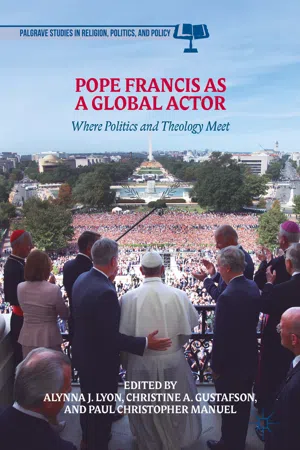
Pope Francis confuses many observers because his papacy does not fit neatly into any pre-established classificatory schemes. To gain a deeper appreciation of Francis's complicated papacy, this volume proposes that an interdisciplinary approach, fusing concepts derived from moral theology and the social sciences, may properly situate Pope Francis as a global political entrepreneur. The chapters in this volume ask what difference it makes that he is the first pope from Latin America, how and why different countries in the world respond to him, how his understanding of scripture informs his ideas on economic, social, and environmental policy, and where politics meets theology under Francis. In the end, this volume seeks to provide a more robust understanding of the enigmatic papacy of Francis.
eBook - ePub
Pope Francis as a Global Actor
Where Politics and Theology Meet
- English
- ePUB (mobile friendly)
- Available on iOS & Android
eBook - ePub
Pope Francis as a Global Actor
Where Politics and Theology Meet
About this book
Information
Topic
Theology & ReligionSubtopic
Comparative Politics© The Author(s) 2018
Alynna J. Lyon, Christine A. Gustafson and Paul Christopher Manuel (eds.)Pope Francis as a Global ActorPalgrave Studies in Religion, Politics, and Policyhttps://doi.org/10.1007/978-3-319-71377-9_11. Eluding Established Categories: Toward an Understanding of Pope Francis
Alynna J. Lyon1 , Christine A. Gustafson2 and Paul Christopher Manuel3
(1)
University of New Hampshire, Durham, NH, USA
(2)
Saint Anselm College, Manchester, NH, USA
(3)
American University, Washington, DC, USA
Alynna J. Lyon (Corresponding author)
Christine A. Gustafson
Paul Christopher Manuel
Pope Francis scrambles our categories. In a very short time, he has managed to change the way many view the role of the church, and perhaps even the role of religion in politics. The 266th pope is distinct from other popes in several regards. He is the first Jesuit pope, the first from the Global South , the first from the South American continent, the first to “tweet,” as well as the first non-European pope in 1200 years. In 2013, he received accolades from popular culture and was named Time magazine’s “Person of The Year.”1 He is also the first to take “Francis” as his papal name, invoking Saint Francis of Assisi. In harmony with that fifteenth-century Italian saint, we can clearly see an emphasis on both the poor and the natural world under Pope Francis. Indeed, the motto he chose for his pontificate, Miserando atque eligendo, may be translated into English as “by having mercy, by choosing him,” or perhaps “lowly but chosen.”2 This papal motto, which invokes the mercy Jesus showed toward sinners in the New Testament , also signals a leadership style that is refreshingly humble, forgiving, and yet, optimistic and resolutely engaged with the world. He adamantly embraces the poor, defends the marginalized, attacks greed, and champions the environment. In this regard, he is unapologetically political, often chides world leaders, and frequently comments on global economic systems. He is media savvy; aware of optics, placement, and messaging; and prefers the unassuming Fiat to the iconic “Popemobile”—a very twenty-first-century pontiff.
At the same time, Francis’s papacy also retains important traditional elements: he espouses established teachings on morality, sexuality, and marriage; he is an “Italian” pope, as the son of Italian immigrants; and he lobbied against gay marriage when he was Cardinal of Buenos Aires.3 As John Allen aptly noted, “Pope Francis will try to live up to his namesake, Francis of Assisi, as a man of the poor and of peace, but that doesn’t signal any retreat from the moral and cultural positions associated with the papacies of John Paul II and Benedict XVI.”4 As such, there are both progressive and conservative elements to Pope Francis. The Argentine priest Carlos Maria Galli notes the irony, observing that “Pope Francis is popular, but he is not a populist.”5 Scrambled categories, indeed.
A Singular Global Actor
Many political science and international relations scholars tend to think about political or moral leaders in terms of preestablished left–right, or progressive–conservative categories. That is, a leader who favors traditional morality is typically placed on the right, conservative side of the political scale; by contrast, another leader open to new forms of human association would be placed on the left, progressive side of that same scale. Similarly, a leader favoring free-market capitalism would be placed on the right, conservative side, and one who prefers more state-run welfare programs on the left, progressive side. These categories tend to help social scientists make sense of the political life of a given society, but there are limits to their utility.
Pope Francis overturns the applecart of such simplistic classificatory schemes. He genuinely confuses most political observers because his papacy does not fit neatly into any such scheme. To this point, Father Carlos Maria Galli noted that “to understand Francis, you don’t need labels. You need to understand where he comes from.”6 Likewise, Emma Green observed during the Pope’s visit to the United States, “Francis does not fit neatly into American categories. To understand him and his agenda, it’s more helpful to look at America through his eyes than to look at him through an American’s eyes.”7 For instance, as noted above, Pope Francis has argued in favor of traditional marriage as well as state-run welfare programs to help the poor, policies associated with both the right and the left. Social science lacks the vocabulary required to grasp this seeming contradiction. We agree with both Galli and Green’s assessment, and we argue that social scientists must move beyond a one-dimensional, instrumental way of understanding religious leaders such as Francis—an approach that is unable to grasp his papacy. One purpose of this volume is to do just that—to broaden our understanding of Francis’s distinctive blending of theology and politics as well as his ability to authentically embrace normally dichotomous views.
While we note his ambitions, it is instead the open and humble leadership style of Pope Francis that has charmed the world. Without significant changes to church doctrine, he is engaging a variety of conversations on a global scale that in some regards were inconceivable under prior popes. This volume asks what this leadership approach might mean for politics and public policy and thus also explores the relationship between theology and politics from the perspective of Pope Francis as a global actor. Recognizing that his approach is both consistent with and distinct from his immediate predecessors, Pope Benedict XVI and John Paul II, the volume questions whether Francis has found a new way for the nonsecular to make a contribution to civic dialogue in an era when moral teachings are often isolated from society. Has Pope Francis figured out how the Catholic Church can pursue a religious mission in an unreceptive milieu and have a real impact on policy? Has he found a new way for theology and politics to meet?
Finally, these questions also lead to more general lines of inquiry about the role of the Catholic Church and the pope in the twenty-first century. Modernity includes an emphasis on the secular and may even postulate that religion is antiquated and holds little place in contemporary life, where science guides epistemology. Thus, when the church enters the public square, how does it do so, and to what effect? What are the impacts on both church and state, and what place does religion have in a contemporary political life? Can theology engage with science and provide direction for solving contemporary global challenges (e.g. environmental damage, poverty, and conflict)? Pope Francis’s leadership stands in defiance of a secular worldview, one that proclaims there is no place for religion in modernity. In fact, Francis highlights that modernity has proven to be fallible—it has problems which include significant inequalities in humans’ life chances, terrorism, and for some, a path into a moral abyss.
This volume, aptly subtitled “Where Theology Meets Politics,” proposes a new encounter between the disciplines of moral theology and the social sciences in order to properly situate the papacy of Francis. Its contributors explore the connections among Francis’s theological foundations, his personal history and experience, his public words, writings, and deeds as pope, and his potential impact on the challenges facing the public square. Doing so from a global perspective, we believe, offers greater clarity about this singular moral and political actor. Together, the chapters ask how Francis’s moral theology informs his engagement in public narratives on morality, obligation, poverty, identity, and stewardship of the natural environment. We now turn to a brief overview of some of the recent scholarship on Pope Francis.
Scholarship on Pope Francis
Prior to the Second Vatican Council (1962–1965), research about the theology or political approach of sitting pontiffs was scarce. There was a change after the council, when scholars started writing books and articles on the social and political teachings of popes, but it remains a relatively new field. In the time since his 2013 election as pope, Francis has drawn widespread interest. Works that treat Francis and his papacy tend to fall into three categories: biographical works that explore his formation, life, and experiences in Argentina; devotional hagiographical work that focuses on his religious writings and ministry; and a more scholarly body of work that analyzes...
Table of contents
- Cover
- Front Matter
- Part I. Where Politics Meets Theology Under Pope Francis
- Part II. The Global Politics of Pope Francis
- Erratum to: Sign o’ the Times: Does Francis’ Papacy Represent a New Era for Western Europe?
- Back Matter
Trusted by 375,005 students
Access to over 1.5 million titles for a fair monthly price.
Study more efficiently using our study tools.
Frequently asked questions
Yes, you can cancel anytime from the Subscription tab in your account settings on the Perlego website. Your subscription will stay active until the end of your current billing period. Learn how to cancel your subscription
No, books cannot be downloaded as external files, such as PDFs, for use outside of Perlego. However, you can download books within the Perlego app for offline reading on mobile or tablet. Learn how to download books offline
We are an online textbook subscription service, where you can get access to an entire online library for less than the price of a single book per month. With over 1.5 million books across 990+ topics, we’ve got you covered! Learn about our mission
Look out for the read-aloud symbol on your next book to see if you can listen to it. The read-aloud tool reads text aloud for you, highlighting the text as it is being read. You can pause it, speed it up and slow it down. Learn more about Read Aloud
Yes! You can use the Perlego app on both iOS and Android devices to read anytime, anywhere — even offline. Perfect for commutes or when you’re on the go.
Please note we cannot support devices running on iOS 13 and Android 7 or earlier. Learn more about using the app
Please note we cannot support devices running on iOS 13 and Android 7 or earlier. Learn more about using the app
Yes, you can access Pope Francis as a Global Actor by Alynna J. Lyon, Christine A. Gustafson, Paul Christopher Manuel, Alynna J. Lyon,Christine A. Gustafson,Paul Christopher Manuel in PDF and/or ePUB format, as well as other popular books in Theology & Religion & Comparative Politics. We have over 1.5 million books available in our catalogue for you to explore.