- English
- ePUB (mobile friendly)
- Available on iOS & Android
eBook - ePub
About this book
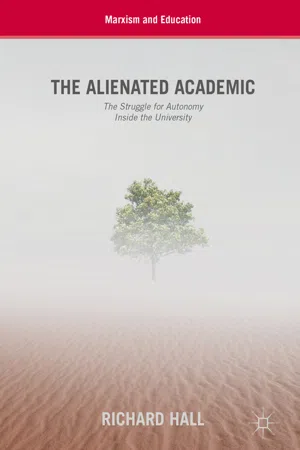
Higher education is increasingly unable to engage usefully with global emergencies, as its functions are repurposed for value. Discourses of entrepreneurship, impact and excellence, realised through competition and the market, mean that academics and students are increasingly alienated from themselves and their work. This book applies Marx's concept of alienation to the realities of academic life in the Global North, in order to explore how the idea of public education is subsumed under the law of value. In a landscape of increased commodification of higher education, the book explores the relationship between alienation and crisis, before analysing how academic knowledge, work, identity and life are themselves alienated. Finally, it argues that through indignant struggle, another world is possible, grounded in alternative forms of organising life and producing socially-useful knowledge, ultimately requiring the abolition of academic labour. This pioneering work will be of interest andvalue to all those working in the higher education sector, as well as those concerned with the rise of neoliberalism and marketization within universities.
Information
Topic
EducationSubtopic
Education Theory & Practice© The Author(s) 2018
Richard HallThe Alienated AcademicMarxism and Educationhttps://doi.org/10.1007/978-3-319-94304-6_11. Awakenings
Richard Hall1
(1)
De Montfort University, Leicester, UK
Richard Hall
1.1 Blind Love and Becoming Awakened
This is a book about estrangement and alienation in academic life; about being a stranger to the nature of your own scholarly work, to yourself and to your peers. This is a book about moving beyond the surface perception of academic work as a labour of love or privilege, in order to understand its essence inside increasingly alienating contexts. This situates academic work against Marx and Engels’ (2002, p. 13) analysis of production under capital, its real conditions and relations, as ‘constant revolutionizing’, ‘uninterrupted disturbance’, and ‘everlasting uncertainty’. The argument arises from the dissonance between: first, the global, competitive re-engineering of higher education (HE) in the name of value; and second, the personal losses associated with the compulsion to work, alongside the realisation of that work as a withering form of living death (Dinerstein and Neary 2002).
These intersections surface forms of estrangement and alienation that are witnessed, understood and felt in differential ways depending upon our personal relationship to privilege and power. However, even those moments of privilege and power melt into air through the commodification of academic lives, and the attempt to valorise the totality of our existence through exchange-value and the generation of surplus (Cederström and Fleming 2012). Material modes of analysis are crucial in enabling the lived realities of academic workers in the global economy to be described in relation to richer narratives of estrangement from the production and consumption of everyday life, and in respecting how these differentially affect individuals and groups based on race, gender, sexuality, and (dis)ability (Ahmed 2017).
In responding to these narratives, this book forms an attempt to understand the eruption of alienation inside specific spaces created by and for academic labour. The intention is to understand how alienation serves as a heuristic for refusing or pushing back against capital as a system of dispossession and oppression (Holloway 2002). Such an approach has a rich lineage, with waves of analyses of alienation being catalysed by the rediscovery of Marx’s early writings, and their application to societies affected by economic cycles of capitalist boom and bust. Thus, Nisbet (1962, pp. viii) argued that alienation is a ‘determining’ ‘cultural and psychological condition’ that reproduces social relations as ‘remote, incomprehensible, or fraudulent’, engendering hopelessness, ‘apathy, boredom, or even hostility.’
Whilst not privileging the source of alienation inside wage-labour, such analyses highlight a general state of Weltschmerz or world weariness, which gives us a starting point for uncovering how the production and circulation of alienation are immanent to processes of dispossession and oppression. As a result, through a focus on the manifestations of an alienated existence, we can attempt to reconnect the material production of our lives, in the things that we make and the ways in which we make them, to the humanity of our existence, in the ways that we relate to ourselves and others (Marx 1974). By theorising a circuit of alienation (A-A’) we can point towards a world beyond value (Jappe 2016), and towards the richness of life (Holloway 2015). This circuit begins from our simple alienation from the process of production and its products, from ourselves and our humanity (as alienation, A), and is then expanded through the addition of increments of alienation (as expanded alienation, A’). This reflects capital’s expansion through the extraction of surplus value and its accumulation as capital through valorisation, reflected in the circuits of commodities and money (C-M-C′, and M-C-M’). The circuit of expanded alienation (A-A’) is our ongoing, everyday alienation from the process of production and its products, from ourselves and our humanity (A), reproduced anew in an expanded circuit, such that A’ becomes a renewed form of A. This is a new starting point for an expanding circuit that reflects how capital continues to own our existence through narratives of productivity, excellence, impact, precarity, casualisation, status and so on. This feeds off our need to see ourselves in our work and to maintain our labour as the site of our identities, rather than enabling us to work to abolish that labour.
These forms of analysis are rooted in the modes by which individuals produce in society and how their production is socially-determined. For Marx (1993), this is the point of departure for understanding the capitalist system of production as apparently natural and ahistorical, such that no other form of social mediation can be imagined or desired (Lazzarato 2014; Lordon 2014). What is required is an analysis from below, which enables a reimagining of an escape from capital, rooted in the potential richness of life rather than the imposition of ever-greater material and ecological devastation (Burkett 2014). Following Marx and Engels (2002), moving beyond ever more extensive and destructive crises demands being awakened to the realities of our alienation.
The importance of an engagement with concepts of estrangement and alienation in the context of academic labour lies in the idea of academics becoming and staying woke. The reality of #staywoke (Taylor 2016), emerging from the renewal of organised, anti-oppressive actions and networks in the Global North, was rooted in a set of interconnected fronts-of-resistance, which open-out opportunities not only to be awakened to and vigilant about social injustices, but to refuse them. This is about more than awareness-raising, and enables us to become awakened to the need for transnational networks of solidarity, re-organisation and re-imagination (Haiven 2014), as framings for understanding systemic oppressions, such that new methods for resistance can be collectively developed (Ciccariello-Maher 2017; Davis 2016; Narayan 2017).
An engagement with awakenings or being awoken is not about attempting to co-opt or subsume the work emerging from specific networks like Black Lives Matters or Rhodes Must Fall, or that of aboriginal or identity struggles. Rather it takes Ahmed’s (2017, p. 10) point that ‘theory can do more the closer it gets to the skin’. This is the flow between the concrete and the abstract; between the lived realities of life inside the system of capital and ways of detonating that system. Possibilities emerge from an engagement with ideas of decolonising systems of oppression, in order to understand more fully the revolutionary, dialectical method of proletarian science as an overcoming of the totalising compulsion of capital (Lukács 1990). As Weldon (2006, pp. 79–80) argues, ‘marginalized viewpoints are especially valuable for seeing the limits of dominant conceptual schemes because they offer a perspective on social reality that is invisible from the perspective of the dominant group’. This is an attempt to question capital’s enforcement of the law of value as a measurement of the dignity of certain bodies, such that specific forms of being are appreciated. Those who do not fall into these valuable measurements are pushed to the margins or exiled into zones of non-being. This is why a range of narratives about being and becoming inside alienated academic labour matter.
Whilst I attempt to draw inspiration from critical race, decolonising, feminist, disability rights, queer and other praxis and movements, I am aware that these can appear to be presented in an undifferentiated way as one counter-hegemonic source of inspiration. I recognise that they have specific lineages and histories, and enable a range of contributions that extend any argument around estrangement in academic practice. Moreover, they do not represent a utopian set of solutions and as with all human practice they generate their own limitations. There is a need to develop this work through concrete examples that come from these communities and movements, to give further contextualisation, texture and specificity. However, my purpose here is to challenge my own privilege: first, by pointing towards a range of narratives that are new to me; and second, by beginning a process of listening to positions that challenge my own.
Thus, this work also forms an attempt to question whether academics are awake to their role in the reproduction of systems of alienating oppression. It questions how academic labour is insinuated in the circuits of capitalist reproduction, and whether those who labour in academia are able to imagine that another world is possible. This is amplified by the psychology of academic work, and the idea that it encompasses privilege. Tokumitsu (2014) argues that ...
Table of contents
- Cover
- Front Matter
- 1. Awakenings
- Part I. The Terrain of Academic Labour
- Part II. The Terrain of Academic Alienation
- Part III. A Terrain for Overcoming Alienation
- Back Matter
Trusted by 375,005 students
Access to over 1.5 million titles for a fair monthly price.
Study more efficiently using our study tools.
Frequently asked questions
Yes, you can cancel anytime from the Subscription tab in your account settings on the Perlego website. Your subscription will stay active until the end of your current billing period. Learn how to cancel your subscription
No, books cannot be downloaded as external files, such as PDFs, for use outside of Perlego. However, you can download books within the Perlego app for offline reading on mobile or tablet. Learn how to download books offline
We are an online textbook subscription service, where you can get access to an entire online library for less than the price of a single book per month. With over 1.5 million books across 990+ topics, we’ve got you covered! Learn about our mission
Look out for the read-aloud symbol on your next book to see if you can listen to it. The read-aloud tool reads text aloud for you, highlighting the text as it is being read. You can pause it, speed it up and slow it down. Learn more about Read Aloud
Yes! You can use the Perlego app on both iOS and Android devices to read anytime, anywhere — even offline. Perfect for commutes or when you’re on the go.
Please note we cannot support devices running on iOS 13 and Android 7 or earlier. Learn more about using the app
Please note we cannot support devices running on iOS 13 and Android 7 or earlier. Learn more about using the app
Yes, you can access The Alienated Academic by Richard Hall in PDF and/or ePUB format, as well as other popular books in Education & Education Theory & Practice. We have over 1.5 million books available in our catalogue for you to explore.