eBook - ePub
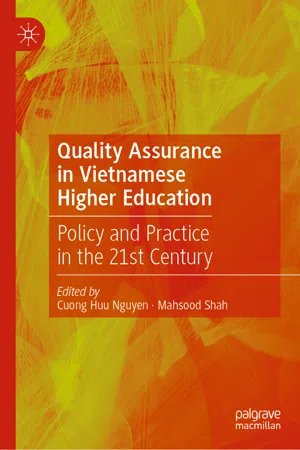
Quality Assurance in Vietnamese Higher Education
Policy and Practice in the 21st Century
- English
- ePUB (mobile friendly)
- Available on iOS & Android
eBook - ePub
Quality Assurance in Vietnamese Higher Education
Policy and Practice in the 21st Century
About this book
This book provides a comprehensive overview of quality assurance in Vietnamese higher education under the centralised management of the government after 15 years of development. By implementing quality assurance and accreditation mechanisms, the Vietnamese government expected to be able to control and improve the quality of the higher education system. The editors and contributors therefore examine and analyse policies and practices related to the establishment and development of Vietnam's quality assurance system. Amongst other things, the chapters investigate drivers of quality assurance, stakeholders engaged in quality assurance and the future of quality assurance in Vietnamese higher education in benchmarking with other quality assurance systems in the region and across the world. This book will be of interest and value to students and scholars of Vietnamese higher education, as well as quality assurance in higher education more generally, but particularly in developing nations.
Information
Topic
DidatticaSubtopic
Amministrazione nella didattica© The Author(s) 2019
C. H. Nguyen, M. Shah (eds.)Quality Assurance in Vietnamese Higher Education https://doi.org/10.1007/978-3-030-26859-6_11. Development of the Higher Education Sector in Vietnam
Kim Anh Thi Le1 , Martin Hayden2 and Thuy Thi Nhan3
(1)
Hanoi National University of Education, Hanoi, Vietnam
(2)
School of Education, Southern Cross University, Lismore, NSW, Australia
(3)
Melbourne Graduate School of Education, The University of Melbourne, Melbourne, VIC, Australia
Keywords
VietnamHigher educationUniversities academic culturePolicy challengesIntroduction
Vietnam has showed a remarkable development over the past two decades. It began with the transformation in the economy in late 1980 when the country departed from the socialist model of State centralisation to a socialist market economy. Because of sustaining a high economic growth rate over the past two decades, Vietnam has succeeded in gaining membership in the group of ‘low middle income’ economies according to World Bank classification. With continuing high economic growth rates in recent years and strong determinations in economic reforms, Vietnam is expected to achieve the status of ‘high income’ on the World Bank classification by 2035 (World Bank, 2016).
The higher education system has grown up double in size for the recent two decades. The enrolment rate was 10.6% in 1999 and was almost three times in 2013 (UNESCO, 2017). Since 2011, the growth rate has dropped because of a slowdown in the natural birth rate but remains high in recent years. In 2017, there were 446 universities and colleges all over Vietnam (Ministry of Education and Training [MOET], 2017a) with enrolments reaching a figure of 2.24 million (MOET, 2017a). The quality improvements of the sector have been reported in numerous aspects. The composition student enrolment is improved: the rate of enrolments in postgraduate education has increased steadily, and the one at colleges has decreased gradually to 14% as of 2017. The quality of academic staff members has shown significant improvements. The rate of Ph.D. holders among academic staff flatted at 10% until 2014 (MOET, 2012, 2015) and recently has improved and reached 22.7% in 2017 (MOET, 2018). Quality assurance has been implemented at both institutional and programme levels (Nguyen, Evers, & Marshall, 2017; Nguyen & Ta, 2018). Almost all universities have completed institutional self-assessment reports, and 113 higher education institutions (HEIs) have been accredited by National Accreditation Standards as of 2018 (Nguyen, Nguyen, & Banh, 2018). Significant improvements have also been reported in the quality of undergraduate training programmes. Nearly 70 high quality and collaborative with overseas universities undergraduate programmes, which have been offered since the early 2010s, at present, produced high-quality graduates (MOET, 2015, 2016a, 2017b, 2018). Continuing investments over the recent twenty years have also contributed to significant improvements in the quality of physical infrastructure. The quality of research and research education also has been facilitated by new regulations on Ph.D. graduation and awarding professoriate titles in effect since 2016 and mechanisms that encourage publication productivity by academic staff members. The number of articles published by university academics has been reported to double between 2012 and 2017 with 6400 publications produced (Scimago, 2018).
Reforming the higher education sector in Vietnam demands strong determinations and intensive reforms but at the same has always been a desperately difficult task. Vietnam aspires to have a higher education system that can produce a highly productive and globally competitive labour force in its contribution to the country’s industrialisation and building, yet many aspects still remain in need of urgent and consistent improvements.
Individual academic staff members are being seen as the primary actors in the development of the organisation—the university and its departments (see, e.g., Clark, 1987). Therefore, this chapter focuses more closely on the issues that are challenging individual works by academic staff members at public universities. The chapter starts with a brief on the development of the sector over the past two decades. The challenges that constrain the development of academic culture at the system’s organisational and departmental levels are then identified and discussed. The chapter concludes with some recommendations that might be taken into account by the sector in its future reforming efforts to forge the academic culture in Vietnamese universities.
This chapter is built on a rich source of international and local literature which concerns the development of the higher education sector in Vietnam. More recent works include Le and Hayden (2017), Le (2017), Nguyen (2016), Dao (2015), Dao and Hayden (2015), Harman, Hayden, and Pham (2010), Pham and Briller (2015), Pham and Hayden (2015), Tran et al. (2014), and Hayden and Pham (2015).
Recent Reforms
Early significant reforms in the higher education sector were initiated in the 1990s. A landmark Prime Ministerial decree (Decree No. 90/NĐ-TTg) issued in 1993 pronounced a strong determination and promulgated a process for departure from Soviet Union’s influence on higher education sector. Until this date, HEIs were small, confined to teaching functions only and provided educational programmes in narrowly specialised areas. Immediately, in 1994, two national universities in Hanoi and Ho Chi Minh City and three regional universities in Thai Nguyen, Hue and Da Nang were established by mean of merging smaller mono-disciplinary institutions. Education programmes in multidisciplinary areas were offered and followed an American model of qualification frameworks with four-year programmes for universities and three-year programmes for colleges.
A number of changes are of importance to note. This was for the first time that graduates were no longer provided with employment guarantee; students were not given scholarship; tuition fees were first introduced for all students, except those attending teacher education institutions and some HEIs were under army and security force authorities. It is also for the first time that research began to be seen as the responsibility of the university rather than the sole duty of research institutes. Another importance was that the private sector of universities and colleges was permitted to be established. Universities began to be not only own and run by the State but by various local communities. These developments have been critical in enabling the system to become ready to meet the tenfold growth in regard to the number of enrolments in the coming three decades.
The next significant reform was the approval of ‘Higher Education Reforming Agenda—HERA’ by the government in 2005 (Resolution No. 14/2005/NQ-CP dated November 2, 2005, Government, 2005) which targets various objectives by 2020. An important goal of HERA was the abandonment of line management control by various government ministries and provincial instrumentalities on the university management. HERA insisted universities to have their own governing boards. Another goal set in HERA is that Vietnam will have a group of research-oriented universities which will enrol 20% of the student population. The other main goals set in HERA were that 35% of university lecturers will hold a Ph.D. degree; 40% of university revenues will be generated from research and research applications; the ratio of academic staff members to students will be reduced; and Vietnam inspires to have one university ranked among the top 200 universities in the world. The private sector was expected to grow up to the extent that 40% of students will enrol in a private university by 2020.
The aims set in HERA are ambitious as the main figures by 2018 are well behind the targets set, as reported earlier in the chapter; however, HERA is still an important policy document and initiative given the insistence that it has placed on the future directions for Vietnam’s higher education sector.
The next reform of significant importance was the development and adoption of Higher Education Law (Law No. 8/2012/QH13 dated June 18, 2012, National Assembly, 2012). The operation of HEIs was previously regulated by separate circulars and decrees which were accommodated with ones of school education and vocational education in Education Law (2005). It is significant that Higher Education Law, for the first time, has brought together all incremental regularities, decrees and guidelines on the system under a single legal document. Higher Education Law (2012) prescribed the development of multi-tier higher education system, which consisted of research-oriented universities at the top tier, research-applied universities at the second tier and profession-oriented universities at the third tier.
The Higher Education Law (2012) and the Revised Higher Education Law (2018) continuously insisted on the development of the university autonomy. All HEIs are being placed under pressure to establish a university board (public universities) or university governing board (private universities) capable of taking responsibilities on behalf of the government instrumentalities, for example, for setting up its strategic decisions, developing regulations on institutional structure, issuing guidelines for educational programs, for staff recruitment, implementing staff development, and regulating institutional use of public funds, students’ fees, and other incomes. Strong determinations and pressures on the forming of the university board and delegating it prescribed role and responsibility are perceived to be compatible with those at developed HEIs globally.
Another important reform was the government’s approval of Resolution on ‘Fundamental and Comprehensive Education Reform to meet the needs for country’s industrialisation, modernisation in context of market economy with socialism direction and global integration (FCER)’ (Resolution No. 29/2013/NQ-TW dated November 4, 2013, Communist Party Central Committee [CPCC], 2013). FCER has placed the fostering of institutional autonomy at the centre of HEIs reform activities. The specific objectives of the higher education reform set out in FCER (2013, p. 5) included producing highly qualified human resources, cultivating talents, fostering self-learning values and capacities, fostering the capacity for self-enriching and innovation of learners, perfecting the HEIs network, profession structure, and education levels in alignment with the planning of national human resources developme...
Table of contents
- Cover
- Front Matter
- 1. Development of the Higher Education Sector in Vietnam
- 2. Internationalisation of Higher Education in Vietnam
- 3. History of Quality Assurance in Vietnamese Higher Education
- 4. Quality Assurance and Accreditation as a Mechanism for Accountability
- 5. Fifteen Years of Accreditation in Vietnam
- 6. Drivers of Vietnamese Higher Education Quality Assurance
- 7. Stakeholders’ Engagement in Quality Assurance in Vietnam
- 8. Access and Equity in Vietnamese Higher Education
- 9. Institutional and Programme Accreditation
- 10. Digital Innovation and Impact on Quality Assurance
- 11. Building National Capacity for Quality Assurance
- 12. The Future of Quality Assurance in Vietnamese Higher Education
- Back Matter
Trusted by 375,005 students
Access to over 1.5 million titles for a fair monthly price.
Study more efficiently using our study tools.
Frequently asked questions
Yes, you can cancel anytime from the Subscription tab in your account settings on the Perlego website. Your subscription will stay active until the end of your current billing period. Learn how to cancel your subscription
No, books cannot be downloaded as external files, such as PDFs, for use outside of Perlego. However, you can download books within the Perlego app for offline reading on mobile or tablet. Learn how to download books offline
Perlego offers two plans: Essential and Complete
- Essential is ideal for learners and professionals who enjoy exploring a wide range of subjects. Access the Essential Library with 800,000+ trusted titles and best-sellers across business, personal growth, and the humanities. Includes unlimited reading time and Standard Read Aloud voice.
- Complete: Perfect for advanced learners and researchers needing full, unrestricted access. Unlock 1.5M+ books across hundreds of subjects, including academic and specialized titles. The Complete Plan also includes advanced features like Premium Read Aloud and Research Assistant.
We are an online textbook subscription service, where you can get access to an entire online library for less than the price of a single book per month. With over 1.5 million books across 990+ topics, we’ve got you covered! Learn about our mission
Look out for the read-aloud symbol on your next book to see if you can listen to it. The read-aloud tool reads text aloud for you, highlighting the text as it is being read. You can pause it, speed it up and slow it down. Learn more about Read Aloud
Yes! You can use the Perlego app on both iOS and Android devices to read anytime, anywhere — even offline. Perfect for commutes or when you’re on the go.
Please note we cannot support devices running on iOS 13 and Android 7 or earlier. Learn more about using the app
Please note we cannot support devices running on iOS 13 and Android 7 or earlier. Learn more about using the app
Yes, you can access Quality Assurance in Vietnamese Higher Education by Cuong Huu Nguyen, Mahsood Shah, Cuong Huu Nguyen,Mahsood Shah in PDF and/or ePUB format, as well as other popular books in Didattica & Amministrazione nella didattica. We have over 1.5 million books available in our catalogue for you to explore.