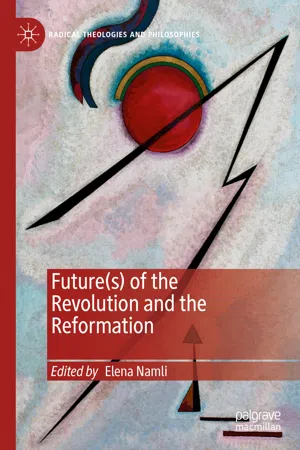
This volume brings together philosophers, social theorists, and theologians in order to investigate the relation between future(s) of the Revolution and future(s) of the Reformation. It offers reflections on concepts and interpretations of revolution and reformation that are relevant for the analysis of future-oriented political practices and political theologies of the present time.
- English
- ePUB (mobile friendly)
- Available on iOS & Android
eBook - ePub
Future(s) of the Revolution and the Reformation
About this book
Information
Topic
PhilosophySubtopic
Eastern European History© The Author(s) 2019
E. Namli (ed.)Future(s) of the Revolution and the ReformationRadical Theologies and Philosophieshttps://doi.org/10.1007/978-3-030-27304-0_2Revolution as a Political Category
The original draft of this essay was prepared for a conference on the ninetieth anniversary of the October Revolution held at the Federal University of Sao Paulo and was printed in Portuguese in Lua Nova in 2008. Further elements were prepared for the introduction to the Spanish translation of my book Modern Revolutions in 2014.
End AbstractThe key question about revolution as a political category is how far the concept itself assists or impedes our understanding of what is politically at stake and of what may be brought about by political action at particular times and places (Dunn 2008a). No one doubts that the category can be employed very vaguely or very flippantly. Enough has happened to and through the category since 1789 to ensure that, for some time to come, it will remain in active circulation over much of the world in ways that often do little to clarify what is going on in the settings to which it is applied. Others, we may be very sure, have long grossly abused it and will do their best to continue to do so for more or less clearly conceived political purposes of their own. What is altogether less clear is how we ourselves now have good reason to employ the category, and what, if anything, it equips us to understand that we could not understand, and even grasp decidedly better, through other categories of lesser epistemic ambition, which yield fewer hostages to political fortune. It is never wise to overestimate the intrinsic capacity to illuminate that is carried by political categories (democracy, state, rights, pick whichever you choose), but it remains reasonable to credit some particular political categories, at least in some settings or for some portion of their historical life span, with a considerable and inherent capacity to mystify and confuse. (Such categories do not have to be primarily political in reference: church, for example, would be a strong instance, and quite arguably, if more recently, market too.) In that sense, revolution, in the lengthy epoch when it manifestly held a potent charge of meaning, originated in trauma and exhilaration, and fanned out in ever widening ripples for a good two centuries, propelled quite largely by confusion, and spreading confusion ahead of it wherever it went. The epoch where its presence cannot readily be missed spans at least the two centuries from 1789 to 1989, and the single largest impetus behind its dispersion came, by common consent, with the downfall of the Tsarist Empire in 1917.
Distinguished historians of France’s great revolution at the outset of this epoch, in one influential case driven by the will to reverse what he saw as the damage inflicted by 1917 and to repair the indiscretions of his own youth, have sought to present the whole two centuries as, in part, a working-through of a single great illusion, now belatedly drawing to its close (Furet 1981, 1999). But no historian of either episode could readily doubt that something momentous did take place in those two societies in the periods in question, and that the term revolution, whatever else might be thought about it, properly referred to and picked out what made their subject so momentous. In those two episodes at least, the category of revolution, whatever its standing in relation to other happenings before or since, took on the status of a proper name. One can (and should) certainly ask what exactly the French or Russian revolutions were—what they consisted in—as well as why they took place, but you cannot sanely ask whether they did take place (Dunn 1972, 1990; Skocpol 1979).
Before 1789, there were two distinct traditions of political and moral inquiry that focused on the vulnerability of France’s absolutist state, the institutions that governed it, and the society that it strove to organize: what we now call the ancien régime. One was preoccupied above all by its fiscal predicament and the geo-political engagement that had amplified that predicament so drastically, and concerned above all to judge how far that predicament could be repaired by more skillful or drastic reconstruction of its legal, political, social, or economic arrangements. Since it was the faltering grip of the King’s government on this aspect of its resources and liabilities that led to the summoning of the Estates General in 1788 and that gave the Abbé Sieyès his great opportunity, it is reasonable to see it as the proximate cause for the old regime’s collapse, however, little the predicament itself was in the end modified by the revolution’s aftermath. As Michael Sonenscher has shown in his striking study Before the Deluge (2007; see also Sonenscher 1997, pp. 64–103 and pp. 267–325; Hont 2005), the political challenge to fund ever-more-expensive war across the globe had been, by 1789, identified by many of the most acute political thinkers in Europe for almost a century as the main threat to the political, economic, and social shape of Europe’s monarchies and commercial republics.
The second tradition did not focus, in the first instance, on states at all, but on a critical assessment of the truth and falsity of human belief. It was always many-layered and politically plastic. In its most radical and disabused form, its trajectory toward 1789 has recently been recounted, at great length and with unflagging gusto, by Jonathan Israel (2001, 2006, 2009, 2014) as a story of the increasingly confident diagnosis and dismissal of Europe’s entire ancien régime as a single massive structure of systematically false and superstitious belief (see Koselleck 1985, 1988, especially pp. 39–54). In 1789, for the first time in history, the two traditions merged into one, lending a measure of mass credibility to the prospect of comprehensive reconstruction of states (and even of societies and economies) to fit the demands of true and wholly unsuperstitious belief. Each tradition highlighted something that conspicuously occurred between 1789 and 1794. Neither tradition provided a wholly convincing explanation of why the revolution should have happened as it did, and each therefore left ample room in the revolution’s aftermath for the development of a comprehensive repudiation of its legitimacy or rationality, which viewed the revolution in its entirety as a single ghastly political error, or an indefensible crime against humanity. The explanatory inadequacy of each tradition, and the conspicuous difficulty of dovetailing the two, also left open an essentially opposite political conclusion, which saw the revolution not as a pre-destined working-through of its own inherent limitations, but instead, above all, as a failure in political clarity and resolution, aggravated by sheer bad luck. The retrospective picture of an ancien régime structurally vulnerable, not merely in its strategic and fiscal exposure, but also in its constitutive beliefs, flagrantly inequitable economic organization, and inane cruelties, undermined by generations of increasingly enlightened and audacious interrogation, and brought low by bold popular confrontation, vindicated the basis of that challenge, and reinforced the impetus to call the restored monarchy to account.
Both the friends and the enemies of the revolution, in retrospect, disagreed bitterly amongst themselves over the contribution of conscious political effort to jeopardizing the old order or intensifying the bitter conflict that followed its fall. The casuistry of allocating responsibility for the squalor, suffering, and brutality that suffused both revolutions ran on relentlessly for generations in their wake and is, even now, far from having run its course. Much of the history of western political thinking, for these two centuries, was driven by the voracious demands of that casuistry, which required that every state that fell within the European sphere of interest (until quite recently, most of the world aside from the Americas) should vindicate its structure and its principal informing purpose in the shadow of these two great convulsions. For about half a century, in the aftermath of the Second World War, even the United States of America, hitherto buoyantly sufficient unto itself and eager to keep Europe at a respectful distance, found itself in the unfamiliar predicament of having to do so too. The basis of that vindication could, in principle, be simple or infinitely complex, but the rhetorical and imaginative requirements of politics drastically favor simplicity over complexity and rule out any tendency to slip away into infinity. The outcome, accurately foreseen by Edmund Burke (1989) more or less from the outset, was a contextually enforced choice between two ways of seeing the revolution as a bloc, with the more intellectually attractive and politically prudent option of viewing it as an unstructured infinity of options and wholly contingent decisions all but buried for decades at a time. In familiar caricature, the politically available and pertinent choice lay (as it had lain long before each broke out) between two strongly impacted projects. The first required a stalwart defense of the ancien régime in its entirety, a comprehensive repudiation of the pretensions of human reason to transform it for the better, and a resolute commitment to its re-establishment as completely and rapidly as possible. The second demanded the systematic and comprehensive completion of the reconstruction that the revolution had launched, so that the outcome met the full demands of human reason and eliminated the ample residues of false and damaging belief that its temporary failure had left behind. The excluded middle, the entire space of detailed institutional reform or piecemeal social engineering—as Karl Popper (1960, pp. 64–70; see also 1957, vol. 2, pp. 388–389) was later to call it—naturally retained a vivid political appeal to incumbent governments, and to emerging elites who saw real opportunities to challenge such governments, wherever the latter proved more or less able, in Lenin’s phrase, to “carry on in the old way” (1947, p. 621), or found an acceptable basis on which to concede ground to their challengers.
Under the stern gaze of the committed revolutionary or counter-revolutionary, such regimes were living in the historical equivalent of a fool’s paradise, a transitory delusion that could only be resolved in one direction or the other. In their o...
Table of contents
- Cover
- Front Matter
- Introduction
- Part I
- Part II
- Back Matter
Trusted by 375,005 students
Access to over 1.5 million titles for a fair monthly price.
Study more efficiently using our study tools.
Frequently asked questions
Yes, you can cancel anytime from the Subscription tab in your account settings on the Perlego website. Your subscription will stay active until the end of your current billing period. Learn how to cancel your subscription
No, books cannot be downloaded as external files, such as PDFs, for use outside of Perlego. However, you can download books within the Perlego app for offline reading on mobile or tablet. Learn how to download books offline
Perlego offers two plans: Essential and Complete
- Essential is ideal for learners and professionals who enjoy exploring a wide range of subjects. Access the Essential Library with 800,000+ trusted titles and best-sellers across business, personal growth, and the humanities. Includes unlimited reading time and Standard Read Aloud voice.
- Complete: Perfect for advanced learners and researchers needing full, unrestricted access. Unlock 1.5M+ books across hundreds of subjects, including academic and specialized titles. The Complete Plan also includes advanced features like Premium Read Aloud and Research Assistant.
We are an online textbook subscription service, where you can get access to an entire online library for less than the price of a single book per month. With over 1.5 million books across 990+ topics, we’ve got you covered! Learn about our mission
Look out for the read-aloud symbol on your next book to see if you can listen to it. The read-aloud tool reads text aloud for you, highlighting the text as it is being read. You can pause it, speed it up and slow it down. Learn more about Read Aloud
Yes! You can use the Perlego app on both iOS and Android devices to read anytime, anywhere — even offline. Perfect for commutes or when you’re on the go.
Please note we cannot support devices running on iOS 13 and Android 7 or earlier. Learn more about using the app
Please note we cannot support devices running on iOS 13 and Android 7 or earlier. Learn more about using the app
Yes, you can access Future(s) of the Revolution and the Reformation by Elena Namli in PDF and/or ePUB format, as well as other popular books in Philosophy & Eastern European History. We have over 1.5 million books available in our catalogue for you to explore.