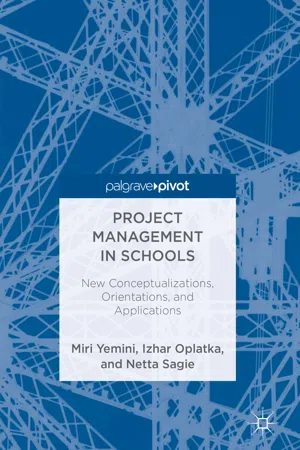
This book provides a comprehensive overview of various models and practices of implementing project management in schools, and conceptualizes the processes of adaptation and development of project management curricula within the unique context of the contemporary school environment. By presenting the general theories and research on project management and adapting these theories to educational organizations and to this specific audience, the authors open a new and promising niche for teaching, research, and practice.
eBook - ePub
Project Management in Schools
New Conceptualizations, Orientations, and Applications
- English
- ePUB (mobile friendly)
- Available on iOS & Android
eBook - ePub
Project Management in Schools
New Conceptualizations, Orientations, and Applications
About this book
Information
Topic
EducationSubtopic
Project Management© The Author(s) 2018
Miri Yemini, Izhar Oplatka and Netta SagieProject Management in Schoolshttps://doi.org/10.1007/978-3-319-78608-7_11. Implementing Project Management in Schools
Miri Yemini1 , Izhar Oplatka1 and Netta Sagie2
(1)
School of Education, Tel Aviv University, Tel Aviv, Israel
(2)
School of Education, Tel Aviv University, Ramat Gan, Israel
Abstract
The first chapter outlines the history and definitions of projects and project management from the managerial approach (Meredith & Mantel, Project management: A managerial approach, Wiley, 2011) in diverse organizations and makes the reader familiar with major concepts used in the discipline of project management. It then goes on to discuss the particular features of schools as a distinguished form of organization that is different from for-profit firms and businesses as well as from other non-profit organizations that therefore make it necessary to propose a different modeling of project management in educational institutions. The chapter concludes with the presentation of the uniqueness of project management in the education sector and particularly in schools, discussing the specificities of schools in relation to initiation and development of projects at pedagogical, organizational, ethical, political, social, and other levels. This book implicitly focuses on public schooling, but most of the implications are suitable for use in private schooling as well.
Keywords
Information technologiesProject lifecycleNon-profitInitiation1.1 The History and Uses of Project Management in Contemporary Organizations
For centuries, project management has been used to plan and implement changes in organizations and societies (Cleland & Ireland, 2006). The great pyramids of Egypt, the pronounced cathedrals of Europe, the Panama Canal, the Manhattan Project for the development and delivery of the atomic bomb, the Siberian transcontinental railroad are all examples of great projects in human history that have been set up for a wide variety of purposes and delivered through a variety of methods. Projects exist in all sectors of industry (e.g., construction, high technology, and consumer products) and in every type of organization (Lake, 1997). In fact, many organizations have always been project-driven, dealing with multiple projects simultaneously (Knutson, 2001). It is worth noting here that large-scale projects in the field of education (digitalization, construction of schools, development of curricular materials etc.) have for decades been managed implicitly using project management methodologies as well.
While most organizations have been traditionally departmentalized according to functional expertise, with specialists from design, marketing , manufacturing, and finance residing in different units (Larson, 2007), projects are no longer the exception but are the everyday reality critical to the success of many firms worldwide. By initiating and managing projects, firms are taking advantage of the latest information technologies , using human and financial resources, working according to the known constraints , dealing with uncertainty and risk to coordinate and track the efforts of professionals both within and across organizations (Larson, ibid.). Nevertheless, projects are often perceived as high-risk ventures with limited success in terms of the planned versus actual costs and time limits.
Our understanding of project management as a social construct has evolved over the years since the early 1950s, and is continuing to do so nowadays (Schwalbe, 2009). In these early phases of research on project management, it came to be seen for many years as epitomized by tools such as PERT and CPM,1 Work Breakdown Structures (WBS) , and Earned Value , managed in a strictly quantitative way, using engineering methodologies and tools. Only in recent decades, however, have researchers claimed that a more fundamental feature of project management is integration around a clear objective accepted by the project manager and their team (Morris, 2011). Such developments in the discipline of project management might have brought the momentum for deeper utilization of such methodologies in formal schooling settings. This leads us to a discussion on the meaning of the term ‘project’ and its definition in the literature.
Projects exist to sort out problems of cooperation and coordination (Soderlund, 2011), in a process of creating something new or different in the organization or society, and they have a beginning and an end (Webster, 2014). The dynamic nature of the project and its unique outcomes is reflected in the following definitions:
[A] temporary endeavor undertaken to create a unique product, service, or result. (Schwalbe, 2009, p. 4)
Other definitions emphasize effective planning and resource allocation as major characteristics of projects in modern organizations as follows:A project is a temporary endeavor involving a connected sequence of activities and a range of resources, which is designed to achieve a specific and unique outcome and which operates within time, cost and quality constraints and which is often used to introduce change. (Lake, 1997, p. 8)
[T]he allocation of resources directed toward a specific objective following a planned, organized approach. (Lientz & Rea, 1998, p. 12)
[A] combination of organizational resources pulled together to create something that did not previously exist and that will provide a performance capability in the design and execution of organizational strategies. (Cleland & Ireland, 2006, p. 26)
[A] planned undertaking that requires a set of human task and activities toward achieving a specific objective within a defined time period. (Wong, 2007, p. 18)
Notably, projects have been contrasted with the operation (routine) processes in work organizations (Lake, 1997; Schwalbe, 2009). Accordingly, operation is work performed in organizations to sustain the business, and managers of this organizational unit are chiefly concerned with stability and continuity of routine task performances. In contrast, projects end when their objectives have been reached or when the project has been terminated, and their managers aim to achieve a limited set of objectives within an agreed amount of time and a fixed budget. In this sense, project management is not the same as ordinary, day-to-day operational management. In other words, a project is about creating something new or implementing a change, whereas a process is a repeatedly performed activity.
Congruent with the major definitions of the organizational project, project management theory and practice continues to be refined toward a purpose of managing change to achieve greater efficiency with less risk and uncertainty (Cleland & Ireland, 2006). In this sense, project management ensures the stability and control required to reduce the risk factors of dealing in a rapidly changing environment (Knutson, 2001) and is responsible for applying the proper skills and competencies to achieve the project’s goals. The different definitions of project management highlight this and related aspects of organizational projects:
The application of a collection of tools and techniques to direct the use of diverse resources toward the accomplishment of a unique, complex, one time task within time, cost and quality constraints. (Lake, 1997, p. 12)
The application of knowledge, skills, tools, and techniques to project activities to meet project requirements. (Schwalbe, 2009, p. 7)
Project management involves a group of people with complementary skills and experiences who are committed as a team to work together to accomplish the goals and objectives of the project (Wong, 2007), that is, to develop and execute a work plan that will meet the expectations of stakeholders and executives. However, the team ought to be aware of the particular contexts, characteristics, and results during the project’s lifecycle . We discuss these aspects in the next section.Project management is a series of activities embodied in a process of getting things done on a project by working with project team members and other stakeholders to attain project schedule, cost, and technical performance objectives. (Cleland & Ireland, 2006, p. 51)
1.2 The Basic Vocabulary of Project Management
Projects have unique characteristics, contexts, and lifecycles that make it necessary for their managers to hold specific skills and competencies in order to bring about appropriate consequences in effective ways. We detail now some of those basic features that are necessary to begin our discussion on projects in education.
1.2.1 Characteristics
Projects are unique undertakings that result in a single unit of output (Webster, 2014). For example, a project aimed at an office building in one location is not identical to one aimed at an office building on another site, and their project managers are likely to face a different set of challenges (Lake, 1997). Yet, projects are characterized by interdependent activities with a beginning and an end that are interrelated either arbitrarily (e.g., each activity can be carried out at the same time) or consecutively (e.g., one activity must be completed before another can begin). Without these activities the outcome of the project is unlikely to be achieved. In a small project, though, these activities may be performed by the same multi-skilled individual or individuals. However, in a large project, the performance of these activities usually requires a team of people who have different types of technical skills or specialist knowledge, as well as investment in coordinating and managing efforts (Lake, 1997). The team faces the challenge of diversity and therefore the project manager has to address a multi-functional, multi-cultural, and multi-gender project environment.
Generally speaking, projects are...
Table of contents
- Cover
- Front Matter
- 1. Implementing Project Management in Schools
- 2. Project Initiation
- 3. Educational Planning and Its Unique Characteristics
- 4. Project Implementation in Schools
- 5. Project Termination
- 6. Project Monitoring, Control, and Evaluation: The Unique Aspects of Projects in Schools
- Back Matter
Trusted by 375,005 students
Access to over 1.5 million titles for a fair monthly price.
Study more efficiently using our study tools.
Frequently asked questions
Yes, you can cancel anytime from the Subscription tab in your account settings on the Perlego website. Your subscription will stay active until the end of your current billing period. Learn how to cancel your subscription
No, books cannot be downloaded as external files, such as PDFs, for use outside of Perlego. However, you can download books within the Perlego app for offline reading on mobile or tablet. Learn how to download books offline
Perlego offers two plans: Essential and Complete
- Essential is ideal for learners and professionals who enjoy exploring a wide range of subjects. Access the Essential Library with 800,000+ trusted titles and best-sellers across business, personal growth, and the humanities. Includes unlimited reading time and Standard Read Aloud voice.
- Complete: Perfect for advanced learners and researchers needing full, unrestricted access. Unlock 1.5M+ books across hundreds of subjects, including academic and specialized titles. The Complete Plan also includes advanced features like Premium Read Aloud and Research Assistant.
We are an online textbook subscription service, where you can get access to an entire online library for less than the price of a single book per month. With over 1.5 million books across 990+ topics, we’ve got you covered! Learn about our mission
Look out for the read-aloud symbol on your next book to see if you can listen to it. The read-aloud tool reads text aloud for you, highlighting the text as it is being read. You can pause it, speed it up and slow it down. Learn more about Read Aloud
Yes! You can use the Perlego app on both iOS and Android devices to read anytime, anywhere — even offline. Perfect for commutes or when you’re on the go.
Please note we cannot support devices running on iOS 13 and Android 7 or earlier. Learn more about using the app
Please note we cannot support devices running on iOS 13 and Android 7 or earlier. Learn more about using the app
Yes, you can access Project Management in Schools by Miri Yemini,Izhar Oplatka,Netta Sagie in PDF and/or ePUB format, as well as other popular books in Education & Project Management. We have over 1.5 million books available in our catalogue for you to explore.