eBook - ePub
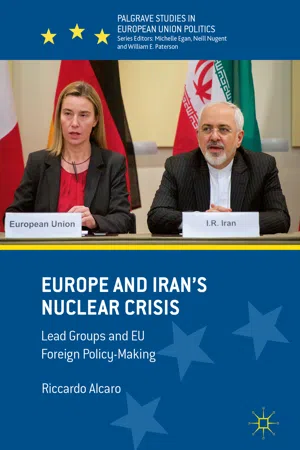
Europe and Iran’s Nuclear Crisis
Lead Groups and EU Foreign Policy-Making
- English
- ePUB (mobile friendly)
- Available on iOS & Android
eBook - ePub
About this book
This book investigates the European involvement in managing the nuclear dispute with Iran, shedding new light on EU foreign policy-making. The author focuses on the peculiar format through which the EU managed Iran's nuclear issue: a 'lead group' consisting of France, Germany and the UK and the High Representative for EU foreign policy (E3/EU). The experience of the E3/EU lends credibility to the claim that lead groups give EU foreign policy direction and substance. The E3/EU set up a negotiating framework that worked as a de-escalating tool, a catalyst for Security Council unity and a forum for crisis management. They inflicted pain on Iran by adopting a comprehensive sanctions regime, but did so only having secured US commitment to a diplomatic solution. Once the deal was reached, they defended it vigorously. The E3/EU may have been supporting actors, but their achievements were real.
Information
© The Author(s) 2018
Riccardo AlcaroEurope and Iran’s Nuclear CrisisPalgrave Studies in European Union Politicshttps://doi.org/10.1007/978-3-319-74298-4_11. Introduction: The E3/EU Iran Group
Riccardo Alcaro1
(1)
Istituto Affari Internazionali, Rome, Italy
For the best part of the 2000s and 2010s, Iran’s nuclear programme was a major source of international concern. In spite of Iran ’s insistence that it sought the capability to use atomic energy for electricity production, policy-makers and experts in America, Europe and elsewhere feared that the Islamic Republic could in fact be after the technological and industrial capacity to build nuclear weapons.
A nuclear-capable Iran was associated with a number of threats. One was that the antagonism between Iran and Israel would reach the boiling point. The Israelis feared that a nuclear Iran would diminish their military edge and jeopardise their regional monopoly over nuclear arms. Many in Israel—the government included—depicted a nuclear Iran as nothing less than an existential threat. The Sunni Arab states of the Gulf Cooperation Council (GCC), especially Saudi Arabia, were concerned that, sheltered by a nuclear deterrent, the Islamic Republic would pursue a more aggressive foreign policy. A further risk was that an Iranian nuclear weapons capacity could engender a desire for emulation in Saudi Arabia, but also countries that saw themselves as critical regional players such as Egypt or Turkey. A nuclear arms race would not only plunge the region into further instability but also deal a fatal blow to the nuclear non-proliferation regime .
Iran’s nuclear plans did pose, then, a real and multifaceted challenge to international security. A coalition of six world powers— China, France, Germany, Russia, the United Kingdom (UK) and the United States (US), along with the European Union (EU)—determined to bring Iran to agree to verifiable guarantees of the solely peaceful nature of its nuclear programme. Thanks to a combination of diplomacy and sanctions, their efforts were eventually successful. On 14 July 2015, after marathon talks in Vienna, the group and Iran struck a landmark deal that removed the prospect of an Iranian nuclear breakout for an extended period of time.
The agreement created a complex system of temporary limits to the ability of Iran to carry out key nuclear and nuclear-related activities, and gave the International Atomic Energy Agency (IAEA), the nuclear watchdog of the United Nations (UN), the authority to conduct intrusive inspections to detect improper, suspicious or illicit behaviour. In return, the six powers and the European Union agreed to lift or suspend the wide-ranging sanctions regime that they had imposed on Iran for defying international demands for more cooperation and transparency.
The agreement did not meet with universal acclaim. Its critics, numerous in the United States, Israel and Saudi Arabia, complained that it was at best a transitory framework. They pointed out that, once the most restrictive provisions of the deal would expire between 10 and 15 years after its inception, Iran would be entitled to develop a full-fledged nuclear industry that it could then try to divert to military uses. Supporters retorted that critics had failed to provide workable alternatives. In addition, they contended that a deal in which all parties had invested so much political capital would create strong incentives for Iran not to pursue the military option after the expiration date of the deal (at least stronger incentives than it would have been the case absent any agreement). Neither party could pretend to have a definitive argument invalidating the opposite one. Nonetheless, the lack of any viable alternative to the final deal and the plausibility of Iran being less willing to risk again confrontation with the international community were strong reasons to conclude that, all considered, the deal was worth striking.
For sure, the agreement is not perfect. Its value would amount to little if the parties failed to implement its terms or withdrew from it altogether—a prospect that cannot be ruled out, not least given US President Donald Trump ’s view that the deal is deeply flawed. And even if all parties did comply with the agreement, the question of how to make sure that Iran would not go nuclear after the deal’s expiration would remain. In these terms, the Vienna agreement did not put an end to Iran’s nuclear issue. It was the end of Iran’s nuclear crisis, however, in the sense that it turned a dynamic of confrontation into one of rules-based interaction.
At the time of writing, the endurance of the deal is imperilled by President Trump’s decision to disavow it. The potential US-induced collapse of the deal would usher in a new phase in Iran’s nuclear issue and probably an even graver crisis than the one before 2015. This new crisis would be different in nature because its proliferation dimension would be entirely subordinated to the more volatile dynamics of US-Iranian antagonism. The way the pre-2015 crisis was resolved, however, would contribute to shaping the contours of the new crisis and would constrain the policy choices of all involved players. The US administration—as much as Iran —would find it impossible to neglect entirely the rules-based interaction mechanisms created by the deal. Iran and the other signatories of the deal, for their part, would react to US policies including by drawing heavily on those mechanisms, if only to lend legitimacy to their position.
The nuclear deal, in a word, would continue to have an effect even if one of its two most important parties, the United States (the other being Iran), were to distance itself from it. Studying the process that resulted in the deal, even with a narrow focus on the role played by an important but secondary actor as Europe (as this book does), retains value thus both in academic research a policy-relevant terms.
1 Aim of the Book
The culmination of a 12 years’ process, the Iran nuclear deal set a precedent for the consensual resolution of contentious issues between countries divided by bitter ideological and geopolitical antagonism, such as the United States and Iran . It was also an unusual example of effective multilateral crisis management in a time of increasing tensions between the established powers of the West and their rising or resurgent rivals, China and Russia. Moreover, the deal restored a degree of authority to international institutions and treaties, notably the United Nations Security Council (UNSC), which oversaw and sanctioned the overall process, and the Nuclear Non-proliferation Treaty (NPT), to which Iran was a non-nuclear party. Finally, the nuclear agreement was a resounding success in the generally unimpressive foreign policy record of the European Union.
Undoubtedly, the nuclear drama mostly revolved around other characters than Europe, namely Iran and the United States. Yet, as it often happens in complex ploys, supporting actors play an important, and sometimes even essential, role. This book assumes that the Europeans were such supporting actors and that the part they had in Iran’s nuclear crisis was indeed essential.
Initially the Europeans even occupied the driver’s seat, as the process that eventually resulted in the nuclear agreement originated from a tripartite initiative by France, Germany and the United Kingdom. It was the three European countries (the E3) that first engaged the Iranians in nuclear talks in 2003, with a wary United States remaining on the sidelines for about two years. The Americans entered the stage only after the E3-Iran talks collapsed, but even then they did so by joining the diplomatic framework created by the Europeans—as China and Russia did. Even while the United States gradually became the main driver of the negotiation, the Europeans continued to contribute to the process, including by having an EU official, the High Representative (HR) for Common Foreign and Security Policy (CFSP), act as chief interlocutor of Iran on behalf of the six powers. Besides, a series of increasingly harsh restrictions enacted by the European Union inflicted serious harm on Iran’s public finances and economy, making the overall sanctions regime both comprehensive and pervasive. No analysis of Iran’s nuclear crisis would therefore be complete or accurate if it overlooked the European part in it.
The E3’s bold initiative to reach out to Iran in spite of US wariness in the early 2000s soon captured the attention of scholars and experts, who analysed and assessed the early E3-Iran engagement (Kile 2005a; Quille and Keane 2005: 111–119; Denza 2005; Perthes 2005a, b; Zammit Borda 2005; International Crisis Group 2004, 2006: 6–13; Martellini and Redaelli 2006; Posch 2006). The issue continued to generate expert and scholarly interest in the following years. Scholars dissected ...
Table of contents
- Cover
- Front Matter
- 1. Introduction: The E3/EU Iran Group
- Part I. Theory and History
- Part II
- Part III
- Back Matter
Trusted by 375,005 students
Access to over 1.5 million titles for a fair monthly price.
Study more efficiently using our study tools.
Frequently asked questions
Yes, you can cancel anytime from the Subscription tab in your account settings on the Perlego website. Your subscription will stay active until the end of your current billing period. Learn how to cancel your subscription
No, books cannot be downloaded as external files, such as PDFs, for use outside of Perlego. However, you can download books within the Perlego app for offline reading on mobile or tablet. Learn how to download books offline
Perlego offers two plans: Essential and Complete
- Essential is ideal for learners and professionals who enjoy exploring a wide range of subjects. Access the Essential Library with 800,000+ trusted titles and best-sellers across business, personal growth, and the humanities. Includes unlimited reading time and Standard Read Aloud voice.
- Complete: Perfect for advanced learners and researchers needing full, unrestricted access. Unlock 1.5M+ books across hundreds of subjects, including academic and specialized titles. The Complete Plan also includes advanced features like Premium Read Aloud and Research Assistant.
We are an online textbook subscription service, where you can get access to an entire online library for less than the price of a single book per month. With over 1.5 million books across 990+ topics, we’ve got you covered! Learn about our mission
Look out for the read-aloud symbol on your next book to see if you can listen to it. The read-aloud tool reads text aloud for you, highlighting the text as it is being read. You can pause it, speed it up and slow it down. Learn more about Read Aloud
Yes! You can use the Perlego app on both iOS and Android devices to read anytime, anywhere — even offline. Perfect for commutes or when you’re on the go.
Please note we cannot support devices running on iOS 13 and Android 7 or earlier. Learn more about using the app
Please note we cannot support devices running on iOS 13 and Android 7 or earlier. Learn more about using the app
Yes, you can access Europe and Iran’s Nuclear Crisis by Riccardo Alcaro in PDF and/or ePUB format, as well as other popular books in Politics & International Relations & European Politics. We have over 1.5 million books available in our catalogue for you to explore.