Drawing on decolonial perspective, this book provides a critical retrieval of Sergio Arce's theological thought, and proposes it as a source of inspiration to continue renewing liberation theologies in Cuba and in Latin America. In light of current social contexts in Cuba and abroad, this volume examines the relevance of Arce's theological legacy, identifying significant contributions and also key limitations. It presents a panoramic view of the historical contexts previous to Arce's articulation of his theology, and also reconstructs the various stages of the development of his theology by reviewing his major writings from the early 1960s to the late 1990s. Bringing Arce into a conversation with other recognized Latin American liberation theologians, this book delivers a reconstruction of his major theological insights related to discourses and practices of liberation, highlighting important similarities and differences between their approaches.
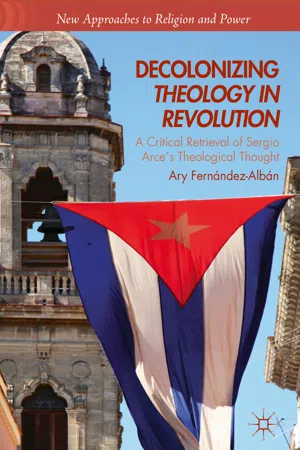
eBook - ePub
Decolonizing Theology in Revolution
A Critical Retrieval of Sergio Arce´s Theological Thought
- English
- ePUB (mobile friendly)
- Available on iOS & Android
eBook - ePub
Decolonizing Theology in Revolution
A Critical Retrieval of Sergio Arce´s Theological Thought
About this book
Information
© The Author(s) 2018
Ary Fernández-AlbánDecolonizing Theology in RevolutionNew Approaches to Religion and Powerhttps://doi.org/10.1007/978-3-030-02342-3_11. Introduction
Ary Fernández-Albán1
(1)
Seminario Evangélico de Teología, Matanzas, Cuba
Ary Fernández-Albán
As part of a larger complex set of sociopolitical, economic, and ideological geopolitical global shifts, the triumph of the Cuban revolution in 1959 was one of the most significant and influential sociopolitical events in the world. Because of the characteristics of its “revolution,”1 Cuba quickly became a source of inspiration for many liberation movements and revolutionary forces around the world.2 It also became a cause of contention (during the Cold War) between the powerful forces of “Capitalism” and “Communism” represented by the interests of the USA and the Soviet Union.
Despite the multiple, opposing internal and external forces the Cuban revolutionary process has shown great resilience and adaptability, particularly during the last two decades. In the last eight years a new set of controversial economic reforms seeking to “update” the Cuban economic system, and more importantly to avoid the definitive collapse of the “revolution,” has gradually been put in place.3
For some commentators, these reforms are a clear sign that the “revolution”—or the “regime” as some prefer to call it—signals the end, or at least the transition toward something very different from what it has been in the past.4 For many reasons, many consider that Cuba is at a crucial crossroads in history once again. It should not come as a surprise that heated debates about the continuity of the revolutionary process and its legacy, and Cuba’s likely future scenarios are increasingly taking place inside and outside of the island.5 These debates have increased exponentially and intensified, especially after the announcement of “normalization” of diplomatic relations between the USA and Cuba,6 and, more recently, by the changes carried out by the new administration under President Donald Trump.
After more than 50 years of strained relations and strong confrontations, the announcement on the normalization of diplomatic relations came as a great surprise. Many Cubans saw this new context as a promising path to improve the economy by significantly increasing tourism and creating new jobs in both state and private sectors. Specifically, the opening of embassies in both countries, Obama’s lifting of travel and remittance restrictions, and especially his official visit to Cuba in 2016 generated a great deal of expectations in the island.7 More importantly, this still premature and limited process of normalization of relations likely meant for many the beginning of the end of the US embargo against Cuba. There were some who were not persuaded by the new changes! No voices arose to express their concern about the potentially negative socioeconomic and political implications for Cuba. Some even thought that the changes signified a new albeit surreptitious neocolonial and imperialist strategy of domination.8
In June 2017, President Trump unveiled his policy regarding Cuba, which effectively reversed, to some extent, his predecessor’s.9 The actual scope and impact of these measures remain to be seen, as they were implemented barely in September 2017. Nevertheless, some analysts claim that such measures imply a regression to the USA’s confrontational relations with Cuba, which, in the past, have proved to be ineffective in terms of achieving a change of the political system in the island. Economically speaking, Trumpʼs policy seeks to reinforce the embargo (blockade) because it intensifies the restrictions on US citizens traveling to Cuba and disallows US investments in an economy mostly run by the state. In the opinion of many commentators, this policy could significantly affect the limited sector of small private businesses, which according to Obama, would play a crucial role in the promotion of the economic and political changes that US governments have pursued in the island for more than five decades.10
For many Christians in Cuba, including myself, it is important to engage in discussions about present and future possibilities with appreciation for the “advances” made and, in some measures, still maintained by the revolutionary process, especially when measured against the extreme poverty of many other countries in the Caribbean, Latin America, and around the world. As a pastor and as a theologian, and as an “heir” of the Cuban revolution as it triumphed in the imaginations of most Cubans after 1959, my main concern is how to contribute to the current debates on alternative “socialist” paths of social development and Cubans’ life improvement in the face of many complex historical events and unexpected challenges.11
Key points in the discussions within churches today also concern their current and future roles at this time of social transformations.12 And this issue includes theological reflections on their mission in light of the myriad challenges and future implications of the current processes of widespread changes—indeed, historic transition.13
The guiding question at this juncture is how a renewed theology, starting from the current Cuban context, in the midst of great transitions in Cuba and the world, and drawing on specifically Cuban experiences and traditions, can help churches (and other faith communities) to address the challenges and discern the possibilities to construct alternative paths in the best interests for all, especially for the historically poor and marginalized. As many Cubans imagine answers to the multiple issues this question evokes, I propose that a central point of reference is the work of Sergio Arce (1924–2015) and his theology in Revolution.
From a Protestant vantage point, Arce’s theological articulation has been the most significant, systematic, and original attempt at interpreting the Cuban revolutionary context. For over 50 years he was very influential in the process of forging a revolutionary theological perspective and reorienting the mission of many churches, especially the Presbyterian-Reformed Church in Cuba (IPRC).
Since my incorporation to the IPRC in the early 1990s, after many years of Marxist-Leninist atheist formation in my adolescence and youth, I found in Arce’s theological thought one of the main spiritual sources of inspiration and theological influence for my initial formation as a Christian and, a few years later, as a pastor. Arce’s theological work helped me to understand Christian faith in non-spiritualistic and “this worldly” ways. His theology showed me creative ways of interpreting the Bible and Christian doctrines in light of past contexts and present realities we lived and were living as Cubans. It also encouraged me to practice my Christian faith in connection to the social situation at the time, and to participate, along with others, in seeking ways of fulfilling our mission and witness as Christians in those circumstances.
At this crucial juncture, Arce’s dynamic, radical, and groundbreaking theological vision of the “revolution” and impact on transforming the mission of the church in Cuba deserves serious consideration for understanding the past and the parameters of debate today as Cubans face new waves of historical transitions. Accordingly, in this book I engage in a process of critical retrieval of his numerous theological insights. I argue that his written legacy must be understood as a key source of inspiration in the ongoing process of renewing liberation theologies in Cuba and in Latin America.14 I will do this in three main interconnected points.
First, I reconstruct Arce’s perspective and framework, noting some of the similarities and differences of his work with other Latin American liberation theologians.15 In this first point, I argue that Arce’s theology can be understood as part of a much broader liberationist current across Latin America and around the world in these decades. Still, his theology is also very unique. I will specify and highlight the distinctiveness of his theological work, as I bring him into a conversation with other Latin American liberation theologians, mainly Hugo Assmann, Gustavo Gutiérrez, and José Míguez Bonino. I do not intend to do an exhaustive comparison between Arce and these theologians. My aim is to introduce Arce’s work in a way that the scope of his thought, its unique features, and his singular contributions in the reframing of theology, mission, and ethics in the post-1959 Cuban church can be better appreciated.
Second, I reinterpret Arce’s theology using a decolonial interpretive framework. Drawing on decolonial theorists I will identify some of the crucial contributions of Arce’s work as well as important limitations. This point will help me demonstrate the fruitfulness of the decolonial perspective for theology today.
Third, my goal is not primarily historical, revising the debates and criticisms of the past. Rather, my objective is to examine Arce’s legacy in addressing the questions of today, the contributions and limitations of his still influential perspective in confronting the profound transitions faced by the church and the Cuban society as a whole.
Arce’s contributions have been recognized by theologians such as José Míguez Bonino,16 Leonard...
Table of contents
- Cover
- Front Matter
- 1. Introduction
- 2. Situating the Debates Between Worlds: Concerning the Socioeconomic, Political, and Ecclesial Contexts of Pre-revolutionary Cuba and the First Years of the Revolution
- 3. Sergio Arce’s Theology in Revolution: Main Influences and Stages of Development
- 4. Theology in Revolution: A Revolution in Theology
- 5. Cuba and the Global Context Since the 1990s: New Challenges, Voices, and Theoretical Developments
- 6. Sergio Arce’s Legacy and Inspiration to the Renewal of Theology Today
- 7. Conclusion
- Back Matter
Trusted by 375,005 students
Access to over 1.5 million titles for a fair monthly price.
Study more efficiently using our study tools.
Frequently asked questions
Yes, you can cancel anytime from the Subscription tab in your account settings on the Perlego website. Your subscription will stay active until the end of your current billing period. Learn how to cancel your subscription
No, books cannot be downloaded as external files, such as PDFs, for use outside of Perlego. However, you can download books within the Perlego app for offline reading on mobile or tablet. Learn how to download books offline
Perlego offers two plans: Essential and Complete
- Essential is ideal for learners and professionals who enjoy exploring a wide range of subjects. Access the Essential Library with 800,000+ trusted titles and best-sellers across business, personal growth, and the humanities. Includes unlimited reading time and Standard Read Aloud voice.
- Complete: Perfect for advanced learners and researchers needing full, unrestricted access. Unlock 1.5M+ books across hundreds of subjects, including academic and specialized titles. The Complete Plan also includes advanced features like Premium Read Aloud and Research Assistant.
We are an online textbook subscription service, where you can get access to an entire online library for less than the price of a single book per month. With over 1.5 million books across 990+ topics, we’ve got you covered! Learn about our mission
Look out for the read-aloud symbol on your next book to see if you can listen to it. The read-aloud tool reads text aloud for you, highlighting the text as it is being read. You can pause it, speed it up and slow it down. Learn more about Read Aloud
Yes! You can use the Perlego app on both iOS and Android devices to read anytime, anywhere — even offline. Perfect for commutes or when you’re on the go.
Please note we cannot support devices running on iOS 13 and Android 7 or earlier. Learn more about using the app
Please note we cannot support devices running on iOS 13 and Android 7 or earlier. Learn more about using the app
Yes, you can access Decolonizing Theology in Revolution by Ary Fernández-Albán in PDF and/or ePUB format, as well as other popular books in Theology & Religion & Latin American & Caribbean History. We have over 1.5 million books available in our catalogue for you to explore.