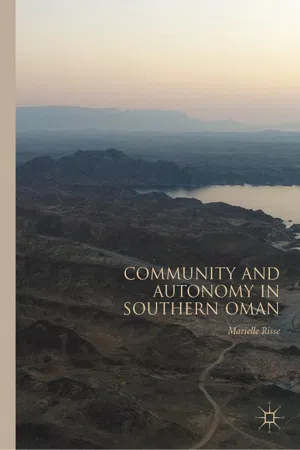
This book explores how there is latitude for people to make their own choices and how the chances to assert independence change over time in a Muslim, Arab, tribal culture. The book first gives a brief overview of day-to-day life in the Dhofar region of southern Oman, then focuses on how the traits of self-control and self-respect are linked in the everyday actions of several groups of tribes who speak Gibali (Jibbali, also known as Shari/??eret), a non-written, Modern South Arabian language. Although no work can express the totality of a culture, this text describes how Gibalis are constantly shifting between preserving autonomy and signaling membership in family, tribal, and national communities. The work reflects observations and conclusions from over ten years of research into the history and culture of the Dhofar region along with longstanding, deep involvement with both men and women in the Gibali community.
- English
- ePUB (mobile friendly)
- Available on iOS & Android
eBook - ePub
Community and Autonomy in Southern Oman
About this book
Information
© The Author(s) 2019
Marielle RisseCommunity and Autonomy in Southern Omanhttps://doi.org/10.1007/978-3-030-17004-2_11. Language, Culture, Methodology, and Literature Review
Marielle Risse1
(1)
Dhofar University, Salalah, Oman
Marielle Risse
Introduction
Once while gardening, a branch I was trimming snapped and hit me in the eye. When one of the Gibali men in my research group saw my bruises, he teased me by asking several times about which tree I had been trimming, when it had happened, etc. I finally had enough and told him I didn’t want to discuss it further, so he asked me point-blank who had hit me.
I was so surprised by this question; we went back over our conversation carefully. He had not, in fact, been teasing me from his point of view. He assumed that I had been punched and was lying about the tree to cover myself, i.e. he thought I was following the Gibali pattern of ignoring/distancing myself from the insult to keep not only my self-respect, but his. If I admitted to him I had been hit, he might have had to get into “the story” by figuring out if the hit was justified and, if not, perhaps help me figure out a reprisal.
He kept asking me about the tree to check whether I was really going to stand by my “lie” or not. My refusal to keep bantering about the bruises meant that I was ready to admit what had happened. If I wanted to keep my self-control/autonomy, I would have continued to discuss the subject without emotion, proving that I was going to handle the situation myself. After I understood his POV, I explained that if I had been hit, I would have started with that point.
A few points stand out in that story. One is that he didn’t ask me directly. From the outside, tribal cultures can appear to have people locked into certain actions but, as I will explain in this book, Gibalis are always negotiating between preserving their rights and acting in accordance to group dictates. As a result, Gibalis are wary of entering into the private life of others, as they don’t want people interfering in their own lives.
Second, he didn’t mind that I was lying to him. In tribal cultures in general and Gibali culture in particular, it is accepted that people will cover their actions and motivations to protect themselves and others. It is better to “hold yourself” than to show. Lastly, although he had known me for over five years at that point, he believed there was a possibility that I had done something to warrant for being punched. His reaction was: someone hit Marielle and it seems she doesn’t want me to get involved, let me check if she is going to stand by her lie or not. There was no automatic assumption that I was the victim. Given the propensity to cover unpleasantness, it was possible I had some (hitherto) hidden personality flaws which would give someone justification to punch me.
Community and Autonomy in Southern Oman explains how and why Gibalis create and interpret situations based on the twin desires of autonomy and collectivity.
Gibali Language
Gibali as a noun refers to a non-written, Modern South Arabian (MSA) language and the tribes of people who speak it in Dhofar. The country of Oman is divided into eleven governorates and Dhofar is the southernmost governorate. Dhofar is 38,300 square miles, bordering Yemen, Saudi Arabia and the Indian Ocean. From Salalah, the largest city in Dhofar, to Muscat, the capital of Oman, it is a 10-hour drive across a mostly barren desert plain; thus Dhofar is quite separated from the rest of Oman. Salalah is located on a coastal plain with a 40-kilometer beach on the southern side; the mountains Jebel al Qamar, Jebel al Qara, and Jebel Samhan ascend on three sides, set back about 10 kilometers from the coast (see Zarins 2001, 23). There are towns and villages in the mountains, one town (Thumrayt/Thumreit) and a few villages in the bare gravel plain on the far (northern) side of the mountains and a series of small towns strung along the coast from Dhalkut (close to Yemen) to Hasik.
Arabic is the official language and used for education, government, and business in Oman, but in Dhofar many people in the coastal and mountain villages speak Gibali as a first language.
The word “Gibali” comes from the Arabic jabal, mountain, and can be spelled in English as Jibbali, Jebbali, or Gebali. 1 Gibali is also referred to as Shehri/Shahri/Shary which is an approximation of the word “mountain” in the Gibali language and the name of a tribe. The people who I know, work with and/or interviewed, however, refer to themselves and their language as Gibali. The word can also be used as an adjective, e.g. “a Gibali house .”
When I say a person is “Gibali,” I mean a person who has one or both parent(s) who spoke/speak Gibali as a first language, who themselves speak Gibali as a first language and who identify themselves as Gibali not just in a linguistic but a cultural sense. 2 In Dhofar, “Gibali culture” has a specific meaning, i.e. events, actions, and circumstances that are seen as “Gibali” but within groups of Gibali speakers there are linguistic and cultural divisions, for example, between the Al Sheri, Al Kathiri, and hakli . There is also some intermarriage between Gibali and non-Gibali Dhofaris.
The Culture/Not Culture Argument
As I have and will continue to use the word/concept of culture, I want to briefly acknowledge criticism of the term. Abu-Lughod (1999) argues that
My own argument for writing against culture was developed in the context of trying to think how I might write an ethnography of a Bedouin community…that did justice to the complexity, uncertainly, and contestations of everyday life and to the individuality of its members…I concluded that the idea of ‘a culture,’ with its inevitable generalizations and typifications, had become a central component of the distancing and othering against which I wanted to work, even while I recognize that humans are, in the broadest sense, ‘cultural’ beings. (1999, S14)
Further, “the culture concept retains some of the tendencies to freeze difference” (Abu-Lughod 1991, 144). Volpp frames it that there is “the general failure to look at the behavior of white persons as cultural, while always ascribing the label of culture to the behavior of minority group” (2001, 1189). Thus
Those with power appear to have no culture; those without power are culturally endowed. Western subjects are defined by their abilities to make choices, in contrast to Third World subjects, who are defined by their group-based determinism…Culture is constantly negotiated and is multiple and contradictory. The culture we experience with a particular community will be specific and affected by our age, gender, class, race, disability status, and sexual orientation.” (1192)
I think the way to combat culture as a concept that confines and codifies is to make explicit the multiplicities of people’s lives, as Abu-Lughod does, and to make the limitations of both the anthropologist and her/his research clear. For example, my research is limited because I don’t have access to older (over 60) or very wealthy Gibalis. Almost all my informants and friends are middle-aged and middle-class.
Further, I think Brumann has a practical point of view that is helpful in taking some of the power away from the term “culture”: “it could be a healthy reminder that what people of a given nation really have in common is often trivial things such as familiarity with certain soap brands, commercial slogans or TV stars and not an ever-present awareness of their common history and heritage” (1999, S12). I have a friend who grew up in East Germany and to her, the fall of the Berlin Wall meant the disappearance of all of the common household products. The companies that made the laundry soap, canned food, window cleaners, tissues, etc., that she had grown up with were all out of business within a few years. When I meet Americans overseas, we don’t chat about the Bill of Rights, the Supreme Court, “American exceptionalism,” Manifest Destiny, or Congress, we commiserate about the lack of ice in drinks and our favorite football teams’ standings.
When a Gibali friend went to Europe, he complained to me that he couldn’t get “fresh milk.” I wrote to him that every store had fresh milk and that he should look in the refrigerated section, but he insisted that there was none. When he came back to Dhofar, I tried to figure out what the problem was. He had been looking for milk that was labeled with both the expiration date and the production date. In Dhofar, you usually buy milk “made” the same day or only one day before, as the factory that bottles the milk is less than a kilometer away from stores that sell the milk. He had been asking cashiers for milk of the same day and was amazed that European commercialism, technology, education, and organization couldn’t manage to figure out how to get milk from cows to a store in one day. That’s the kind of culture I am interested in—the moments when what it is normal for you conflicts with someone else’s normal, and then figuring out the details of why the conflict happened.
My Research/Gibali Language
Although I have lived in Dhofar for over twelve years, I am not fluent in Gibali and not speaking the language might seem to be an insurmountable barrier to understanding the cultures. One point is that an outsider’s behavior is more important than their language for integrating with Gibalis. When I am with Gibali friends and informants, we are on their terms and only their terms when we sit, talk, eat, drink, drive, fish, and on camping trips, sleep. It’s not imperative that I know how to conjugate the verb “to drink”; it is imperative that I don’t start to drink a cup of tea until all the older people I am sitting with have their own cup. To drink before all of the group has their own cup marks a person as selfish and greedy, someone to be avoided.
The “avoid” is significant because Omanis in general, and Gibalis in particular, take great pride in not showing their emotions. Thesiger (1991/1959) describes this as the “the deep and biting social discipline” of Be...
Table of contents
- Cover
- Front Matter
- 1. Language, Culture, Methodology, and Literature Review
- 2. Situating Gibalis: Governance, History, Religion, and Tribes
- 3. Community/Autonomy in Daily Life: People and Places
- 4. Community/Autonomy in Daily Life: Practices and Perceptions
- 5. Community/Autonomy: Honor and Self-Respect
- 6. “Why Would I Hurt a Woman”?: The Absence of Honor Killing in Gibali Culture
- 7. Generosity and Gifts in Gibali Culture
- Back Matter
Trusted by 375,005 students
Access to over 1.5 million titles for a fair monthly price.
Study more efficiently using our study tools.
Frequently asked questions
Yes, you can cancel anytime from the Subscription tab in your account settings on the Perlego website. Your subscription will stay active until the end of your current billing period. Learn how to cancel your subscription
No, books cannot be downloaded as external files, such as PDFs, for use outside of Perlego. However, you can download books within the Perlego app for offline reading on mobile or tablet. Learn how to download books offline
We are an online textbook subscription service, where you can get access to an entire online library for less than the price of a single book per month. With over 1.5 million books across 990+ topics, we’ve got you covered! Learn about our mission
Look out for the read-aloud symbol on your next book to see if you can listen to it. The read-aloud tool reads text aloud for you, highlighting the text as it is being read. You can pause it, speed it up and slow it down. Learn more about Read Aloud
Yes! You can use the Perlego app on both iOS and Android devices to read anytime, anywhere — even offline. Perfect for commutes or when you’re on the go.
Please note we cannot support devices running on iOS 13 and Android 7 or earlier. Learn more about using the app
Please note we cannot support devices running on iOS 13 and Android 7 or earlier. Learn more about using the app
Yes, you can access Community and Autonomy in Southern Oman by Marielle Risse in PDF and/or ePUB format, as well as other popular books in Social Sciences & Anthropology. We have over 1.5 million books available in our catalogue for you to explore.