eBook - ePub
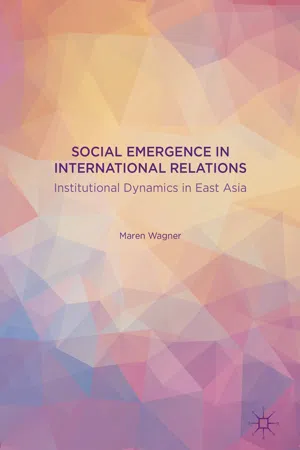
Social Emergence in International Relations
Institutional Dynamics in East Asia
- English
- ePUB (mobile friendly)
- Available on iOS & Android
eBook - ePub
About this book
This book presents a conceptualization of social emergence in international relations as a novel angle to analyse institutional dynamics in East Asia, introducing the concept of emergence from a critical realist perspective. The author examines East Asia's characteristic mesh work of regional institutions that affect integrative processes and regional policies, exploring how such institutions emerge and acquire their own nature and why this pattern persists over time, an unresolved and contested subject in the field of International Relations. This book suggests that regional institutions are emergent entities of the international system that arise as forms of self-organization by states to achieve certain emergent properties and powers. The author's approach sheds light on the particular emergent properties and powers of regional institutions and identifies discourse as a key mechanism of social emergence. Besides engaging in relevant questions of the philosophy of science and its methodological implications for studying social emergence in world politics, the book also analyses the concrete case of two East Asian regional institutions: ASEAN Plus Three and the East Asia Summit. This book will engage scholars and postgraduate students of Asian Studies and International Relations.
Information
Part I
© The Author(s) 2016
Maren WagnerSocial Emergence in International Relations10.1007/978-3-319-33551-3_11. The Issue of Institutional Emergence in East Asia: An Introduction
Maren Wagner1
(1)
GIGA German Institute of Global and Area Studies, Hamburg, Germany
When we take a look at the institutional dynamics and transformations unfolding in East Asia 1 over the past 20 years, we can observe a great many changes occurring within the regional institutional landscape. More and more novel institutional arrangements have emerged that are contributing to integrative processes in the region and affecting regional policies, thereby constituting the regional order. In the academic discipline of International Relations (IR), 2 the creation of regional institutions is commonly studied as being an integral part of regionalism in world politics (e.g. Fawcett and Hurrell 1995; Hurrell 1995). Herein, the regional architecture of East Asia is often used as a salient case for investigating the dynamic interplay of integrative processes (e.g. Rozman 2012; Stubbs 2002; Terada 2012; Webber 2001). Besides the questions of why and how specific regional institutions are designed, another central research theme is in what ways regional institutions matter and to what extent they have an effect on regional and international relations.
Regional institutions are designed by individual actors, while at the same time also having an effect on the latter’s actions and behavior. Though institutions constrain their members to a certain extent, only individuals can change them and it is they who are ultimately responsible for the institution’s actions. These circumstances provoke certain questions relating to the ontological status of institutions: Do they have causal effects independent of their member states? Are they real entities? Or, are their members the only real entities? In my view, such ontological questions about the nature of institutions need to be addressed first, in order to understand how we can even begin to study them.
By drawing on critical realism (Bhaskar 1998, 2008)—a philosophy of science 3 that argues for a world existing independently of our conceptions or knowledge about it—this work aims to reconsider the emergence of regional institutions in the international system by introducing the concept of “emergence” (e.g. Bedau and Humphreys 2008; Greve and Schnabel 2011) to IR theory. 4 How we can best think of emergence in the international system remains an underexplored yet highly relevant theme in IR. First, in terms of theory, it addresses the question of how we can most satisfactorily conceive of the ways in which forms of social order emerge out of underlying social structures and relations, but at the same time generate their own irreducible characteristics and abilities. Second, as to empirical work, it is important to study how emergence works in particular settings and in what ways emergent entities within the international system have a causal impact on their individual parts’ actions and behavior. From this perspective, emergence is significant for understanding ontological questions in the social sciences (see Elder-Vass 2012). The concept is, therefore, “critical to the examination of the most fundamental questions of the origin and behaviour of modern states” (Root 2013, 32), and to the scrutiny of other entities of the international system such as institutions.
In this book, I seek to introduce a conceptualization of social emergence to IR theory, in order to rethink how novel structures or forms of order—such as regional institutions in East Asia—emerge in the international system, thereby developing their own causal effects. Rather than focusing only on when and/or how particular regional institutions emerge, my main interest is instead to consider in what ways regional institutions can be understood and studied as emergent entities—and their creation as an emergent process in the international system. This requires the following issues being addressed:
- First, identifying the novel or innovative properties of the emergent structure. That is to say, the emergent properties that a regional institution possesses but none of its parts possess need to be detected.
- Second, the relationship between an institution and its parts. In this regard, it is asked in what ways a regional institution depends on the interactions of its parts but is not reducible to the latter at the same time, so that it cannot be deduced from them alone. This is connected to the question of whether a regional institution has some kind of downward causal effect on its parts.
- Third, the underlying structures and mechanisms from which new forms of order emerge. This means looking into how regional institutions emerge from the interactions among and between states, and thus identifying the mechanisms of institutional emergence (while taking into account that both the process of emergence and the specific form of an emergent institution cannot be foreseen).
Accordingly, the particular research problem that I am interested in here is the nature of regional institutions and their emergence. The focus of analysis is specifically on institutional dynamics, so that emphasis is put on process. The critical realist approach advanced here conceives of the international system as a stratified and open one made up of emergent entities, and starts from a different point of view when studying regional institutions than most IR approaches do. It builds on the assumption that the complexity of the international system repeatedly displays new forms of social structure that arise from the continuous interactions of its components.
These new structures demonstrate properties that the parts themselves do not possess. Regional institutions, according to the main argument of this work, can be understood as such emergent entities of the international system, ones that arise out of underlying structures and relations but that are not simply reducible to any of their constituent parts. I do not, then, aim to lay out specific factors or events that have led to the emergence of regional institutions, which means I do not intend to explain the individual causes of particular instances of institution building. Rather, based on critical realist ontology, I aim to examine the particular underlying structures, relations, and processes that are at work in the emergence of regional institutions—and the latter’s emergent properties and powers, which are implicated in the process.
Besides offering a novel perspective on how to understand regional dynamics and institution building in East Asia, another aspiration of this work is to illustrate how emergence works in this particular regional setting. For this purpose, it investigates in depth two regional institutions: Association of Southeast Asian Nations (ASEAN) Plus Three (APT) and the East Asia Summit (EAS). The East Asian case is a particularly interesting one due to the distinct dynamic of a mixture of diverse bi-, tri-, and multilateral groupings that partly overlap in their issues and tasks. In this way, regionalism in East Asia is particularly pragmatic and flexible. Definitions of what constitutes the East Asian region are determined by the principle of “variable geometry” (Asian Development Bank 2008), in that the structure of cooperation often adapts to the shifting priorities of different groups and members. As such, there are multiple tracks and speeds that mark the different parallel arrangements in the region.
Furthermore, integrative processes in East Asia are rather informal and inclusive as compared to other regions. This shows up in the regional institutions’ distinctive designs, which are characterized by an “Asian way” of institution building that emphasizes decisions based on deliberation and consensus (e.g. Kahler 2013). A further characteristic of the regionalism in East Asia is the central role that the ASEAN—rather than a single regional power—plays within related institution-building processes.
With Russia and the USA having become recent members of the EAS, a new dynamic in the regional integration process might now develop. The growth of China and India into the main regional powers demonstrates the importance of East Asia for the world economy and politics. ASEAN economies are growing steadily in a relative stable political environment. Both institutional processes, APT and the EAS, illustrate the awareness of East Asian leaders of the need for further regional cooperation and integration. Besides, both groupings have served China by being a platform through which to attain greater political and economic influence in the region—something the USA is still concerned about (Chye 2012, 121).
With due regard to these current dynamics, institutional processes in East Asia are thus exceptionally open and often unpredictable. For example, the creation of new institutional arrangements often occurs in response to external impetus—such as the establishment of APT after the Asian financial crisis of 1997. Sometimes, institutional membership is expanded—as in the case of the EAS’s aforementioned recent membership enlargement to now also include the USA and Russia. However it is also common to establish a new institutional forum so as to include an enlarged number of possible participants, as was the case with the EAS’s inception.
While most IR studies concerned with institutional developments in East Asia focus on those incidents and events that we can tangibly observe, this work seeks to shed light on the mechanisms within such institutional dynamics that we cannot directly see but that still contribute to emergence. What is also striking is that although most of the contemporary literature on East Asian regionalism commonly uses the term emergence to describe the institutional dynamics in the region (e.g. Stubbs 2002; Terada 2003), it is not further conceptualized or declared to be worthy of consideration in itself. Some authors criticize, similarly, the fact that there are too few systematic studies explaining the emergence of and change in Asian regionalism (e.g. Yu 2003, 263).
Much the same applies to the institutionalist literature (e.g. Hall and Taylor 1996; March and Olsen 1989), which aims to explain institutional changes and transformations but fails to adequately consider the process of how institutions initially come into being (see Pierson 2000). In my view, conceptualizing emergence in the international system is a crucial step toward analyzing such processes and dynamics, and furthermore, it provides an alternative perspective regarding how to best account for the ever-changing nature of diverse forms of social order. In this connection, it is crucial to highlight how I start from a different point of view when I examine regional institutions and their emergence than IR studies influenced by regionalism and institutionalism commonly do. This does not mean, however, that the latter are simply disregarded, but that they (as discussed in the following two sections) serve rather as a starting point from which to develop a critical realist view on social emergence in the international system.
1.1 Regionalism in East Asia: Changing Institutional Patterns in a Complex Region
In IR, the emergence of regional institutions has thus far been mainly considered in the context of regionalism in world politics (e.g. Fawcett and Hurrell 1995; Haas 1958; Hurrell 1995; Väyrynen 2003). Regionalism commonly implies “the deliberate act of forging a common platform, including new intergovernmental organizations and transnational civil society networks, to deal with common challenges, realize common objectives, and articulate and advance common identity” (Acharya 2010, 1002). In this context, the evolution of regional cooperation in East Asia has been remarkable, coming especially in response to the Asian financial crisis of 1997. Despite different theoretical approaches, a great many studies have in common the interpretation of this crisis as an event that set new forms of regionalism in East Asia in motion.
Various contributions have analyzed the crisis and its aftermath from a political–economic perspective, in order to capture the interaction of the diverse factors that caused it—as well as to evaluate its implications (e.g. Hende...
Table of contents
- Cover
- Frontmatter
- 1. Part I
- 2. Part II
- Backmatter
Trusted by 375,005 students
Access to over 1.5 million titles for a fair monthly price.
Study more efficiently using our study tools.
Frequently asked questions
Yes, you can cancel anytime from the Subscription tab in your account settings on the Perlego website. Your subscription will stay active until the end of your current billing period. Learn how to cancel your subscription
No, books cannot be downloaded as external files, such as PDFs, for use outside of Perlego. However, you can download books within the Perlego app for offline reading on mobile or tablet. Learn how to download books offline
Perlego offers two plans: Essential and Complete
- Essential is ideal for learners and professionals who enjoy exploring a wide range of subjects. Access the Essential Library with 800,000+ trusted titles and best-sellers across business, personal growth, and the humanities. Includes unlimited reading time and Standard Read Aloud voice.
- Complete: Perfect for advanced learners and researchers needing full, unrestricted access. Unlock 1.5M+ books across hundreds of subjects, including academic and specialized titles. The Complete Plan also includes advanced features like Premium Read Aloud and Research Assistant.
We are an online textbook subscription service, where you can get access to an entire online library for less than the price of a single book per month. With over 1.5 million books across 990+ topics, we’ve got you covered! Learn about our mission
Look out for the read-aloud symbol on your next book to see if you can listen to it. The read-aloud tool reads text aloud for you, highlighting the text as it is being read. You can pause it, speed it up and slow it down. Learn more about Read Aloud
Yes! You can use the Perlego app on both iOS and Android devices to read anytime, anywhere — even offline. Perfect for commutes or when you’re on the go.
Please note we cannot support devices running on iOS 13 and Android 7 or earlier. Learn more about using the app
Please note we cannot support devices running on iOS 13 and Android 7 or earlier. Learn more about using the app
Yes, you can access Social Emergence in International Relations by Maren Wagner in PDF and/or ePUB format, as well as other popular books in Politics & International Relations & Asian Politics. We have over 1.5 million books available in our catalogue for you to explore.