eBook - ePub
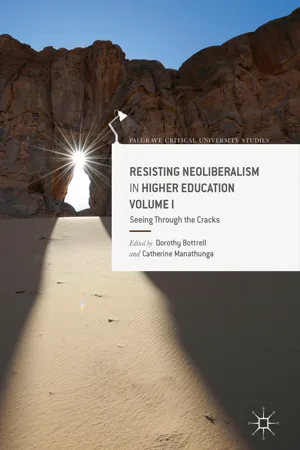
Resisting Neoliberalism in Higher Education Volume I
Seeing Through the Cracks
- English
- ePUB (mobile friendly)
- Available on iOS & Android
eBook - ePub
Resisting Neoliberalism in Higher Education Volume I
Seeing Through the Cracks
About this book
In light of the overwhelming presence of neoliberalism within academia, this book examines how academics resist and manage these changes. The first of two volumes, this diptych of critical academic work investigates generative spaces, or 'cracks' in neoliberal managerialism that can be exposed, negotiated, exploited and energised with renewed collegiality, subversion and creativity. The editors and contributors explore how academics continue to find space to work in collegial ways; defying the neoliberal logic of 'brands' and 'cost centres'. Part I of this diptych illuminates the lived experiences of changing academic roles; portraying institutional life without the glossy filter of marketing campaigns and brochures, and revealing generative spaces through critical testimony, fiction, arts-based projects, feminist and Indigenous critical scholarship. It will be of interest and value to anyone concerned with neoliberalism in academia, as well as higher education more generally.
Information
Topic
EducationSubtopic
Education Administration© The Author(s) 2019
Dorothy Bottrell and Catherine Manathunga (eds.)Resisting Neoliberalism in Higher Education Volume IPalgrave Critical University Studieshttps://doi.org/10.1007/978-3-319-95942-9_11. Shedding Light on the Cracks in Neoliberal Universities
Dorothy Bottrell1 and Catherine Manathunga2
(1)
School of Education and Social Work, University of Sydney, Sydney, NSW, Australia
(2)
School of Education, University of the Sunshine Coast, Maroochydore, QLD, Australia
Keywords
Neoliberal universitiesManagerialismCritical university studiesCultural democratisationAcademic resistanceIntroduction
Under the ethos of neoliberalism , universities have been transformed. In Australia, the alignment of higher education provision with neoliberalism began in the 1980s, as successive governments advocated the need to boost efficiencies, productive competition and public accountability , all deemed lacking within the system of university self-governance.1 The economic logic of reform ran counter to dominant conceptions of universities as collegial institutions concerned with public and democratic purposes.2 The dominance of market-driven business models instituted by governments through regulatory regimes and a volatile, mainly lean or declining funding policy environment has similarly reshaped higher education in variegated yet consistent ways in the global north and south.3
Twenty years of scholarship on the neoliberalisation of higher education has captured its features in designations such as the corporate 4 or enterprise university,5 the entrepreneurial university6 and the overarching descriptor, the neoliberal university.7 All universities are now entrenched in academic capitalism, 8 internally distorted by an audit culture 9 and governed by managerialism that is intensified in internal conflicts over the purpose and conditions of academic work .10 These shifts and their collateral damage to academic autonomy and professional standing are captured in new designations of the measured university11 and the toxic university .12
However, there are cracks in the neoliberal university that still present opportunities for academics to pursue alternative priorities, resistances and refusals .13 Seeing through neoliberalism is anchored in the strong traditions and values of academic freedom , autonomy, participatory and cultural democracy and the public good . In this book, as Readings14 noted, ‘dwelling in the ruins’ of the university is our starting-point for interrogating, understanding and articulating new ways of seeing the substance and politics of change.
Resisting neoliberalism in higher education : seeing through the cracks and a second volume, on prising open the cracks, aim to shed light on how academics are surviving neoliberal changes and working the spaces15 of managed life in universities. We use the metaphor of seeing through the cracks to emphasise the diminished space of “traditional” academic purposes within neoliberalised universities. It references the double meaning of academics seeing neoliberal and authoritarian managerialist processes for what they are; and articulating how we are continuing to find spaces to work in collegial ways that defy neoliberal logic : that is, a logic of bringing closure to non-economic aims of academic work 16; a logic of seeing ourselves as brands, cost centres and purveyors of education and research .
This collection furthers our understanding of current trends in working conditions under corporate managerialism in higher education in diverse contexts, with a focus on teaching-research-service academic work alongside critical responses and initiatives. This chapter provides a brief account of how the books came about, then discusses some key features of the increasingly ruthless managerialism that drives universities’ internal reshaping of academic work . We then place our focus on resisting neoliberalism within the tradition of critical studies in higher education and explain how seeing through the small “window” of free education in Australia situates our view of academic work . Finally, we introduce the chapters of this volume, organised around the themes of seeing outside-in and inside-out. Throughout this chapter, we refer to ‘the university’ as a shorthand for the diversity of institutions and to emphasise that our concerns are connected into ongoing struggles over the idea of the university.17
Back Story
As our initial work on this volume was conducted in Melbourne, Australia, we respectfully acknowledge the Ancestors, Elders and families of the Boonwurrung and Woiwurrung of the Kulin who are traditional custodians of these lands and have been for many centuries. We pay respect to the deep knowledge embedded within the Aboriginal community and unique role of the Kulin Nation’s living culture in the life of this region. Thinking about the transformation of universities, the cultural protocol of Acknowledgement of Country brings to the fore questions of power , privilege , equity. The colonial establishment of Eurocentric universities deliberately excluded Indigenous people, their knowledge, science and culture18 and thus entailed the “logic of elimination”19 that undergirded genocidal massacres, expropriation of lands and resources, Stolen Generations and a school-to-prison pipeline, all carried into the present through widespread societal refusal to acknowledge systemic racism and White privilege . Because neoliberalism is built on structures accomplished through the dispossession, colonisation and the empire building of industrial and corporate capitalism, the issues we raise concerning contemporary universities “must be understood within the context of historical struggles for voice, participation and self-determination ”20 that shaped contemporary universities and continues in the present.
This book and Volume II grew out of several research events conducted at local and national levels. These research activities were very much inspired by the opportunity to work with Professor Antonia Darder, an eminent critical theorist, Freirean scholar, activist and Leavey Endowed Chair of Ethics & Moral Leadership , Loyola Marymount University and Professor Emerita, University of Illinois, Urbana Champaign. As part of a Visiting Professorship at Victoria University, Melbourne, Antonia gave a keynote presentation on The Legacy of Paulo Freire: The Continuing Struggle for Liberation and facilitated resear...
Table of contents
- Cover
- Front Matter
- 1. Shedding Light on the Cracks in Neoliberal Universities
- Part I. Seeing Outside-In
- Part II. Seeing Inside-Out
- Back Matter
Trusted by 375,005 students
Access to over 1.5 million titles for a fair monthly price.
Study more efficiently using our study tools.
Frequently asked questions
Yes, you can cancel anytime from the Subscription tab in your account settings on the Perlego website. Your subscription will stay active until the end of your current billing period. Learn how to cancel your subscription
No, books cannot be downloaded as external files, such as PDFs, for use outside of Perlego. However, you can download books within the Perlego app for offline reading on mobile or tablet. Learn how to download books offline
Perlego offers two plans: Essential and Complete
- Essential is ideal for learners and professionals who enjoy exploring a wide range of subjects. Access the Essential Library with 800,000+ trusted titles and best-sellers across business, personal growth, and the humanities. Includes unlimited reading time and Standard Read Aloud voice.
- Complete: Perfect for advanced learners and researchers needing full, unrestricted access. Unlock 1.5M+ books across hundreds of subjects, including academic and specialized titles. The Complete Plan also includes advanced features like Premium Read Aloud and Research Assistant.
We are an online textbook subscription service, where you can get access to an entire online library for less than the price of a single book per month. With over 1.5 million books across 990+ topics, we’ve got you covered! Learn about our mission
Look out for the read-aloud symbol on your next book to see if you can listen to it. The read-aloud tool reads text aloud for you, highlighting the text as it is being read. You can pause it, speed it up and slow it down. Learn more about Read Aloud
Yes! You can use the Perlego app on both iOS and Android devices to read anytime, anywhere — even offline. Perfect for commutes or when you’re on the go.
Please note we cannot support devices running on iOS 13 and Android 7 or earlier. Learn more about using the app
Please note we cannot support devices running on iOS 13 and Android 7 or earlier. Learn more about using the app
Yes, you can access Resisting Neoliberalism in Higher Education Volume I by Dorothy Bottrell, Catherine Manathunga, Dorothy Bottrell,Catherine Manathunga in PDF and/or ePUB format, as well as other popular books in Education & Education Administration. We have over 1.5 million books available in our catalogue for you to explore.