Liberal democracy today, having aligned itself with capitalism, is producing a generalized feeling of weariness and disillusionment with government among the citizenry of many countries. Because of a decades-long march of globalized capitalism, economic oligarchies have gained oppressive levels of political power, and as a result, the economic needs of many people around the world have been neglected. It then becomes essential to remember that our ability to change society emerges from our power to formulate different questions; or, in this case, alternative understandings of democracy. This book draws together a variety of alternative theories of democracies in a quest to expose readers to a selection of the most exciting and innovative new approaches to politics today. The consideration of these leading alternative conceptualizations of democracy is important, as it is now common to see xenophobic and racist rhetoric using the platform of liberal democracy to threaten ideasof plurality, diversity, equality, and economic justice. In looking at four different models of democracy (utopian democracy, radical democracy, republican democracy, and plural democracy) this book argues that encounters with alternate conceptualizations of democracy is necessary if citizens and scholars are going to understand the constellation of possibilities that exist for inclusive, plural, economically equal, and just societies.
eBook - ePub
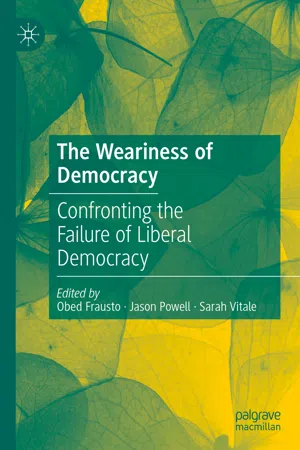
The Weariness of Democracy
Confronting the Failure of Liberal Democracy
- English
- ePUB (mobile friendly)
- Available on iOS & Android
eBook - ePub
The Weariness of Democracy
Confronting the Failure of Liberal Democracy
About this book
Information
© The Author(s) 2020
Obed Frausto, Jason Powell and Sarah Vitale (eds.)The Weariness of Democracyhttps://doi.org/10.1007/978-3-030-19341-6_11. Introduction: The Weariness of Democracy
Obed Frausto1 , Jason Powell1 and Sarah Vitale2
(1)
Honors College, Ball State University, Muncie, IN, USA
(2)
Department of Philosophy and Religious Studies, Ball State University, Muncie, IN, USA
In the United States, the presidential campaign of Donald Trump and his 2016 victory empowered a nationalist, intolerant, and xenophobic rightwing constituency. Around the world, similar forms of rightwing populism have gained momentum. Europe has witnessed the growth of nationalist movements with the United Kingdom’s Brexit vote; the advancement of the National Front led by Marine Le Pen in France; the success of rightwing, nationalist governments in Hungary, Poland, and Italy; and the 2017 electoral rise of the Party for Freedom in the Netherlands. Rightwing parties have gained strength throughout Latin America as well. In Argentina, the center-right coalition Propuesta Republicana (PRO) has had electoral successes, with its founder Mauricio Macri becoming president in 2015. In Brazil, far-right Jair Bolsonaro was elected president in 2018. Both Macri and Bolsonaro advocate anti-immigration policies. Other rightwing parties have had electoral victories in Colombia, Chile, and Ecuador as well. As they have supported rightwing movements, these nations have called into question the democratic ideals of plurality, equality, and diversity.
It is in light of this rightward trend that we have formed our concept of the weariness of democracy, an increased sense of disillusionment that liberal democracy can effectively address the large-scale social, cultural, political, and economic problems we face today. We recognize that this weariness is ubiquitous, as indicated in recent polls, such as a Washington Post poll that shows a 20 percent rise among those who are not proud of the way democracy works in the United States: from 16 percent in 1996 to 36 percent in 2017.1 Other polls around the world have recorded similar drops in citizens’ commitment to representative democracy.2 We also observe that this recent weariness has two aspects: a rightwing populism weary of an increasingly inclusive and pluralistic society and a weariness experienced by the social, cultural, political, and economic groups who have been marginalized and even vilified by those same rightwing populists.
It is to this second aspect that our volume is devoted. Undeniably, it is the people from these marginalized groups who can truly appreciate the irony that the recent phenomenon of electing rightwing plutocrats to address serious social problems is the equivalent of catching an arsonist who has torched a building and then paying that same arsonist exorbitant amounts of money to rebuild it. Indeed, the very populism that has risen from a disillusionment with democracy has itself become a fountainhead for a much more debilitating and oppressive form of disillusionment. We believe that it is the rise of these rightwing, anti-democratic movements, and the weariness that they generate, that makes it both timely and appropriate to ask the following question: are there different and better ways of creating democratic societies that can generate more inclusivity, prosperity, and social justice? To respond, the essays in this volume offer a panoply of vital, creative, and original thoughts on democracy from thinkers in Latin America, Europe, and the United States.
Liberalism and the Diminution of Democracy
We argue that the weariness of democracy comes from the problems inherent in liberal democracy, a system that empowers only a few individuals. Indeed, it is the very entitlement of the few that has precipitated democracy’s collapse into itself. Two fundamental principles explain this crisis: the tyranny of the individual and the tyranny of the market.
Liberal democracy was originally defined as a form of government characterized by representation, the rule of law, and the distribution and balance of power. It became the foundational pillar of modern societies in the seventeenth and eighteenth centuries, and social-contract theorists provided ideological argumentation to justify the superiority of democratic institutions above all other forms of government. The democracy they conceptualized, in general, envisions a society in which equal citizenship rights are guaranteed, conflicts are resolved by rational arguments, and public virtues are predominant in society.3 To be legitimate, democracy would require that all citizens are provided an equal opportunity to deliberate on solutions until agreement is reached, in many cases, through majority rule.4
Inspired by the principles of classical liberalism, this configuration of government holds the interests of individuals to be of paramount importance. It considers the individual to have the rational capacity and clarity to determine what is best for him or herself.5 Indeed, during the French Revolution, Nicolas de Condorcet suggested that his era understood freedom in a way that the ancients did not conceive: freedom came to be understood as the freedom of the will, the capacity to choose a religion, a truth, and a personal life.6 Consequently, because the legitimacy of any constituent power is based on the guarantee and protection of those freedoms, the government must comply with individual interests. As Benjamin Constant points out, the growth of individual power and influence means that civil authority becomes limited and relative.7
Along with the individual, the market has also garnered undue influence over politics and social life. The freedom of capital, Constant notes, emerges as a new type of liberty in the eighteenth century. Marx and Engels note the prominence of this new freedom in the Communist Manifesto, when they write that the bourgeoisie, “in place of the numberless indefeasible chartered freedoms, has set up that single, unconscionable freedom—Free Trade.”8 Intellectuals started to consider market phenomena as independent from other social dimensions such as religion, the state, and morality.9 Using contemporaneous theories from physics to explain how the market functions, they argued that human beings were moved by unknown forces and necessary laws. This new belief in the market as a natural force prompted a different perspective on the state, limiting its role to guaranteeing the safety of the citizens and funding itself through taxation. Beyond that, the state should not intervene in the lives of the individuals and should certainly not impose its power on them to prevent income inequality.10 Instead, solutions to any social problems caused by the vagaries of the market would come from free, responsible, and innovative individuals who would necessarily perpetuate the social good. The market would naturally and competently adjust, resulting in economic prosperity for everyone.11
The ideological connection between the market and the liberal state became actualized in the newly industrialized bourgeois nation-states of Western Europe in the seventeenth and eighteenth centuries. In the Communist Manifesto , Marx and Engels write that with the liberal state, “the bourgeoisie has at last, since the establishment of Modern Industry and of the world market, conquered for itself… exclusive political sway.”12 The modern state, then, was not born out of a longing for freedom itself but from the new bourgeoisie’s desire to expand its profits.
The state continued to play a role in advancing the interests of capitalist markets in the nineteenth century. With the support of liberal democratic regimes, under the guise of spreading democracy, a massive colonial land grab ensued, wherein European powers essentially carved up Africa and Asia for their own economic interests.13 Continuing into the twentieth c...
Table of contents
- Cover
- Front Matter
- 1. Introduction: The Weariness of Democracy
- Part I. Utopian Democracy
- Part II. Radical Democracy
- Part III. Republican Democracy
- Part IV. Plural Democracy
- Back Matter
Trusted by 375,005 students
Access to over 1.5 million titles for a fair monthly price.
Study more efficiently using our study tools.
Frequently asked questions
Yes, you can cancel anytime from the Subscription tab in your account settings on the Perlego website. Your subscription will stay active until the end of your current billing period. Learn how to cancel your subscription
No, books cannot be downloaded as external files, such as PDFs, for use outside of Perlego. However, you can download books within the Perlego app for offline reading on mobile or tablet. Learn how to download books offline
Perlego offers two plans: Essential and Complete
- Essential is ideal for learners and professionals who enjoy exploring a wide range of subjects. Access the Essential Library with 800,000+ trusted titles and best-sellers across business, personal growth, and the humanities. Includes unlimited reading time and Standard Read Aloud voice.
- Complete: Perfect for advanced learners and researchers needing full, unrestricted access. Unlock 1.5M+ books across hundreds of subjects, including academic and specialized titles. The Complete Plan also includes advanced features like Premium Read Aloud and Research Assistant.
We are an online textbook subscription service, where you can get access to an entire online library for less than the price of a single book per month. With over 1.5 million books across 990+ topics, we’ve got you covered! Learn about our mission
Look out for the read-aloud symbol on your next book to see if you can listen to it. The read-aloud tool reads text aloud for you, highlighting the text as it is being read. You can pause it, speed it up and slow it down. Learn more about Read Aloud
Yes! You can use the Perlego app on both iOS and Android devices to read anytime, anywhere — even offline. Perfect for commutes or when you’re on the go.
Please note we cannot support devices running on iOS 13 and Android 7 or earlier. Learn more about using the app
Please note we cannot support devices running on iOS 13 and Android 7 or earlier. Learn more about using the app
Yes, you can access The Weariness of Democracy by Obed Frausto, Jason Powell, Sarah Vitale, Obed Frausto,Jason Powell,Sarah Vitale in PDF and/or ePUB format, as well as other popular books in Politics & International Relations & Political Philosophy. We have over 1.5 million books available in our catalogue for you to explore.