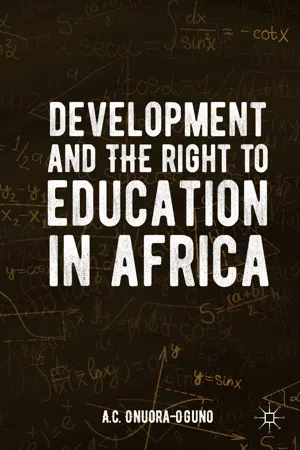
This book is about the right to basic education and its impact on development in Africa. It focuses on the elusive subject of litigating the right to education by examining jurisprudence from select African countries and India. The project further analyses the various challenges that impede access to education, with the attendant lack of political will to curb corruption, and calls for the building of strong institutions and the involvement of both state and non-state actors in driving development via education. It also covers the scope for legal practitioners and policy makers, and supports institutional framework in realizing the right to basic education.
- English
- ePUB (mobile friendly)
- Available on iOS & Android
eBook - ePub
Development and the Right to Education in Africa
About this book
Information
© The Author(s) 2019
A.C. Onuora-OgunoDevelopment and the Right to Education in Africahttps://doi.org/10.1007/978-3-319-90335-4_11. Right to Development and Education: An Introductory Note
A. C. Onuora-Oguno1
(1)
University of Ilorin, Ilorin, Nigeria
Establishing the nexus between education and development is fundamental to appreciating the core purpose of this book. In attempting to establish this nexus, the book examines the concept of the right to education and its impact on development. It would resolve if the later is dependent on the former and the situation in Africa as regards both concepts. Considering that Africa is generally accepted to be the least developed in the equation of continental statistics, the need to examine the factors that influence the poor state of development is fundamental vis-a-vis the role that education plays. For the purposes of this, low access to basic education is identified as playing a major role in this seeming underdevelopment. This situation is all the more disturbing as the government continues with political rhetoric: mainly insincere and pretentious commitment s to curbing poor access to basic education and developmental issues in Africa. In the human rights discourse today, the role of education is important as it forms the basis on which other rights are built. The government is required by national legislation and international law to protect, promote and fulfil human rights. African governments are under an obligation to ensure the elimination of all challenges capable of depriving the African child access to basic education .
In analysing the state of education in African countries, the lived realities present a situation in dire need of urgent revival. For instance in Nigeria, the level of illiteracy has reached an alarming rate and has consequently jostled all spheres of the national existence.1 The situation in Ghana , Zambia and South Africa all present the same challenges ranging from issues of access to education to poor quality of the accessed education. In Nigeria, with a population of about 180 million,2 an estimate of about 10 million children are out of school and almost the same number are forced to drop out of school because of an inability to sustain the requirements of the basic education system , most often occasioned by poverty , cultural and religious affiliations of parents.3 Issues of access, acceptability and quality today confront the education industry in Africa, providing a basis for poor development of the continent.
Some scholars have blamed the advent of the European colonialists on the African continent as a major contributor to the underdevelopment of Africa.4 Scholars like Mandela and Fafunwa opine that education has a central basis in ensuring and driving development thus aligning with the theory of both Mandela and Fafunwa the book advances the need to drive development in Africa by relying on the place of an enhanced access to quality education . The poor access and poor completion of basic education remain a major challenge . For instance in Nigeria statistics show that, at present, access to basic education in Nigeria is poor, especially in the northern part of the country, with quality below an acceptable threshold in the nation as a whole.5 Apart from the challenge of access, quality is another huge challenge in the realisation of basic education . The African Peer Review Mechanism (APRM) to Nigeria noted that, despite the legislative provisions and policies in place in Nigeria, the quality of education is substandard, with many schools ill-equipped and lacking qualified teachers.6 The APRM, in addition, noted the impact of corruption and poverty as challenges hampering access to quality education in Nigeria.7 This example from Nigeria clearly finds expression in other situations across the African continent. With the menace of corruption leading to a lack of access to and, consequently, the non-availability of basic education , the problem deepens. Cultural and religious undertones, coupled with the non-adaptability of the curriculum content of basic education in Nigeria , further leads to the rejection of education.8
In understanding the nexus between education and development, it is equally important to take into cognisance the role institutions would generally play in ensuring a sustainable synergy. Smith9 and Heyns10 adumbrate the role of institutions in realising rights be it development or education vis-à-vis their relationship with the state. In this regard, Heyns projects the possibility of a struggle approach, which may arouse people towards realising their fundamental rights when the institutions fail to do their work. Laure-Helene,11 while providing a rights-based insight into social protection, discusses the mandate of the state to ensure the promotion, protection and fulfilment of rights. McLean and Mbazira12 explore the issues of litigating socio-economic rights, Olowu13 deals with the issues of justiciability of socio-economic rights and human development in Africa. Woolman and Fleisch14 provide insight into law and education. Veriava and Coomans in their treatise, ‘the right to education’, identify core issue that is important to the focus of this book.
I argue that ‘denial of the right to education is a denial of the full enjoyment of other rights that enable an individual to develop to his or her full potential and participate meaningfully in the society’ .15 They advance that denial of access to education is a tool that can be employed to ensure the continued discrimination of a people and ultimately their underdevelopment. This is argued to influence the South African situation showing how education was used by apartheid to ensure that the black South African remained at the lower end of the ladder.
The right to a basic education is described as been a priority right above other socio-economic rights. It is an ‘unqualified right that necessitates a determination of the scope and content of basic education’ .16 This approach requires the state to ensure that comprehensive measures must be adopted, well-articulated and co-ordinated towards realising the right to basic education.17
The work of McConnachie and McConnachie18 also support the views adopted in this book that the right to basic education is an unqualified right. They, however, advance reasons on which the right to education may be reasonably limited19 while also identifying the increasing impact of litigation in the quest to enhance the realisation of the right to basic education .20 McConnachie and McConnachie work provides a valuable guide as it examines the interpretation of the right to basic education in both India and South Africa amidst the challenge of resources while yet demanding and imposing ‘extensive range of obligation on the state to provide an education’.21 They explore the role of the courts by finding22:
The unqualified right will require courts to give content to the right to a basic education and to assess the impact of poor school facilities on learners and teachers to determine whether the right has been limited.
Thus for development to be achieved via education, the approach of the state must be ‘effective , indicative and hold the real prospect of providing relief to the individuals whose rights have been violated, even if the relief cannot be immediate’.23
Another aspect touched by the book is on the role the judiciary can play in this regard. The challenge facing the judiciary and the anticipatory role that t...
Table of contents
- Cover
- Front Matter
- 1. Right to Development and Education: An Introductory Note
- 2. Theoretical Framework and Benefits of Basic Education
- 3. Obstacles Affecting Access to Basic Education
- 4. Beyond Nomenclature: Special Education or Inclusive Education—Advocating Quality Basic Education
- 5. African Perspective of Education: A Catalyst for the Desired Africa of Tomorrow?
- 6. Human Right or Human Capital Approach: Walking the Path to Actualisation of Access to Basic Education in Africa
- 7. Comparative Analysis of Jurisprudence Governing Basic Education
- 8. The African Human Rights Response to Access to Basic Education
- 9. Repositioning Institutions for Realisation of the Right to Basic Education
- 10. Conclusions and Recommendations
- Back Matter
Trusted by 375,005 students
Access to over 1.5 million titles for a fair monthly price.
Study more efficiently using our study tools.
Frequently asked questions
Yes, you can cancel anytime from the Subscription tab in your account settings on the Perlego website. Your subscription will stay active until the end of your current billing period. Learn how to cancel your subscription
No, books cannot be downloaded as external files, such as PDFs, for use outside of Perlego. However, you can download books within the Perlego app for offline reading on mobile or tablet. Learn how to download books offline
Perlego offers two plans: Essential and Complete
- Essential is ideal for learners and professionals who enjoy exploring a wide range of subjects. Access the Essential Library with 800,000+ trusted titles and best-sellers across business, personal growth, and the humanities. Includes unlimited reading time and Standard Read Aloud voice.
- Complete: Perfect for advanced learners and researchers needing full, unrestricted access. Unlock 1.5M+ books across hundreds of subjects, including academic and specialized titles. The Complete Plan also includes advanced features like Premium Read Aloud and Research Assistant.
We are an online textbook subscription service, where you can get access to an entire online library for less than the price of a single book per month. With over 1.5 million books across 990+ topics, we’ve got you covered! Learn about our mission
Look out for the read-aloud symbol on your next book to see if you can listen to it. The read-aloud tool reads text aloud for you, highlighting the text as it is being read. You can pause it, speed it up and slow it down. Learn more about Read Aloud
Yes! You can use the Perlego app on both iOS and Android devices to read anytime, anywhere — even offline. Perfect for commutes or when you’re on the go.
Please note we cannot support devices running on iOS 13 and Android 7 or earlier. Learn more about using the app
Please note we cannot support devices running on iOS 13 and Android 7 or earlier. Learn more about using the app
Yes, you can access Development and the Right to Education in Africa by A.C. Onuora-Oguno,A. C. Onuora-Oguno in PDF and/or ePUB format, as well as other popular books in Social Sciences & Educational Policy. We have over 1.5 million books available in our catalogue for you to explore.