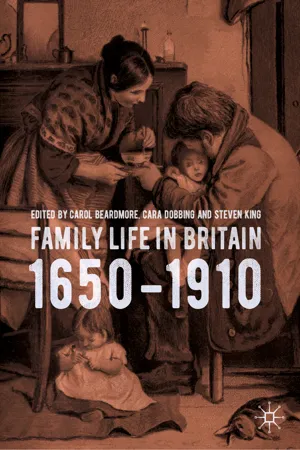
This book explores the ways that families were formed and re-formed, and held together and fractured, in Britain from the sixteenth to twentieth century. The chapters build upon the argument, developed in the 1990s and 2000s, that the nuclear family form, the bedrock of understandings of the structure and function of family and kinship units, provides a wholly inadequate lens through which to view the British family. Instead the volume's contributors point to families and households with porous boundaries, an endless capacity to reconstitute themselves, and an essential fluidity to both the form of families, and the family and kinship relationships that stood in the background. This book offers a re-reading, and reconsideration of the existing pillars of family history in Britain. It examines areas such as: Scottish kinship patterns, work patterns of kin in Post Office families, stepfamily relations, the role of family in managing lunatic patients, and the fluidity associated with a range of professional families in the nineteenth century.
eBook - ePub
Family Life in Britain, 1650–1910
- English
- ePUB (mobile friendly)
- Available on iOS & Android
eBook - ePub
Family Life in Britain, 1650–1910
About this book
Chapter 8 of this book is available open access under a CC BY 4.0 license at link.springer.com
Information
© The Author(s) 2019
Carol Beardmore, Cara Dobbing and Steven King (eds.)Family Life in Britain, 1650–1910https://doi.org/10.1007/978-3-030-04855-6_11. Introduction
Carol Beardmore1, 2 , Cara Dobbing3 and Steven King4
(1)
Faculty of Arts and Social Sciences, The Open University, Milton Keynes, UK
(2)
University of Leicester, Leicester, UK
(3)
School of Media, Communication and Sociology, University of Leicester, Leicester, UK
(4)
School of History, Politics and International Relations, University of Leicester, Leicester, UK
Context
Early narratives of the size and structure of British families and their place in wider European systems of family formation and re-formation were fundamentally shaped by Peter Laslett and the wider Cambridge Group for the History of Population and Social Structure. At the broadest level, it was argued that extended families were never a common feature of the British, and particularly English, domestic landscape. 1 It has been estimated for the period between 1622 and 1854 that households containing more than two generations constituted a mere 5.7% of the whole, in contradistinction to some European family forms. 2 By the nineteenth century more people lived alone (often with servants) than lived in such multigenerational families. Moreover, English co-residential units in particular tended to be relatively small (between four and five members at any one time) as well as relatively simple. Households and housefuls were of course often rather larger, but the sense that the British lived in kin-light contexts was a powerful driver of early narratives of the family. 3
For Laslett, Richard Wall and others this situation was a reflection of three influences. The first was the expectation that young couples at the point of marriage would start their own lives together living under their own roof and apart from either of their spousal families. Economic factors affected this choice and thus the age of marriage might vary according to social class or the financial ability to set up a new household, but was often higher than in societies where this expectation of residential separation was not enforced. 4 This characterisation of British household formation practices has been subject to sustained criticism, but it remains a cornerstone of our understanding of the place of British families in the European demographic system. 5 A second important influence was migration among the young. In pre-industrial and industrial England there was a high degree of geographical mobility and it was not unusual for young people to leave home very early to enter service or an apprenticeship. The exact age at leaving home varied according to region or class, 6 but the work of Colin Pooley and Jean Turnbull has provided convincing evidence that multiple mobilities were part of the expectational landscape of young people from at least the eighteenth century. 7 In this sense, there was a ‘natural’ cap on the size and complexity of the British co-residential family unit. Finally, Laslett in particular argued that nuclear family hardship placed strict limitations on the ability of different generations of the same family to provide care through co-residence when sickness, poverty or old age became a reality. Clearly, middling families had more potential in this respect than did those with fewer resources, 8 but at the core of Laslett’s construction of nuclear hardship was that the family burdens of children were heaviest at the very time that parents were most likely to need care. 9 Alternatively, and variably depending upon time period, death may have taken out generations that would otherwise have become co-resident. Subsequently, historians have come to understand that the Old and New Poor Laws rarely enforced the legal stipulation that kin should provide care for destitute relatives and in effect provided welfare benefits and forms which substituted for such family care. 10
Critics of Laslett pointed forcefully to the sense that his core source—censuses and census-like enumerations—created a path dependency. Such sources start from the basis of the (often hazily defined) co-residential unit, generating artificial distinctions both between those living within the same house and those people related by blood and marriage who lived nearby. 11 Crudely, we might regard a nuclear family unit living next to a grandparent on one side and a married daughter or son on the other as one extended family instead of three separate entities. On the other hand, the work of the Cambridge Group on a wider microsimulation exercise to underpin their national population estimates seemed to confirm Laslett’s sense that death and marriage had a profound effect on the pool of people who could come together to form complex and extended families in England and Wales. 12 Other challenges have gained more traction. Naomi Tadmor, for instance, built upon Miranda Chaytor’s early work to show that families were often deeply enmeshed into networks of fictive kin—people related to families through contract, acquaintance, friendship, or work—some of whom were co-resident and some more distantly resident. Fictive kinship, she argued was at least as important for the meaning of family and kinship as relations of blood, marriage and law. 13 Whether this was also true for the labouring poor as opposed to the literate middling sorts who were the focus of Tadmor’s analysis, remains to be seen. Di Cooper and Moira Donald offer a firmer challenge. Reconstructing the familial relations of streets in nineteenth-century Exeter, they have shown that by linking together census material and a dense raft of other sources (in an exercise akin to that of Iain Riddell in his contribution to this volume) it is possible to move beyond the household relationship labels that dominate our understanding of the nineteenth-century family. Thus, terms such as lodger, visitor, servant, pupil, assistant and apprentice might actually mask a blood or marriage relationship between one or more family members. At the same time, seemingly concrete labels such as daughter, mother or aunt might in fact denote fictive kinship, much as Tadmor suggested. 14
Against this backdrop, it is unsurprising that historians of the British family have, through surveys and detailed microstudies of individuals and family groups, sought to reimagine the constitution and meaning of family groups and to investigate in much more depth the kinship networks within which such groupings were enmeshed. 15 Thus we now know that English marriage ages for women were not uniformly low by the eighteenth century, that proximate residence of kin might be as important as co-residence, that the Poor Law worked in partnership with kinship groups to engineer what we might now understand as adult social care, and that from the early modern through to the modern periods, brothers, sisters, fathers, mothers and others managed to maintain close and affective kinship ties through epistolary networks. Of course, it has been much easier to reconstruct the meaning and form of the family for the middling sorts and others of the literate classes who have left ego documents. Historians of the families of the labouring poor have been beset with the central problem that rather more was written about them than by them. Even here, however, inventive use of court records, pauper letters and witness statements has begun to reveal a rich and varied landscape of family structures and meanings. Rebecca Probert, for instance, has shown beyond reasonable doubt that stable and unstable family grouping based upon cohabitation rather than formal marriage were rare from the late eighteenth century onwards. 16 Steven King has suggested that the dependent poor were, and were meant to be, part of a rich canvas of functional kinship. 17 And we have begun to understand that poorer families experienced the same emotional attachments to absent family members as did their middling counterparts, a theme continued in this volume through the work of Cara Dobbing. 18 These are all important perspectives, but significant challenges remain for British family historians and it is to those challenges (and by inference the agenda for this volume) that we now turn.
The Size and Shape of Co-residential Units
That census documents reveal most co-residential family units to be broadly nuclear both at any point in time and over time, is undeniable. Diaries and letters also sometimes suggest that the nuclear form dominated the number of years lived out by individual family members. Peter Laslett in his original conception of nuclear hardship was, however, alive to the limitations of the sources that he used, recognising the likely fluidity of family membership (and thus family form, size and structure) in the intervals between observable points like that provided by census material. Historians have subsequently made much of the fact that the census was taken on one day in every ten years, of the problems with census labels and definitions, and of the flaws with collecting, recording and preserving census data. 19 It is now clear, especially from work on the middling sorts that families were and were meant to be fluid entities with permeable borders and the flexibility to cope with various levels of crisis. Indeed, and a theme to which we return below, this had to be the case given the frequency with which families were broken by death or abandonment and subsequently re-formed. Thus Tadmor advocates the need for a much broader definition of ‘the nuclear family’, suggesting that family historians should consider as one conceptual landscape ‘the nuclear family of origin, the nuclear family of procreation’ and even the original nuclear family of a spouse. 20 In this way, the definition of co- and proximately resident ‘family’ is stretched to include most familial relations and consequently the unit becomes less fixed and far more fluid across time and space. Her wider point, that a neighbour, friend, former apprentice or a business associate—so-called fictive kin—could be as important to a family grouping as relations of blood and marriage whether co-resident or not, further complicates this picture. 21
Laslett, as we have observed, to some extent anticipated these issues, but their logic remains to be followed through, particularly for groups outside the middling sorts. As Leonore Davidoff reminds us the frequent presence of non-nuclear members in middling co-residential units—grandparents, grandchildren, siblings, aunts, uncles, nephews, nieces, cousins and others—signal an essential fluidity that should cause us to question the very conceptual label ‘nuclear family’. 22 There is much to recommend this view. We now know from various levels of court records, for instance, that visitors (related by blood and marriage, and not) were a normative part of the year and life cycle for ordinary families across space and time. Steven King through his work on memorials in this volume provides further evidence of the sheer ubiquity of such visitors in ordinary nineteenth-century households. More widely, apprentices might become in effect adoptive children, while the orphaned children of brothers and sisters might be taken in by another family even if they were subsequently labelled for census purposes ‘boarders’. The practice of siblings and parents taking in the children of family members who had fallen into poverty so as to give some respite to the family budget and prevent kin from applying to the poor law, also appears to have been common. 23 And while Probert is right to argue that cohabitation was uncommon, those who have sought evidence to support or contest this assertion have always ended up finding stories of highly fluid and unstable family forms and complexions among ordinary people. 24
More observations of this sort could be made but the key point is that a number of question...
Table of contents
- Cover
- Front Matter
- 1. Introduction
- Part I. Economies of the Family
- Part II. Family Processes
- Part III. Reconstituting the Family
- Back Matter
Trusted by 375,005 students
Access to over 1.5 million titles for a fair monthly price.
Study more efficiently using our study tools.
Frequently asked questions
Yes, you can cancel anytime from the Subscription tab in your account settings on the Perlego website. Your subscription will stay active until the end of your current billing period. Learn how to cancel your subscription
No, books cannot be downloaded as external files, such as PDFs, for use outside of Perlego. However, you can download books within the Perlego app for offline reading on mobile or tablet. Learn how to download books offline
Perlego offers two plans: Essential and Complete
- Essential is ideal for learners and professionals who enjoy exploring a wide range of subjects. Access the Essential Library with 800,000+ trusted titles and best-sellers across business, personal growth, and the humanities. Includes unlimited reading time and Standard Read Aloud voice.
- Complete: Perfect for advanced learners and researchers needing full, unrestricted access. Unlock 1.5M+ books across hundreds of subjects, including academic and specialized titles. The Complete Plan also includes advanced features like Premium Read Aloud and Research Assistant.
We are an online textbook subscription service, where you can get access to an entire online library for less than the price of a single book per month. With over 1.5 million books across 990+ topics, we’ve got you covered! Learn about our mission
Look out for the read-aloud symbol on your next book to see if you can listen to it. The read-aloud tool reads text aloud for you, highlighting the text as it is being read. You can pause it, speed it up and slow it down. Learn more about Read Aloud
Yes! You can use the Perlego app on both iOS and Android devices to read anytime, anywhere — even offline. Perfect for commutes or when you’re on the go.
Please note we cannot support devices running on iOS 13 and Android 7 or earlier. Learn more about using the app
Please note we cannot support devices running on iOS 13 and Android 7 or earlier. Learn more about using the app
Yes, you can access Family Life in Britain, 1650–1910 by Carol Beardmore, Cara Dobbing, Steven King, Carol Beardmore,Cara Dobbing,Steven King in PDF and/or ePUB format, as well as other popular books in History & British History. We have over 1.5 million books available in our catalogue for you to explore.