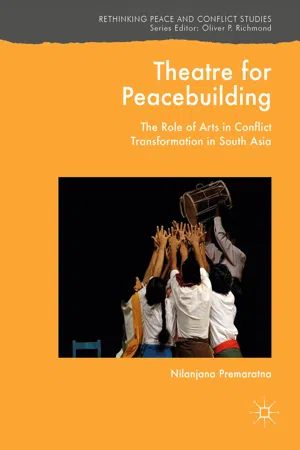
This book contributes to key debates in peacebuilding by exploring the role of theatre and art in general. Premaratna argues that the dialogical and multi-voiced nature of theatre is particularly suited to assisting societies coming to terms with conflict and opening up possibilities for conversation. These are important parts of the peacebuilding process. The book engages the conceptual links between theatre and peacebuilding and then offers an in-depth empirical exploration of how three South Asian theatre groups approach peacebuilding: Jana Karaliya in Sri Lanka, Jana Sanskriti in India, and Sarwanam in Nepal. The ensuing reflections offer insights that are relevant to both students and practitioners concerned with issues of peace and conflict.
eBook - ePub
Theatre for Peacebuilding
The Role of Arts in Conflict Transformation in South Asia
- English
- ePUB (mobile friendly)
- Available on iOS & Android
eBook - ePub
Theatre for Peacebuilding
The Role of Arts in Conflict Transformation in South Asia
About this book
Information
© The Author(s) 2018
Nilanjana PremaratnaTheatre for PeacebuildingRethinking Peace and Conflict Studieshttps://doi.org/10.1007/978-3-319-75720-9_11. Introduction
Keywords
ArtPeacebuildingSouth AsiaMy interest in the arts goes a long way back: I was in primary school during the 1987–1989 insurgency in Sri Lanka. I have two vivid memories of that time: the first is the smell of burning human flesh one morning and the resulting fear and frenzy, trying to find out whether it was someone we knew. Being children, we were warned not to speak about these incidents in public, as they were intimately connected to the politics of the period. Even at home, state actions were questioned only in whispers, only among the family. Questioning the government openly was a guaranteed way to end up on a roadside pyre, so there were not many who dared to do it. The second thing I remember about that time is the arts: the songs and the dramas. These were the most vocal critiques of the senseless killings that had been going on in the country for so long. In fact, art seemed to be the only voice that broke through the curtain of silence that blanketed all other public spaces. A handful of artists toured the country, performing and singing in schools and public grounds, raising questions of justice, freedom, democracy , ethnic unity, and power. This made a lasting impression on me about the resilience of art: how it survives when nothing else does. And how it can speak when nothing else can. Also, looking back, I see that art gave people hope , a way to come together through the trauma, a way to reconstitute community separated by alienation and suspicion. This is when I started seeing the potential of art to reach into—and make peace with—the core of ourselves: to present a way out of the deadlock in which we find ourselves, during and after a conflict .
Motivated by this personal interest, I undertake a systematic study into the role of arts in peacebuilding through this book. As a Sri Lankan growing up during the war , conflict was just another part of life. Tallying death tolls was a nightly ritual mediated through the state television channels whenever active military operations were underway. At more than half a decade after the war, and several years of living outside the country, my first reaction to a backfiring tyre still remains an irrational fear and an urge to hold onto the person next to me. The unpredictable regularity of suicide bombs indeed leave scars. Exploring the nexus of peacebuilding and the arts is my way of embracing the sparks of hope, power, and connection that glimmer through the murkier feelings of resignation and apathy. Apart from the relevant and timely contribution it makes to the discipline, this book is meaningful to me in a deeply personal manner.
Key debates and recent developments in peace studies highlight the need for studying local and community-based approaches to building peace. This invites us to step back from the mainstream approaches and blueprints for peacebuilding, and to closely examine the practices that already exist at the ground level . Art is a powerful vehicle with established political significance . Despite this potential and the growing popularity of the arts as a peacebuilding approach among practitioners, there has been little scholarly inquiry into the area. The studies that do exist tend to be conceptual. In order to appropriately utilise the arts as a tool for peacebuilding, we need to better understand how the arts work for peacebuilding. What are the key elements in its peacebuilding process? What are the potentials and limitations of the arts for peacebuilding ? Where can we find inspiration and gain pertinent empirical evidence? Using the arts to build peace, consequently, still remains an emerging area within peace and conflict studies.
This book seeks to offer answers to some of the above questions. It focuses on theatre as an art form, and examines its role in contributing to peacebuilding in South Asia.
To further unpack this phenomenon, I raise several critical questions: How has the art of theatre been used for peacebuilding in conflict situations? How does theatre open up possibilities of conversation between parties and narratives in conflict? And what potentials—or limitations—do different forms of theatre hold for peacebuilding?
The book draws on the insights of three theatre groups in order to answer these questions: Jana Sanskiriti from India, Jana Karaliaya from Sri Lanka, and Sarwanam from Kathmandu, Nepal. Doing so, it offers a possible conceptualisation of how theatre works for peacebuilding: the multi-voiced and dialogic form of theatre is particularly suited to express local complexities and open up untapped possibilities of communication between former adversaries. Thus, the relevance of what is discussed here extends beyond the academic study of peace and conflict, into the practice of peacebuilding at different levels.
Approaches to Peacebuilding
The theory and practice of peacebuilding are largely dominated by approaches that stress institution building, democratic procedures , abstract rights, and neoliberal development. 1 Despite adopting a broader definition for peacebuilding that recognises the existence of a range of measures for peacebuilding working at all levels of the society in its May 2007 deliberations, 2 the United Nations Peacebuilding Commission still prioritises institution building through its mandate. The key areas of focus still remain reconstruction, institution building and development. Addressing the social and cultural aspects of a conflict does not receive its due emphasis within this framework. This becomes further evident with a closer look at the prevalent approaches to peacebuilding.
Oliver Richmond presents a four generational trajectory on how efforts to build peace evolved. 3 Albeit being a retrospective reading, this model succinctly captures the tensions in and in the development of the field. I provide a summary here.
Richmond argues that the first generation of peacebuilding was conducted within a “limited state-centric discourse”, based on the assumption that conflict is “inherent.” 4 Consequently, this phase excluded issues and actors that are beyond state parameters. The ensuing peacebuilding employed a generalised set of tools and structures that were developed based on western traditions and diplomacy.
The second-generation peacebuilding builds upon the first, but takes human needs as the focal point. It recognises concepts such as structural violence and individual injustice. The focus on a shared, universal set of human needs, opens up peacebuilding for engagement with non-state actors while still operating within the state-centric framework. The role of citizens and civil society are still limited to basic indicators of needs and are not seen as active agents of the process. Second generation peacebuilding, although it articulates a more mutual vision of peace, prescribes a universal formula that overrides local specificities.
Third generation peacebuilding takes a multilevel approach to address different dimensions of peacebuilding. It takes advantage of the breakthrough of second-generation peacebuilding and opens up the field to engage with a broader stakeholder base. It recognises the importance of engaging with both the top-down and bottom-up approaches to peacebuilding. The needs and perception of actors at multiple levels guide the process. International Organisations and bodies such as the United Nations Peacebuilding Commission worked within this framework in recognising the importance in bringing together relevant actors, marshalling resources, and providing “expert” advice on post-conflict peace-building and recovery. This format intends to bring peace through a transformation of key local institutions and practices relating to conflict, both from a state and citizens’ perspective.
Despite the broader outlook, third generation peacebuilding is critiqued for emphasising western approaches at the cost of inadequate engagement with local practices and knowledge sources. Richmond points out that it allows context-specific renegotiation only at a marginal and superficial level. 5 The heavy emphasis placed on institution building and liberal-democratic practices, obstructs the potential for context specific adaptations. Stable political order leading to peace does not necessarily emerge from legislative frameworks or institution building. Protracted conflicts are often divided along social elements such as ethnicity, identity, or class. In addition to the establishment of institutions and procedures, sustainable peacebuilding requires the transformation of such root cases and social constructions. Furthermore, blueprints introducing democracy and liberal economic policies can have negative side effects. Hughes, Thompson, and Balfour observe that introducing such measures can profoundly threaten local initiatives working to create a communal foundation for a culture of peace . 6 Failing to appropriately take local practices into account when introducing liberal democracy in post-conflict situations can have serious consequences. It can challenge existing relationship networks and cultural patterns of a given context, that could have been the very threads that held the community together during conflict. Alienation and loss of community can possibly result. The relationship between liberal values and democracy is asymmetrical even though it is perceived to co-exist within the third generation approach to peacebuilding. 7 This fusion leads existing heterogeneity to be eroded in favour of creating a homogenous whole. 8 Therefore, pushing for democracy and free markets soon after a conflict can indeed destabilise a fragile post-conflict situation, undermining existing foundations of community and restricting the expression of minority voices. This often results in threatening local cultural shifts toward peace. Thus, pushing towards implementing western approaches to peacebuilding implies a disregard towards local agency , skill and knowledge.
Consequently, prevailing approaches to peacebuilding—primarily falling into the third generation of Richmond ’s categorisation—cannot adequately address local complexities and fails to satisfactorily include conflict transformation processes taking place at the local context. Ho-Won Jeong criticizes the discipline for its focus on liberal democratic solutions to a conflict at the cost of ignoring economic, institutional and cultural realities at the ground level . 9 These debates, previously located at the fringes of peacebuilding, have become central today. Formerly peripheral concepts such as culture, l...
Table of contents
- Cover
- Front Matter
- 1. Introduction
- Part I. Conceptualising Theatre for Peacebuilding
- Part II. Exploring Theatre in Local Peacebuilding Processes
- Back Matter
Trusted by 375,005 students
Access to over 1.5 million titles for a fair monthly price.
Study more efficiently using our study tools.
Frequently asked questions
Yes, you can cancel anytime from the Subscription tab in your account settings on the Perlego website. Your subscription will stay active until the end of your current billing period. Learn how to cancel your subscription
No, books cannot be downloaded as external files, such as PDFs, for use outside of Perlego. However, you can download books within the Perlego app for offline reading on mobile or tablet. Learn how to download books offline
Perlego offers two plans: Essential and Complete
- Essential is ideal for learners and professionals who enjoy exploring a wide range of subjects. Access the Essential Library with 800,000+ trusted titles and best-sellers across business, personal growth, and the humanities. Includes unlimited reading time and Standard Read Aloud voice.
- Complete: Perfect for advanced learners and researchers needing full, unrestricted access. Unlock 1.5M+ books across hundreds of subjects, including academic and specialized titles. The Complete Plan also includes advanced features like Premium Read Aloud and Research Assistant.
We are an online textbook subscription service, where you can get access to an entire online library for less than the price of a single book per month. With over 1.5 million books across 990+ topics, we’ve got you covered! Learn about our mission
Look out for the read-aloud symbol on your next book to see if you can listen to it. The read-aloud tool reads text aloud for you, highlighting the text as it is being read. You can pause it, speed it up and slow it down. Learn more about Read Aloud
Yes! You can use the Perlego app on both iOS and Android devices to read anytime, anywhere — even offline. Perfect for commutes or when you’re on the go.
Please note we cannot support devices running on iOS 13 and Android 7 or earlier. Learn more about using the app
Please note we cannot support devices running on iOS 13 and Android 7 or earlier. Learn more about using the app
Yes, you can access Theatre for Peacebuilding by Nilanjana Premaratna in PDF and/or ePUB format, as well as other popular books in Politics & International Relations & Performing Arts. We have over 1.5 million books available in our catalogue for you to explore.