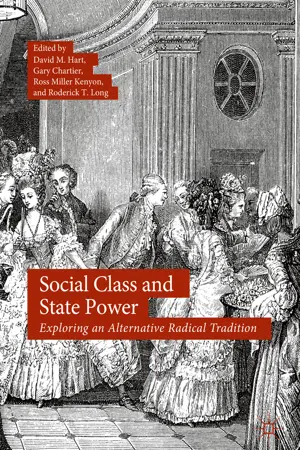
This book explores the idea of social class in the liberal tradition. It collects classical and contemporary texts illustrating and examining the liberal origins of class analysis—often associated with Marxism but actually rooted in the work of liberal theorists. Liberal class analysis emphasizes the constitutive connection between state power and class position. Social Class and State Power documents the rich tradition of liberal class theory, its rediscovery in the twentieth century, and the possibilities it opens up for research in the new millenium.
eBook - ePub
Social Class and State Power
Exploring an Alternative Radical Tradition
- English
- ePUB (mobile friendly)
- Available on iOS & Android
eBook - ePub
Social Class and State Power
Exploring an Alternative Radical Tradition
About this book
Information
Classic Works of Classical Liberal Class Analysis
© The Author(s) 2018
David M. Hart, Gary Chartier, Ross Miller Kenyon and Roderick T. Long (eds.)Social Class and State Powerhttps://doi.org/10.1007/978-3-319-64894-1_11. Richard Overton, “Monopolists as Frogs and Vermin” (1641)
David M. Hart1 , Gary Chartier2, Ross Miller Kenyon3 and Roderick T. Long4
(1)
Indianapolis, Indiana, USA
(2)
La Sierra University, Riverside, California, USA
(3)
Los Angeles, California, USA
(4)
Auburn University, Auburn, Alabama, USA
Abstract
The English Leveller Richard Overton uses biblical references like plagues of frogs and “Diabolical Parasites” to criticize those who have government-issued monopolies for the sale of goods like soap, playing cards, butter, salt, and tobacco which they use to exploit ordinary consumers. He wittily appeals to Parliament for help in putting an end to “the Tyranny of these insulting Projectors.”
Monopolers by their nefarious Projects , and impious exactions, have contaminated the Land with such a contagious exulceration of wicked impositions, that I may with a coequall sympathie, assimulate them to the Frogs of Ægypt. First, In regard that those Frogs were the second Plague that was brought upon the Ægyptians: So these Monopolers (in respect that Bishops had the priority) were the second Plague, which with disastrous aspersions, did infect our Nation. Secondly, As those Frogs came unto Pharaoes Bed-chamber, and upon his Bed: So these Diabolicall Parasites, did creeep into our Kings bosome, with their Phariticall Calumny. Thirdly, Those Frogs did come upon all the people in Ægypt, throughout their Territories: And who is there in all our Kingdom, that have not beene infected by the contagion of their venenosive aspersions: they were a Nest of Wasps, which did Tyrannically sting the Kings loyal Subjects with their exacting impositions: They were a swarme of Vermine, which did pollute sincere purity, and like the Frogs of Ægypt, did over-creep the Land. They warmed themselves at other mens fires, and though the peoples fingers ends were a cold, by regard of their impious Project, yet they would alwayes remember to say with Mantuan, Optimum est alien afrui pecunia. They sip’t of honest mens cups, and did distend their purses in their Bacchanalian ryot, for they drowned themselves in Bacchus Fountaine, while other men payd the reckoning. They did alwaies share with the Butler in his Box, yea they grew so fat and plump with damned Projects, that it was easier for Hercules to beate the Triple-headed Cerberous out of Hells Stygian Portals, then for us of late, to speake against these cursed Projectors, who abused the Triple Crowne.
But (we thank the all-directing providence of the mighty and Almighty God) we have found the like successe with Hercules, and by the inflexible Justice of the Parliament, we shall with him, drag these Hell-hounds upon the earth, who did eradicate the well planted branch of Plenty. They were heretofore so Epidemically strict, that they would not bate us a pin in their exactions; they have worne a Vizard a long time: But a Vizard sayd I? Their pride was a sufficient Vizard, for it was no marvaile that no man else could know them, when they knew not themselves. But when the Parliament shall once unface these, they will prove as bad as any cards in the packe. They were Janus-like, and had two Cloakes to hide their knavery; and like the Pythagorean Monster, they did threaten to devoure the whole Commons at a mouth-full. In Ægypt the thirsty Dog could never lap of the River Nilus, but the Crocodile would assault him immediatly. Neither in our Land could any honest man, whom dire necessitie by compulsive coercion required to allay his sitiating thirst, sip at the odoriferous Spring of Bacchus, but incontinently he was assayled by these cursed Crocodiles , the rubbish of Babylon, Honesties Hangman, fomenters of Impietie, Iniquities prodigious Monsters, Plenties execrable Foes, Envies individuall Companions, detestable Enemies to loyall Subjects ; and in a word, that I may fully paint them out, The Devills Journey-men. The Romans were never in more danger of the Sabines, than wee have beene of these pernicious members: the Sicilians never feared the Basilisk more, nor the Cretans the Minotaure neither the Athenians that pestiferous Serpent Epidaurus, than we have justly feared these wicked Dragons of implety. They are like the Grecian Horse, in the midst of Troy, under pretence of safety, but at length consumed the whole city: So these firebrands of iniquitie would have extirpated the flourishing plenty of the Land, but (thanks be to God and the righteous Parliament ) they are now extinguished. For as a rotten member Ense recidendum est ne pars sincer a trahatur, ought to be cut off, least it infect, and contaminate the whole body; so ought these wicked members of the Common-wealth to be executed with the Sword of Iustice, who have already too farre polluted the body of the Realme. Tis a plausible assimulation which Hippocrates observeth, that in the body naturall, as it must be truely purged, before it can be truely sound: so likewise in the body politicke, unlesse these improbous malefactors be purged out, it can never be truly sound.
Their very name Monopolers doth stigmatize them under the brand of knavery, which is derived from monos which signifies in English, Onely: so that Monopolers, are the Onely Polers of the people, which have abused them by their Projects: But now (alas poore men!) they are intruss’d and like to be whipp’d. Their very Projects themselves are set against them: Their Coles which they did aggerate are ready to consume them: The Butter, which before greased their pockets, now melts in their mouthes: The Sope scornes to be projected any longer, and will invert its first Letter S. into R. and become a Rope to them rather. The Salt is ready to pouder them to Tiburne: The Cards scorne that they should play the Knave any longer: The Pinnes could pin their Heads to the Gall-house, The Wine threatens to lay them dead—drunke: but hang them they are so crafty, that although they fall downe in a Wine-Seller, yet they know how to rise up agine in a Tobacco-Shop, but I hope before they rise there, they will first rise up at the Gall house: where I’le leave them—By these, and the like enormities have our Land beene too farre overspread, it hath lately flourished too luxuriously in impiety, which did accumulate such insupportable burthens to the weather-beaten Commons of this Realme, that they were almost everted. But thankes be to the all-disposig omnipotence of immortall God, who have alwayes preserved this Kingdome from innumerable evills, and have kept it as the apple of his eye. I say thankes be to his Supremacy, who among other evills have preserved us likewise from the Tyranny of these insulting Projectors. But we now solely depend upon the Parliaments exemplary piety and great Justice, of whom we beg with all humility, and with affectionate servency to the truth, doe supplicate that they would with expedition extinguish these cursed firebrands of the Land, who like Samsons Foxes have consumed the Lands and Possions of the Commons. Wherefore let every true hearted Subject enumerate his expresse thankefulnesse to Almigty God for the preservation of this Kingdome, and the multitude of his favours irrigated thereon with all alacritie.
Richard Overton (1631–1664)
was an actor, playwright, and Leveller pamphleteer during the English Revolution. He had his own secret printing press and wrote many articles for the Leveller journal The Moderate. His most important works include Mans Mortalitie (1644), An Arrow Against All Tyrants (1646), and A Defiance Against All Arbitrary Usurpations (1646). Source: Richard Overton, The Frogges of Egypt, or the Caterpillers of the Commonwealth, Truely Dissected and Laid Open; With the Subjects Thankefulnesse unto God for Their Deliverance from That Nest of Vermine ([London]: npu 1641) 1–5.
© The Author(s) 2018
David M. Hart, Gary Chartier, Ross Miller Kenyon and Roderick T. Long (eds.)Social Class and State Powerhttps://doi.org/10.1007/978-3-319-64894-1_22. Adam Smith, “On Conspiracies, Monopolies, and Unproductive Labour” (1776)
David M. Hart1 , Gary Chartier2, Ross Miller Kenyon3 and Roderick T. Long4
(1)
Indianapolis, Indiana, USA
(2)
La Sierra University, Riverside, California, USA
(3)
Los Angeles, California, USA
(4)
Auburn University, Auburn, Alabama, USA
Abstract
Smith’s book Wealth of Nations is peppered with insights about how some groups conspire together in order to persuade the government to restrict the trade of their competitors in order to benefit themselves. He believes that merchants and manufacturers are particularly susceptible to this, whereas “country gentlemen and farmers” are not. The problem for taxpayers is compounded by the existence of “unproductive hands” who gather in “a numerous and splendid court, a great ecclesiastical establishment, great fleets and armies” and are “all maintained by the produce of other men’s labor.”
But the annual revenue of every society is always precisely equal to the exchangeable value of the whole annual produce of its industry, or rather is precisely the same thing with that exchangeable value. As every individual, therefore, endeavours as much as he can both to employ his capital in the support of domestic industry , and so to direct that industry that its produce may be of the greatest value; every individual necessarily labours to render the annual revenue of the society as great as he can. He generally, indeed, neither intends to promote the public interest, nor knows how much he is promoting it. By preferring the support of domestic to that of foreign industry , he intends only his own security; and by directing that industry in such a manner as its produce may be of the greatest value, he intends only his own gain, and he is in this, as in many other cases, led by an invisible hand to promote an end which was no part of his intention. Nor is it always the worse for the society that it was no part of it. By pursuing his own interest he frequently promotes that of the society more effectually than when he really intends to promote it. […]
People of the same trade seldom meet together, even for merriment and diversion, but the conversation ends in a conspiracy against the public, or in some contrivance to raise prices. It is impossible indeed to prevent such meetings, by any law which either could be executed, or would be consistent with liberty and justice. But though the law cannot hinder people of the same trade from sometimes assembling together, it ought to do nothing to facilitate such assemblies; much less to render them necessary. […]
Country gentlemen and farmers are, to their great honour, of all people, the least subject to the wretched spirit of monopoly. The undertaker of a great manufactory is sometimes alarmed if another work of the same kind is established within twenty miles of him. … Farmers and country gentlemen, on the contrary, are generally disposed rather to promote than to obstruct the cultivation and improvement of their neighbours farms and estates. They have no secrets, such as those of the greater part of manufacturers, but are generally rather fond of communicating to their neighbours, and of extending as far as possible any new practice which they have found to be advantageous. … Country gentlemen and farmers , dispersed in different parts of the country, cannot so easily combine as merchants and manufacturers, who, being collected into towns, and accustomed to that exclusive corporation spirit which prevails in them, naturally endeavour to obtain against all their countrymen the same exclusive privilege which they generally possess against the inhabitants of their respective towns. They accordingly seem to ha...
Table of contents
- Cover
- Frontmatter
- 1. Classic Works of Classical Liberal Class Analysis
- 2. Contemporary Interpretations of Classical Liberal Class Analysis
- Backmatter
Trusted by 375,005 students
Access to over 1.5 million titles for a fair monthly price.
Study more efficiently using our study tools.
Frequently asked questions
Yes, you can cancel anytime from the Subscription tab in your account settings on the Perlego website. Your subscription will stay active until the end of your current billing period. Learn how to cancel your subscription
No, books cannot be downloaded as external files, such as PDFs, for use outside of Perlego. However, you can download books within the Perlego app for offline reading on mobile or tablet. Learn how to download books offline
Perlego offers two plans: Essential and Complete
- Essential is ideal for learners and professionals who enjoy exploring a wide range of subjects. Access the Essential Library with 800,000+ trusted titles and best-sellers across business, personal growth, and the humanities. Includes unlimited reading time and Standard Read Aloud voice.
- Complete: Perfect for advanced learners and researchers needing full, unrestricted access. Unlock 1.5M+ books across hundreds of subjects, including academic and specialized titles. The Complete Plan also includes advanced features like Premium Read Aloud and Research Assistant.
We are an online textbook subscription service, where you can get access to an entire online library for less than the price of a single book per month. With over 1.5 million books across 990+ topics, we’ve got you covered! Learn about our mission
Look out for the read-aloud symbol on your next book to see if you can listen to it. The read-aloud tool reads text aloud for you, highlighting the text as it is being read. You can pause it, speed it up and slow it down. Learn more about Read Aloud
Yes! You can use the Perlego app on both iOS and Android devices to read anytime, anywhere — even offline. Perfect for commutes or when you’re on the go.
Please note we cannot support devices running on iOS 13 and Android 7 or earlier. Learn more about using the app
Please note we cannot support devices running on iOS 13 and Android 7 or earlier. Learn more about using the app
Yes, you can access Social Class and State Power by David M. Hart, Gary Chartier, Ross Miller Kenyon, Roderick T. Long, David M. Hart,Gary Chartier,Ross Miller Kenyon,Roderick T. Long in PDF and/or ePUB format, as well as other popular books in Social Sciences & Politics. We have over 1.5 million books available in our catalogue for you to explore.