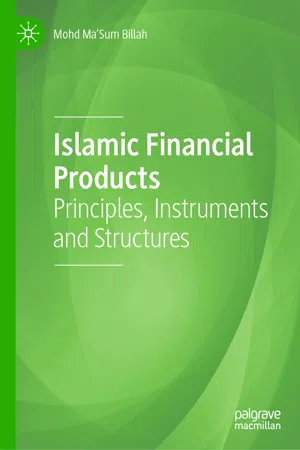
Islamic finance has grown exponentially since 1963 and has reached more than 70 countries around the world with the asset size of about $2.5 trillion. The Islamic financial system today comprises a sizable asset base and there is evidence of sustained demand for Islamic financial products and services in the global market, with demand outstripping supply. This book provides a new source of understanding of the Islamic financial products in view of facilitating academia, industrialists, professionals, product designers, students and policymakers globally. There is a mass of literature on Islamic finance available to the market, but very little research is found in the form of book exclusively on Islamic financial products and their structures. Thus, this book is a timely contribution to the global market with Islamic financial product solutions.
- English
- ePUB (mobile friendly)
- Available on iOS & Android
eBook - ePub
About this book
Information
© The Author(s) 2019
Mohd Ma'Sum BillahIslamic Financial Productshttps://doi.org/10.1007/978-3-030-17624-2_11. The Islamic Financial System
Mohd Ma’Sum Billah1
(1)
Islamic Economics Institute, King Abdulaziz University, Jeddah, Saudi Arabia
Mohd Ma’Sum Billah
1 Introduction
From the perspective of the Western legal system, modern principles are extremely basic. It is precisely because secularism is such an intrinsic part of our thinking that we mention its principles. Indeed, secularism is so fundamental to Western regulatory framework awareness that the laws generated from Islamic and other God-given or ‘received’ legal frameworks can appear irrational and inflexible. Furthermore, in the absence of an understanding of the foundations underlying a non-secular legal system, Western ability to understand and appreciate revisions to the laws of such a system may be severely limited. In contrast, the scope and origin of Islamic law are fundamentally different from those of common and civil laws. The scope of Islam is not limited to religious matters. Rather, Islam is an entire way of life: it is a religion, an ethic, a lifestyle, and a legal system rolled into one, and includes economics and financial systems.
Western jurists are, consequently, empowered to alter their systems as social and economic demands emerge. Conversely, the two primary sources of Islamic law are the Qur’an—the word of God, and the Sunnah—the pronouncements and practices of the Prophet. Having sources that are, by nature, sacred and unchanging has influenced the legal system in a way that has restricted Islamic jurists’ power to interpret and amend laws according to contemporary values and needs.
1.1 Sources of the Islamic Legal System
Since the objective of Islamic law is to define and regulate an individual’s duties according to God’s will, historically there has been no distinction between legal rules and rules of religion. Shari’ah , or ‘the Way’, is the term used to describe Islamic law. There are two primary, independent sources of Shari’ah law: the Qur’an—the Holy book of Islam, and the Sunnah—the pronouncements and practices of the Prophet Muhammad (SAW). There are also three secondary sources: ijma’ (consensus), qiyas and ijtihad (reasoning by analogy), which are not sources in the strict sense of term, but are means of revealing the law.
1.2 Al-Qur’an
The Qur’an is considered to be ‘the bedrock of Islamic jurisprudence’. It represents, to Muslims, the word of God as revealed to and spoken through his prophet, Muhammad (SAW). Although more than 80 verses deal with topics Westerners would consider being legal matters, the 6000 verses that comprise the Qur’an constitute an entire code for a moral, spiritual and social life. The guidelines and commandments of the Qur’an, including those that can be termed as legal matters, must be read as an integrated whole, and not as individual parts. However, the scarcity of actual law within the Qur’an creates the need to look to other sources.
1.3 Al-Sunnah
The Sunnah, which literally means ‘customary procedure or action’ or ‘norm’, is a set of rules deduced from the pronouncements and conduct of the Prophet. When Qur’anic verses did not expressly address an issue at hand, Muslims resorted to the Sunnah, which became Muslim customary law. Over time, the notion of the Sunnah became more restricted. Currently, the Sunnah is regarded as being limited to the collective traditions, pronouncements and conduct of the Prophet, as opposed to tradition in general. The Sunnah includes stories or traditions of the Prophet, called hadith, as well as the prophet’s deeds and tacit approval of the actions or practices of others. The Sunnah is regarded as a source of law, second only in authority to the Qur’an.
The word ‘Sunnah’ means a manner of acting, a rule of conduct, a mode of life. The term hadith refers to the report of a particular occurrence. Although, in the context of Islamic law, the words are often used interchangeably, hadith refers in particular to a tradition or story of the Prophet, while Sunnah signifies the rule of law deduced from the hadith.
1.4 Al-Ijma’
As Islam spread rapidly in Asia and North Africa, questions of personal and societal rights, obligations and relationships arose to which neither the Qur’an or the Sunnah could provide direct answers. Ijma’, a secondary source, provided a way to meet the needs of changing times. Ijma’, which literally means ‘unanimity’, is a way of discovering the law by resorting to the general consensus of opinion among Islamic legal scholars of a particular era.
Rules unanimously agreed, provided they do not conflict with the Qur’an or the Sunnah, become fixed and definite elements of Islamic jurisprudence. At first glance, ijma’ may appear to be a built-in mechanism for integrating Islamic teachings with evolving social practices and technology. However, the Hanbali school of Islamic law, to which Saudi Arabia subscribes, has historically limited ijma’, recognizing only the ijma’ of the companions of the Prophet.
1.5 Al-Qiyas
If the Qur’an, the Sunnah, and ijma’ fail to provide a rule that adequately addresses a problem, jurists may, as a last resort, use qiyas—logical reasoning by analogy to precepts of the Qur’an or Sunnah. Essentially, by using qiyas, the underlying principles of the Qur’an and Sunnah may be extended by analogy to deal with matters similar, but not identical, to those covered by the Qur’an and Sunnah.
Imam Shafi’i (AD 767–820) was the founder of the Shafi’i school. His leading work, Risala, sets forth a fixed framework of rules within which qiyas can be used. To Shafi’i jurists, qiyas, through the proper application of these rules, effectively became a fourth source of law. Adherents to this school are mostly in southern India, southeast Asia, east Africa, and the Arabian coastline.
1.6 Al-Ijtihad
Early in the evolution of Islamic law, any qualified Islamic jurist had the authority to reason and interpret original sources of the law independently through a process known as ijtihad. Ijtihad literally means ‘effort’, ‘endeavour’ and, in the Islamic legal context, means ‘independent judgement of a legal or theological question’. Ijtihad allowed Islamic jurists to interpret the law when circumstances demanded, presumably through logical reasoning.
By the ninth and tenth centuries, the notion of using human reasoning to interpret the Divine word fell out of favour; increasingly, it was argued that nothing more could be gained through interpretation and reason. By the tenth century, ijtihad was repudiated in an event called ‘the closing of the gate of independent reasoning’. Jurists were regarded as muqallids, ‘those whose duty it was to accept the opinions of their great predecessors without the exercise of private judgement’.
Although ijtihad and qiyas may appear to be identical, they are distinct concepts. Ijtihad connotes the entire field or process of ascertaining the terms of Shari’ah law, whereas both qiyas and ijma’ can be viewed as products of ijtihad. Without the general endeavour to determine Shari’ah principles by using independent reasoning, consensus and reasoning by analogy would have never evolved. Qiyas and ijma’ can also be regarded as particular ways in which ijtihad is expressed; for example, by reasoning through analogy or through consensus.
2 The Islamic Financial System
Some of us may wonder what the financial world would be like were Islam to become the basis of the present day financial system. Could it have prevented the stock market and currency crises from occurring? Some will say that this depends on the version of the Islamic financial system (IFS) that we have now. In Malaysia, the IFS has been moulded along conventional philosophy but blended to claim Shari’ah legitimacy by virtue of contracts employed in financial transactions. In essence, a financial system is a set of rules and regulations or principles that governs the flow of funds from the surplus spending unit (SSU), to the deficit spending unit (DSU). The household, business and government sector...
Table of contents
- Cover
- Front Matter
- Part I. An Overview of the Islamic Financial System
- Part II. Governing Principles and Strategies of Islamic Products and Services
- Part III. Islamic Financial Products
- Back Matter
Trusted by 375,005 students
Access to over 1.5 million titles for a fair monthly price.
Study more efficiently using our study tools.
Frequently asked questions
Yes, you can cancel anytime from the Subscription tab in your account settings on the Perlego website. Your subscription will stay active until the end of your current billing period. Learn how to cancel your subscription
No, books cannot be downloaded as external files, such as PDFs, for use outside of Perlego. However, you can download books within the Perlego app for offline reading on mobile or tablet. Learn how to download books offline
Perlego offers two plans: Essential and Complete
- Essential is ideal for learners and professionals who enjoy exploring a wide range of subjects. Access the Essential Library with 800,000+ trusted titles and best-sellers across business, personal growth, and the humanities. Includes unlimited reading time and Standard Read Aloud voice.
- Complete: Perfect for advanced learners and researchers needing full, unrestricted access. Unlock 1.5M+ books across hundreds of subjects, including academic and specialized titles. The Complete Plan also includes advanced features like Premium Read Aloud and Research Assistant.
We are an online textbook subscription service, where you can get access to an entire online library for less than the price of a single book per month. With over 1.5 million books across 990+ topics, we’ve got you covered! Learn about our mission
Look out for the read-aloud symbol on your next book to see if you can listen to it. The read-aloud tool reads text aloud for you, highlighting the text as it is being read. You can pause it, speed it up and slow it down. Learn more about Read Aloud
Yes! You can use the Perlego app on both iOS and Android devices to read anytime, anywhere — even offline. Perfect for commutes or when you’re on the go.
Please note we cannot support devices running on iOS 13 and Android 7 or earlier. Learn more about using the app
Please note we cannot support devices running on iOS 13 and Android 7 or earlier. Learn more about using the app
Yes, you can access Islamic Financial Products by Mohd Ma'Sum Billah in PDF and/or ePUB format, as well as other popular books in Business & Financial Services. We have over 1.5 million books available in our catalogue for you to explore.