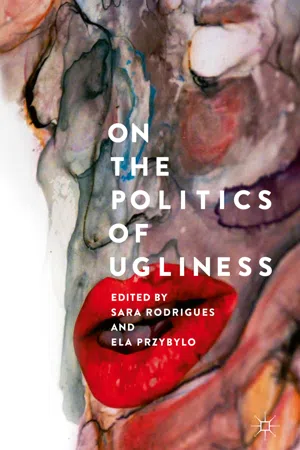
Ugliness or unsightliness is much more than a quality or property of an individual's appearance—it has long functioned as a social category that demarcates access to social, cultural, and political spaces and capital. The editors of and authors in this collection harness intersectional and interdisciplinary approaches in order to examine ugliness as a political category that is deployed to uphold established notions of worth and entitlement. On the Politics of Ugliness identifies and challenges the harmful effects that labels and feelings of ugliness have on individuals and the socio-political order. It explores ugliness in relation to the intersectional processes of racialization, colonization and settler colonialism, gender-making, ableism, heteronormativity, and fatphobia. On the Politics of Ugliness asks that we fight against visual injustice and imagine new ways of seeing.
- English
- ePUB (mobile friendly)
- Available on iOS & Android
eBook - ePub
On the Politics of Ugliness
About this book
Information
Topic
Ciencias socialesSubtopic
Política© The Author(s) 2018
Sara Rodrigues and Ela Przybylo (eds.)On the Politics of Uglinesshttps://doi.org/10.1007/978-3-319-76783-3_11. Introduction: On the Politics of Ugliness
Ela Przybylo1 and Sara Rodrigues2
(1)
Gender, Sexuality, and Women’s Studies, Simon Fraser University, Vancouver, BC, Canada
(2)
Toronto, ON, Canada
Ugliness or unsightliness is much more than a quality or property of one’s appearance. In Western contexts and histories especially, ugliness has long functioned as a social category that demarcates one’s rights and access to social, cultural, and political spaces. People who are unsightly are framed as not only unworthy of being seen or of having eyes set upon them, but they then become the target of interventions to curb the possibility of their causing aversion and discomfort in others. For example, “ugly laws” or “unsightly beggar ordinances,” which were widespread in the US, UK, and Europe by the late nineteenth century, functioned to formally exclude certain people’s access from the public sphere on the basis that their bodies would pollute the public spaces because they were dirty, disabled, “deformed,” sickly, disgusting, or unsightly.1 Emerging in many cities in the US as a tool of the state, ugly laws have functioned at the nexus of ableism, classism, racism, and settler colonialism—protecting wealthy, white, able-bodied, and hetero-domesticated settler subjects from the perceived aggressions of the exploited and exhausted impoverished working classes and other “burdensome” subjects.2 Ugly laws, if nothing else, demonstrate the extent to which what we look like, that is, how we appear to one another but more specifically to those with the power to see, functions as a key determinant in what kind of life we can expect to live. Yet, as with ability, bodies are prone to change, to alter, and to move in and out of categories of ugliness, such that upholding investments in unsightliness ultimately functions against even the most privileged. In the words of Heather Laine Talley, “ugliness matters for us all, but it particularly matters for those with bodies defined as ugly.”3 Bodies are punished when they are deemed “ugly,” and this treatment is justified on account of their reduction to being an ugly thing, and thus, as Noël Carroll argues, “beneath or outside ethics.”4
On the Politics of Ugliness is a collection of engagements with ugliness as a politically invested site, one that flows in and out of dialogue with gender, ability, race, class, age, sexuality, health, and body size. The editors and authors of this collection refuse to accept that ugliness is solely the property of a body, space, or thing, and argue that ugliness is also a function leveraged to uphold notions of worth and entitlement. In identifying and locating ugliness as a political category, On the Politics of Ugliness strives to imagine new ways of seeing ugliness and of being and being seen as ugly by fighting against its categorization and use as a pejorative denomination of visual injustice.
Ugliness appears everywhere in our everyday lives and in scholarship on the body, beauty, culture, appearance, and representation. Yet, it is infrequently engaged with as a direct object of study. As this Introduction will explore, while mentions of ugliness have been abundant in philosophy, aesthetic and literary theory, feminist theory, critical race studies, art history, and critical disability studies, and while ugliness so clearly informs these many fields, it has been elaborated on in fairly limited terms. In philosophy and art history, ugliness is usually explored in terms of aesthetics, tending to erase from view its complex politics and its effects on atypical bodies. In such work, ugliness is also largely dependent on conceptualizations of beauty, while its social and relational aspects are obscured from view. Indeed, ugliness seems to emerge as a property or attribute of places and bodies rather than as a process that relies on an unjust distribution of value and power in relation to the workings of gender, ability, race, class, beauty norms, body size, health, sexuality, and age. This collection seeks to centralize ugliness as an object of study, exploring how ugliness operates in the perpetuation and justification of social, political, and visual injustice, and to consider what drives our social and academic fears of ugliness.
In this chapter, we open up this study of ugliness by exploring what it means and what is at stake when someone or something is marked with and by “ugliness.” We do this by considering contemporary deployments of ugliness, with a focus on Western socio-cultural contexts, as well as by providing a review of theoretical engagements with ugliness. We position ugliness politically, rather than purely aesthetically, tracing its intersections with discourses, practices, and institutions of power. To this end, we trace what it means to engage with a “politics of ugliness,” through a survey of conceptualizations of ugliness in both academic literature and the social context, drawing out ugliness as a uniquely mobile category that is deployed not only to marginalize bodies but also to keep those bodies in their subjugated place.
In outlining the stakes of thinking with ugliness as well as providing an overview of the existing literature on ugliness, this chapter is organized according to the sections that comprise this collection. We begin by exploring ugliness as a form of visual injustice, focusing in particular on how ugliness affects relating and how spatio-temporalities are organized to expunge bodies deemed ugly. Following this, we explore the materialization of ugliness through and on bodies as well as in representations. Next, we consider ways in which ugliness has been imagined as a site to be desired, as a generative power. Throughout, we focus on literature that is adept at exploring the politics behind the operations of ugliness—that is, work within the fields of feminist theory, critical disability studies, sexuality studies, cultural studies, postcolonial literatures, and critical race studies. Yet, we find that while many of these fields are, in intricate and surprising ways, cognizant of the politics of ugliness and how they map onto other categories, they have not meticulously engaged with ugliness as an object of analysis. This body of interdisciplinary work makes mention of ugliness only incidentally, such that it is more difficult to conduct a genealogy on the politics of ugliness than on the aesthetics of ugliness. It seems that theorists have a vested political interested in ugliness but that explicitly politicized analyses of ugliness are wanting. All the same, this work, as we will explore, speaks to the political valence of ugliness and its operation alongside identities and bodies, laying the groundwork for this collection. In what follows, we argue that it is important to position ugliness politically as a form of visual injustice, first tracing extant scholarly considerations of the intersection of ugliness with circuits of power and oppression, and then outlining how the pieces in this collection consider these intersections anew.
Visual Injustice: Relationality and the Spatio-Temporalities of Ugliness
Theoretical and scholarly work on ugliness has developed along two tracks. The first mostly de...
Table of contents
- Cover
- Front Matter
- 1. Introduction: On the Politics of Ugliness
- 2. Ugliness
- Part I. Desire, Relationality, Erotics
- Part II. The Spatio-Temporalities of Ugliness
- Part III. Materialities and Representations
- Part IV. Ugliness as Generative Power
- Back Matter
Trusted by 375,005 students
Access to over 1.5 million titles for a fair monthly price.
Study more efficiently using our study tools.
Frequently asked questions
Yes, you can cancel anytime from the Subscription tab in your account settings on the Perlego website. Your subscription will stay active until the end of your current billing period. Learn how to cancel your subscription
No, books cannot be downloaded as external files, such as PDFs, for use outside of Perlego. However, you can download books within the Perlego app for offline reading on mobile or tablet. Learn how to download books offline
We are an online textbook subscription service, where you can get access to an entire online library for less than the price of a single book per month. With over 1.5 million books across 990+ topics, we’ve got you covered! Learn about our mission
Look out for the read-aloud symbol on your next book to see if you can listen to it. The read-aloud tool reads text aloud for you, highlighting the text as it is being read. You can pause it, speed it up and slow it down. Learn more about Read Aloud
Yes! You can use the Perlego app on both iOS and Android devices to read anytime, anywhere — even offline. Perfect for commutes or when you’re on the go.
Please note we cannot support devices running on iOS 13 and Android 7 or earlier. Learn more about using the app
Please note we cannot support devices running on iOS 13 and Android 7 or earlier. Learn more about using the app
Yes, you can access On the Politics of Ugliness by Sara Rodrigues, Ela Przybylo, Sara Rodrigues,Ela Przybylo in PDF and/or ePUB format, as well as other popular books in Ciencias sociales & Política. We have over 1.5 million books available in our catalogue for you to explore.