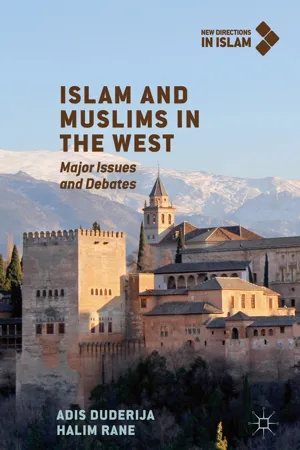
This book analyzes the development of Islam and Muslim communities in the West, including influences from abroad, relations with the state and society, and internal community dynamics. The project examines the emergence of Islam in the West in relation to the place of Muslim communities as part of the social fabric of Western societies. It provides an overview of the major issues and debates that have arisen over the last three to four decades surrounding the presence of new Muslim communities residing in Western liberal democracies. As such, the volume is an ideal text for courses focusing on Islam and Muslim communities in the West.
- English
- ePUB (mobile friendly)
- Available on iOS & Android
eBook - ePub
About this book
Information
Topic
Theology & ReligionSubtopic
Comparative Religion© The Author(s) 2019
Adis Duderija and Halim RaneIslam and Muslims in the WestNew Directions in Islamhttps://doi.org/10.1007/978-3-319-92510-3_11. Introduction
Adis Duderija1 and Halim Rane1
(1)
School of Humanities, Languages and Social Science, Griffith University, Nathan, QLD, Australia
Adis Duderija (Corresponding author)
Halim Rane
This book examines the major issues and debates concerning Islam and Muslim communities in the West. Its focus is not confined to Muslim communities but extends to the manifestations of Islam in Western Muslim-minority contexts of the late twentieth and early twenty-first centuries. Our intention is to provide the reader with insights into the development of Islam as part of the lived experiences of Muslims in the West in response to developments in the broader Muslim world as well as the challenges and opportunities associated with various Western societies. The topics we address in this book reflect the major issues and debates in the extant scholarly literature on Islam and Muslims in the West, encompassing studies from Australia, Europe, and North America.
The story of Islam in the West could begin with the experiences of Muslims who, in some cases, arrived over a century ago and much earlier. These could include African Muslims brought to the USA as slaves or Afghans who were brought to Australia to work as cameleers. However, Muslim communities in the West tend to be established in the latter half of the twentieth century when many Western countries relaxed previous immigration restrictions allowing the migration of people from Muslim-majority countries. While there are a few studies that compare the experiences of early Muslim migrants in the USA (Howell 2014) and Australia (Rane et al. 2015), for instance, most scholarly research on Muslims in the West tends to focus on communities established from around the 1970s and later. The arrival of large numbers of Muslims at this time coincided with a shift towards more inclusive multicultural policies that extended the rights and freedoms enjoyed by established religious communities to newly emerging Muslim communities and others. Immigration and immigrant incorporation policies, particularly multiculturalism, resulted in a more visible presence of Islam in the West, which has since become a matter of public debate in many Western societies.
Significant social and political change in latter half of the twentieth century influenced both the role of Islam in Muslim societies and its perception in the West. Among the post-colonial generations of Muslims were those who sought to reclaim what they perceived to be an erosion of Islamic identity. They advocated for a more public and assertive role for Islam in society and politics. Governments across the Muslim world tended to respond to the wave of Islamic resurgence with a range of measures from symbolic gestures to the adoption of policies and laws demanded by Islamist groups and parties, which resulted in the propagation of neo-traditional/neo-classical interpretations of Islam that tended to be conservative, anti-Western, and politicised. Other means by which such interpretations of Islam were spread included the state-sponsored initiatives of countries such as Saudi Arabia to fund the building of mosques and schools, train imams, patronise Islamic organisations, and disseminate large volumes of literature aligned with the religious ideology of the state. Such manifestations of Islam as Saudi Wahhabism and Salafism more generally struck many Western observers as being antithetical to Western, liberal, secular, democratic models of governance and social organisation. To the extent that Muslims in the West have been associated with such an image of Islam, their acceptance in Western societies has been threatened.
The Islam(s) that came to be established in the West in the 1960s, 1970s, and after was/were influenced by the trends taking place in the broader Muslim world. Approaches to or manifestations of Islam more indigenous to Western societies are still emerging and compete with the more foreign-influenced Islam(s) that tend to be more established in the West and control key Islamic community institutions and infrastructure such as mosques and Islamic schools and organisations. The challenges Muslims face in the West are not restricted to relations with the state and wider society. Just as important are those taking place within Muslim communities between Muslims of various cultures, ideologies, and generations concerning the appropriate understanding, place, and manifestation of Islam.
This book captures a key period in the still-unfolding story of Islam and Muslim communities in the West. The issues and debates examined in this book address the tensions and controversies that have arisen in the context of Western governments’ policies concerning immigration and immigrant incorporation, the rights and freedoms of Western, liberal, secular democracies, and the challenges these present to and presented by late-twentieth/early twenty-first-century Islam and Muslim communities. Many of the issues and debates addressed in this book arose in the aftermath of the events of 11 September 2001 and subsequent terrorist attacks committed around the world under the banner of Islam. An association of Islam with violence and terrorism has shaped many of these issues and debates and influenced the perception of Muslim communities in the West and Muslim relations with wider society. Responses have ranged from highly constructive interfaith dialogue, critical reflection, and reform initiatives to the opposite, manifested in reactive religiosity and radicalisation among segments of Muslim communities to Islamophobia and support for right-wing, anti-Islam populism among segments of wider society.
Chapter 2 provides an introduction to the history of Islam in the West and an overview of current demographics of Muslim communities in various Western countries. It sets the scene for the subject matter of this book through a discussion of the nature and the socio-historical context of interactions between Arabo-Islamic and Western-Christian civilisations. This chapter contests the highly influential perspectives of Bernard Lewis and Samuel Huntington regarding an inevitable clash of civilisations between Islam and the West and expresses broad agreement with the views of Richard Bulliet that Islamic and Christian civilisations are far more complementary than they are contradictory both in historic and contemporary contexts. However, the challenge that segments of Islam, specifically those that espouse an Islamist agenda, pose to the realisation of co-existence between Islam and the West are addressed in subsequent chapters.
Chapter 3 presents an overview of the major contemporary social and discursive orientations among Western Muslims and major transnational Muslim organisations operating in the West. This chapter highlights the diversity of these organisations along with an examination of their ideological underpinnings. While it makes reference to a number of studies that have constructed various typologies of contemporary Islamic trends from both discursive and sociological, theoretical, and methodological vantage points, this chapter offers a detailed examination of two influential organisations, the Hizmet Movement (HM) and the European Council for Fatwa and Research (ECFR), that represent different types of organisations on the Islamic spectrum. These case studies provide insights into two organisations that can be contrasted by their respective emphasis on a bottom-up approach to social relations and cohesion within the Western context versus a more top-down focus on the Western Muslim adherence to jurisprudential and theologically oriented norms. They also showcase the different approaches to Islam in the West that emerge as a result of different external/foreign influences and agendas.
Chapter 4 examines the processes by which Muslim migration to the West has occurred since the latter half of the twentieth century and discusses the issue of Muslim identity as new migrants belonging to a minority religious group. In this context, it explores the question of identity change from the majority to minority context. This chapter highlights the role of scriptural hermeneutics and gender considerations, especially representations of Muslim women in the West, in understanding the dynamics behind Western Muslims’ identity construction. It considers the experiences of immigrant Muslim communities, which are neither the first nor the only minority religious group to have established a new home in the West, and discusses the many parallels between the experiences and identity dynamics.
Chapter 5 addresses the topic of immigrant incorporation with a specific focus on multiculturalism. It highlights that although multiculturalism has been a defining characteristic of many Western societies since, at least, the last third of the twentieth century, it has faced considerable opposition over the past couple of decades on account of terrorism committed in the name of Islam, perceptions of Muslim-minority communities as resistant to integration and of Islam as incompatible with Western society. The chapter discusses the claimed failure of multiculturalism due to Islam and Muslims and the retreat from it observed in many Western societies. It argues that the perception of Islam as a central contributor to the failure of and retreat from multiculturalism in the West is misplaced and proposes that closer attention needs to be paid to the role of the post-colonial, anti-Western ideology of Islamism in undermining multiculturalism in the West. The chapter contends that a failure to distinguish Islam from Islamism, not only among Western governments, media, and publics but within Muslim communities as well, has significantly contributed to unfavourable views of Islam in the West, perceptions of Muslims as undesirable citizens, and claims that multiculturalism has left Western societies vulnerable to unwelcome social change and threats to national security.
Chapter 6 examines the institutionalisation of Islam in the West with a focus on religious, legal, and educational institutions. Islamic institutions tend to represent the public interface of Islam with the state and society and as such their nature, orientation, and activities are a reflection of the faith in society. The chapter traces the evolution of this institutionalisation beginning with the provision of services to enable Muslims to fulfil religious requirements such as the right to build mosques and recognition of Muslim marriage and burial rites to those that cater to a more Islamist agenda of institutionalising shariah through Muslim Arbitration Tribunals, sharia councils, and courts as well as concessions for the incorporation of aspects of Islamist ideology into existing institutions under the guise of religion. It highlights that in many cases what is attempted to be institutionalised by Muslims is not religion per se but Islamist ideology. The chapter offers a cautionary note that supporting certain institutions in the name of equal citizenship, non-discrimination, and freedom of religion may in some cases be contributing to outcomes that undermine these values and principles.
Chapter 7 discusses the issue of female religious authority within Western Muslim communities in light of the growing gender consciousness in the West over the past several decades and the influence of Western liberal democracies and exposure to intellectual feminist currents on Muslim thought. It highlights that Western Muslim communities are becoming increasingly sensitive to the idea that (neo-)traditionalist approaches to Islam were/are exhibiting a lack of interpretational awareness and self-reflexivity. This chapter presents an overview of the main actors and issues with respect to female religious authority among Western Muslims. It focuses on the work of Western Muslim scholars and activists such as Amina Wadud, Asma Barlas, Irshad Manji, and Asra Nomani who have been at the forefront of the debates surrounding female religious authority within Western Muslim communities. The chapter recognises that while the majority of the Islamic organisations and mosques are still firmly in the hands of men, signs of change are evident in the establishment of women-only, women-led, and gender-inclusive mosques as well as the inclusion of women in leadership positions in some major Islamic organisations.
Chapter 8 discusses Western converts to Islam. Particularly since the turn of the century, when so much focus on Islam has been in the context of violence and terrorism, the embracing of Islam by Westerners has become a perplexing phenomenon. On the one hand, segments of Western society express disapproval of converts to Islam, but on the other hand, converts continue a long tradition of cultural exchange and may potentially contribute to the development of Islam(s) in the West that is (are) indigenous rather than imported. This chapter provides insights into the experiences of people in the West who have converted to Islam, their motivations and the particular types or interpretations of Islam embraced by converts. In this context, we discuss the issue of radicalization among converts and their overrepresentation in jihadist groups. This chapter also considers the important question of the relationship of converts to their non-Muslim family and friends, Muslim communities and wider society and the potential role of converts in shaping Islam in the West.
Chapter 9 addressed the relatively recent phenomenon of Islamist militants and home-grown terrorism perpetrated by Muslims in the West. Although Muslims have resided in Western countries for centuries, with large communities having established since the 1960s and 1970s, home-grown Islamist terrorism is a very new phenomenon that emerged in the first decade of the twenty-first century. Following the provision of some key definitions of terrorism, home-grown terrorism, radicalisation, Islamism, and jihadism, this chapter identifies some of the major Islamist terrorist attacks in the West and several perspectives that attempt to explain the phenomenon. It discusses several models of radicalisation and research pertaining to its relationship with Muslim integration. This chapter examines some reoccurring characteristics of home-grown jihadists, including age, gender, and education. The social component of home-grown terrorism is also discussed, including how prisons and the Internet facilitate the radicalisation process. The chapter examines the roles of ideology and religion and discusses the most commonly used methods in countering radicalisation.
Chapter 10 examines the various scholarly perspectives concerning definitions, manifestations, extent, causes, and critiques of Islamophobia in the West. Since the turn of the century, Islamophobia has been widely discussed in regards to Muslims in the West and has attracted considerable concern from governments in the Muslim world and the West as well as transnational organisations. The concept has attracted a large amount of academic research, particularly in respect to the manifestations and impacts of Islamophobia. It has also attracted criticism from those who claim that the use of the term inhibits legitimate criticism of “Islam”. The chapter argues that what tends to be classified as Islamophobia includes prejudice and discrimination of Muslims but also that the underlying fear and concern is generally not the religion per se but political Islam that developed in the mid-twentieth century in the broader Muslim world and began to make its mark on Muslim communities in the West since the 1980s and 1990s.
Chapter 11 addresses the scholarly discourse concerning Islamic jurisprudence for Muslim minorities in the West, also known as fiqh al aqaliyyat or minority fiqh for short. It examines the broader context, origins, theory, and criticisms of this juristic discourse, which has gained considerable scholarly attention among Muslims in the West around the turn of the century. The chapter highlights that minority fiqh does not have immediate relevance to all or even the majority of Muslims in the West who are for the most part ignorant of or indifferent to the kind of arguments and responses the discourse ...
Table of contents
- Cover
- Front Matter
- 1. Introduction
- 2. Islam and Muslims in the West: History and Current Demographics
- 3. Contemporary Islamic Orientations and Transnational Muslim Organisations in the West
- 4. Immigration and Western Muslims’ Identity
- 5. Multiculturalism
- 6. Institutionalisation of Islam
- 7. Female Religious Authority
- 8. Converts
- 9. Islamist Militants and Home-Grown Terrorism
- 10. Islamophobia
- 11. Minority Fiqh (Fiqh al-Aqalliyyat)
- 12. An Emerging Western Islam
- 13. Conclusion
- Back Matter
Trusted by 375,005 students
Access to over 1.5 million titles for a fair monthly price.
Study more efficiently using our study tools.
Frequently asked questions
Yes, you can cancel anytime from the Subscription tab in your account settings on the Perlego website. Your subscription will stay active until the end of your current billing period. Learn how to cancel your subscription
No, books cannot be downloaded as external files, such as PDFs, for use outside of Perlego. However, you can download books within the Perlego app for offline reading on mobile or tablet. Learn how to download books offline
Perlego offers two plans: Essential and Complete
- Essential is ideal for learners and professionals who enjoy exploring a wide range of subjects. Access the Essential Library with 800,000+ trusted titles and best-sellers across business, personal growth, and the humanities. Includes unlimited reading time and Standard Read Aloud voice.
- Complete: Perfect for advanced learners and researchers needing full, unrestricted access. Unlock 1.5M+ books across hundreds of subjects, including academic and specialized titles. The Complete Plan also includes advanced features like Premium Read Aloud and Research Assistant.
We are an online textbook subscription service, where you can get access to an entire online library for less than the price of a single book per month. With over 1.5 million books across 990+ topics, we’ve got you covered! Learn about our mission
Look out for the read-aloud symbol on your next book to see if you can listen to it. The read-aloud tool reads text aloud for you, highlighting the text as it is being read. You can pause it, speed it up and slow it down. Learn more about Read Aloud
Yes! You can use the Perlego app on both iOS and Android devices to read anytime, anywhere — even offline. Perfect for commutes or when you’re on the go.
Please note we cannot support devices running on iOS 13 and Android 7 or earlier. Learn more about using the app
Please note we cannot support devices running on iOS 13 and Android 7 or earlier. Learn more about using the app
Yes, you can access Islam and Muslims in the West by Adis Duderija,Halim Rane in PDF and/or ePUB format, as well as other popular books in Theology & Religion & Comparative Religion. We have over 1.5 million books available in our catalogue for you to explore.