eBook - ePub
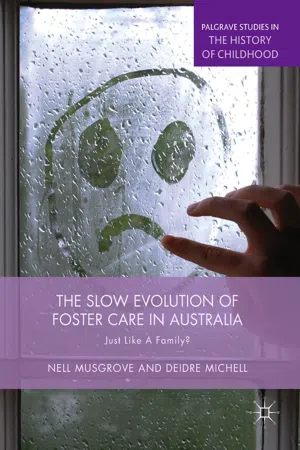
The Slow Evolution of Foster Care in Australia
Just Like a Family?
- English
- ePUB (mobile friendly)
- Available on iOS & Android
eBook - ePub
About this book
Information
© The Author(s) 2018
Nell Musgrove and Deidre MichellThe Slow Evolution of Foster Care in AustraliaPalgrave Studies in the History of Childhoodhttps://doi.org/10.1007/978-3-319-93900-1_11. Introduction: There Is No Typical Story of Foster Care
Nell Musgrove1 and Deidre Michell2
(1)
Australian Catholic University, Fitzroy, VIC, Australia
(2)
University of Adelaide, Adelaide, SA, Australia
The Image of the Child
The early twenty-first century has exposed the plights of vulnerable children to the world in new and disturbing ways. In the age of digital media, the rapid circulation of images and personal stories gives a sense of immediacy to the global community’s expressions of outrage against inhumanities inflicted on children—yet, this outrage can be fleeting. In 2015, photographs of drowned Syrian refugee child Alan Kurdi made a sensation in the international press and then across numerous social media platforms. For a time, this stimulated widespread support for, and interest in, the Syrian refugee crisis. Opinion remains divided as to whether we should understand such public moral outcries as genuine expressions of desire for humanitarian intervention, or as armchair emoting to take the place of direct action, but no matter how we understand the phenomenon, it is clear that the effect, for most, is ephemeral.1 The world may have had sympathy for one child but, on the whole, we were reluctant to confront our own complicity in the systemic economic and social disadvantages which created the situation. The problem with foster care is the same—not only does popular concern rise and fall in reaction to periodic scandals, it also gathers around the ‘simple’ parts of the stories. It is not a bad thing that people feel moved by tragic stories of innocent children’s deaths or other suffering; but the urge, which so often accompanies these scandals, to assign blame so that the problem can be solved and left in the past, rarely adequately grapples with the complexities of events. The many experiences of foster care we have uncovered in researching this book—which go back as far as the mid-nineteenth century and stretch forward to the present—make it impossible for us to paint such a simple picture. There is no typical story of foster care: no universal truths about why children are sent to foster care; no widely applicable archetype of a failing family; and no simple answers about why, as a society, we cannot stem the tide of children we send to foster homes.
Personification of individual cases can serve a purpose. By its very nature foster care is largely hidden, both because it is located in the private homes of geographically scattered families, and because a combination of social and legal factors mean that foster children are not always easily and openly identifiable as such. When foster care goes really wrong—typically when a child dies in foster care (or dies because authorities failed to intervene and initiate foster care)—media coverage of the individual child’s plight can turn public scrutiny to this major social welfare institution which, for many of us, is not a part of our everyday lives. But the question remains: does this promote long-term positive reform? The two examples of boys who died in foster care examined in Chapter 2 of this book, would suggest not.2 These boys were born more than one hundred years apart, yet there were striking similarities in the systemic failures which resulted in their deaths , and in each case, the response was a formal investigation of the individual case but little action with regards to systemic change.
In contrast, some cases provoke such public outrage that anything less than a clear and decisive government response would be tantamount to political suicide. Such was the case in the 2012 death of Chloe Valentine in South Australia . Why, people asked, had the child not been removed from her mother despite the case being well known to local child protection authorities? Many details of the case came to light as Chloe’s mother and her partner both faced criminal charges—each eventually pleading guilty to manslaughter. More than two and a half years after the little girl’s death the government department responsible, Families SA , faced an inquest into their part in the case. Many of the recommendations of the inquest, as well as the pushes from parliamentarians for systemic and legal reforms which followed (only some of which were implemented), tended to share the starting assumption that the department needed to be more proactive in separating children from their families. This satisfied the public appetite for seeing the government ‘take action’ in the Chloe Valentine case, but sat uncomfortably with the national government’s formal apologies recognising the great harms done to children in the past through policies which too readily turned to family separation—to Aboriginal and Torres Strait Islander people separated from their families (apology in 2008), to those sent out as child migrants and all other children separated from their families through historical child welfare policies and practices (apology in 2009), and to those separated through forced adoption (apology in 2013).
The purpose of highlighting this tension is not to suggest that nothing went wrong in Chloe Valentine ’s case. Clearly, it did—not just because she died, but because the court cases and inquest revealed a child welfare system that was not always following its own ideas about best practice. However, the reasons for this were not primarily that the department’s workers did not have the power to remove children from their homes—they did. But there were other important contributing factors, like the chronic under-resourcing of child welfare, social worker burn-out and turn-over, and the complexities of the social problems which arise from marginalisation, poverty and addiction. It is hard for governments to ‘take action’ in ways which account for all of this, let alone the fact that no law or policy can provide case by case answers about when the risks to a particular child in its family home are greater than those we know come with removing children to foster care. This, of course, is not the response the public is seeking in the wake of the death of a child.
Perhaps one of the most internationally famous cases which led to a government ‘taking action’ was that of Welsh foster children Dennis and Terence O’Neill , whose harrowing experience of foster care inspired the Agatha Christie play The Mousetrap .3 The horrific conditions in the O’Neill brothers’ Shropshire foster home were only discovered after Dennis died there on 9 January 1945.4 The boys had been starved, beaten, terrified and humiliated—virtually on a daily basis. Newspapers across Britain covered the story, and in his autobiography, Terence recalls throngs of supporters gathering outside the courtroom when he was called to give evidence against his former foster parents.5 The British Parliament called for an inquiry, and the resulting Monckton Report identified many failures to comply with regulations relating to the placement, inspection and medical care of children in foster homes. It also highlighted problematic inconsistencies between the regulations for placing foster children under Poor Law provisions as compared to those, like the O’Neill boys, under the Children and Young Persons Act 1933.6 The Care of Children Committee, chaired by Dame Edna Curtis, was established in the wake of the Monckton inquiry, and its landmark report , tabled in British parliament in 1946, had a significant influence on child welfare in Britain and internationally—including in Australia.7 It would, therefore, be glib to suggest that nothing happens in response to foster care scandals, but we also know that many of the failures we see in foster care today, share much with those of more than a century ago.8
The History of Foster Care in Australia
This book’s focus is on Australia, yet the issues it raises resonate globally, and the contours of the histories it traces intersect and contrast with studies of child welfare, and foster care more specifically, in other nations.9 Although the purpose of the book is not to provide a detailed chronological charter of the laws and policies which governed foster care and its place within government welfare systems, it is useful to place the broader trajectory of foster care in Australia in an international context. Foster care was used widely across continental Europe , but the nations which influenced practice in Australia most were other anglophone nations.10 In some ways, this is not surprising. Veronica Strong-Boag notes that, in Canada , English and French provinces were often more influenced by other nations within their own language group than they were by each other.11 Yet Australian child welfare departments’ lack of engagem...
Table of contents
- Cover
- Front Matter
- 1. Introduction: There Is No Typical Story of Foster Care
- Part I. Looking for the ‘Care’ in Foster Care
- Part II. Shaping the Lives of the Invisible Children of the State
- Back Matter
Trusted by 375,005 students
Access to over 1.5 million titles for a fair monthly price.
Study more efficiently using our study tools.
Frequently asked questions
Yes, you can cancel anytime from the Subscription tab in your account settings on the Perlego website. Your subscription will stay active until the end of your current billing period. Learn how to cancel your subscription
No, books cannot be downloaded as external files, such as PDFs, for use outside of Perlego. However, you can download books within the Perlego app for offline reading on mobile or tablet. Learn how to download books offline
Perlego offers two plans: Essential and Complete
- Essential is ideal for learners and professionals who enjoy exploring a wide range of subjects. Access the Essential Library with 800,000+ trusted titles and best-sellers across business, personal growth, and the humanities. Includes unlimited reading time and Standard Read Aloud voice.
- Complete: Perfect for advanced learners and researchers needing full, unrestricted access. Unlock 1.5M+ books across hundreds of subjects, including academic and specialized titles. The Complete Plan also includes advanced features like Premium Read Aloud and Research Assistant.
We are an online textbook subscription service, where you can get access to an entire online library for less than the price of a single book per month. With over 1.5 million books across 990+ topics, we’ve got you covered! Learn about our mission
Look out for the read-aloud symbol on your next book to see if you can listen to it. The read-aloud tool reads text aloud for you, highlighting the text as it is being read. You can pause it, speed it up and slow it down. Learn more about Read Aloud
Yes! You can use the Perlego app on both iOS and Android devices to read anytime, anywhere — even offline. Perfect for commutes or when you’re on the go.
Please note we cannot support devices running on iOS 13 and Android 7 or earlier. Learn more about using the app
Please note we cannot support devices running on iOS 13 and Android 7 or earlier. Learn more about using the app
Yes, you can access The Slow Evolution of Foster Care in Australia by Nell Musgrove,Deidre Michell in PDF and/or ePUB format, as well as other popular books in History & Australian & Oceanian History. We have over 1.5 million books available in our catalogue for you to explore.