eBook - ePub
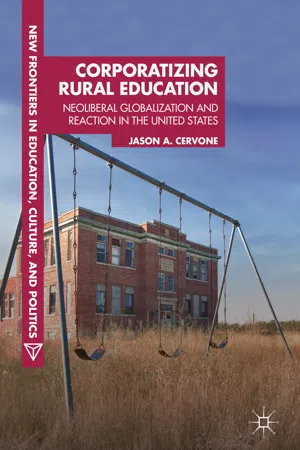
Corporatizing Rural Education
Neoliberal Globalization and Reaction in the United States
- English
- ePUB (mobile friendly)
- Available on iOS & Android
eBook - ePub
Corporatizing Rural Education
Neoliberal Globalization and Reaction in the United States
About this book
Information
Topic
EducationSubtopic
Education General© The Author(s) 2018
Jason A. CervoneCorporatizing Rural EducationNew Frontiers in Education, Culture, and Politicshttps://doi.org/10.1007/978-3-319-64462-2_11. Introduction
Jason A. Cervone1
(1)
University of Massachusetts, Dartmouth, Weymouth, Massachusetts, USA
It is still too early for a postmortem on American politics, as it will be years before the fallout can be properly assessed, but it is fair to say that the election of Donald Trump to the US Presidency may have signaled the end of the political establishment in the United States as we know it. As poll after poll came in showing an inevitable victory for Hillary Clinton , it seemed as though the status quo of neoliberalism with identity politics mixed in would be enough to overcome the frightening rhetoric that was emerging from the Republican side. However, rural America saw a large population of angry, white men and women come out in droves to the shock of the media and political establishment alike. Pundits were quick to jump to conclusions about what could have spurred such an event. Many claimed it racial; a white backlash to eight years of a black president, or that it was a deep-seated misogyny that still runs through the country. Others claimed that it was economic anger stirred from years of living in poverty watching industries decline and jobs moved overseas. Others still explained that it was a response to years of being ignored by mainstream politics. All of these explanations are valid, but none seem to go deep enough or to recognize the nuances and connections between all the issues being raised. There is a deeper structural problem that manifests itself in these racist and misogynist behaviors that come to a head in rural areas in the United States.
The white supremacists and neo-Nazis do exist and are a very real problem. The rampant misogyny directed at Clinton is also a serious problem. But these issues alone do not explain the groundswell of support Trump received. Rather, this is the result of a large, extremely angry population that lacks the ability to articulate or properly channel that anger. While there is no excuse for the horribly sexist things said about Hillary Clinton , to believe that she lost because rural voters would not consent to being ruled by a woman is short-sighted and misunderstands both the realities of rural political and economic life as well as what Clinton truly represents to the rural underclass . As much as this was a vote for authoritarianism , it was also a vote against political elitism. Identity politics aside, Hillary Clinton epitomizes the political elite that has been out of touch with rural life in the United States for decades. The democratic belief that it was her turn because she was most qualified due to her experience and longevity in the political elite runs counter to most ideals held in rural America . Again, this is not to say misogyny does not exist or was not a large factor in the election. Hatred of women in general is as ingrained and structural in the society as racism , but it is not the reason for Clinton’s loss. Rather it is general apathy toward this misogyny that allows people to overlook the things that Trump has said. It is also unlikely a Clinton presidency would have done much to change that. Like President Obama and Bill Clinton before her, Hillary Clinton would have spent the majority of her term placating her Wall Street friends and maybe dabbling slightly in identity politics possibly improving family leave and speaking for equal wages in order to maintain a veneer of Progressivism. Most likely she would have pursued a neoliberalized form of feminism that lionizes female CEOs as if the way to equality is for women to increase their representation in patriarchal capitalism rather than struggle against the system that creates their oppression in the first place.
Sociologist Arlie Hochschild describes this phenomenon, writing that many rural Americans feel as if they are unwanted in their own country. She writes that from their experience they witness:
Strangers step ahead of you in line, making you anxious, resentful, and afraid. A president allies with the line cutters, making you feel distrustful, betrayed. A person ahead of you in line insults you as an ignorant redneck, making you feel humiliated and mad. Economically, culturally politically, you are suddenly a stranger in your own land.1
Hochschild captures perfectly the anxieties felt by the rural underclass along with trying to understand their feelings of betrayal and anger at a political elite that claims to represent the interests of the most oppressed subsets of the population. Instead, the rural underclass views this as the interests of others being placed before them, and their own struggles being ignored and mocked while also being told they are the ones responsible for the oppression. For them, there seemed to be a parade of oppressed groups coming forward and being recognized, yet no one spoke out for the white working class. Yet the result was that anger turned toward the other groups who were seemingly cutting in line, rather than the system that was consistently maintaining the rural underclass .
What seems to be happening here is the neoliberal education project has turned on itself. For generations, corporate ideology has shaped the rural United States in a manner to best suit capitalist accumulation . Rural areas have been painted as backward as long as there have been urban centers, and rural people have become victims of modernization , which in the capitalist sense means industrialization . The result is lower wages, fewer environmental protections, and a pushback against labor laws. Rural youth are groomed to accept this as a natural evolution through neoliberal education that focuses on job training rather than critical thought. When the only ends a student is able to see are economic, it becomes much easier to accept the corporate ideology as any job is better than no job, even if that means surrendering political agency. Education also leads rural people to adopt neoliberalized identities , that is identities focused on economic ends, and identities that are individualized to the point where any economic successes or failures become personal character traits. Lost in these identities is a sense of community or belonging. This leads to the destructive identities being seen in rural America , the misogyny , racism and xenophobia , as economic and political anxieties are causing tremendous stress but education has not provided the ability to criticize and understand power structures and that it is the very neoliberal ideology that they strive to that is causing their discontent. As Hochschild points out, Donald Trump acted as a release for this population, who saw the way his vulgar comments created outrage among the liberal elite. Finally, someone was sticking it to those people who had mocked and denigrated them for so long. Hochschild describes that the feelings of elation produced by Trump ’s comments spoke to their emotional self-interest which overcame the need to protect their economic self-interest.2 The conflation of the economic and the emotional is a theme that will play heavily in this book, as the corporatization of education is producing young people who are seeing themselves primarily as economic actors and equating their self-worth with their ability to consume.
The question many are struggling to understand is why would this population not only identify with but openly embrace ideologies they know to be harmful? When Hillary Clinton referred to Trump supporters as “Deplorables” the reaction was for those supporters to openly identify themselves as such.3 Clinton played right into the hands of the Trump campaign, who were able to use it to justify the belief among rural Americans that they were under attack by political elites from the Left. Here was the epitome of political elitism attacking them directly. It is important to remember that criticisms of the liberal elite are not pinning the election of Trump on them. The biggest issue will always be the super-wealthy who maintain control through the spread of neoliberal ideology. What the liberal elite must accept responsibility for and understand their role in perpetuating the cultural divide between urban and rural. Slavoj Žižek, regarding conservatism in the United States, notes that there are two sides to the culture war. While the liberal concern for misogyny , racism , and religious fundamentalism that exists in many rural areas is valid, Žižek points out that there is a coded class message in American liberalism wherein the Left portrays itself as modern and progressive, thus situating rural as primitive and ignorant.4 What is happening is essentially a class attack being framed as cultural. The Democrats ‘focus on identity politics was really a class antagonism wherein the left situates itself as the superior cultural class ig...
Table of contents
- Cover
- Frontmatter
- 1. Introduction
- 1. Consequences of Neoliberal Corporatization
- 2. Abstraction of Space and Minds
- Backmatter
Trusted by 375,005 students
Access to over 1.5 million titles for a fair monthly price.
Study more efficiently using our study tools.
Frequently asked questions
Yes, you can cancel anytime from the Subscription tab in your account settings on the Perlego website. Your subscription will stay active until the end of your current billing period. Learn how to cancel your subscription
No, books cannot be downloaded as external files, such as PDFs, for use outside of Perlego. However, you can download books within the Perlego app for offline reading on mobile or tablet. Learn how to download books offline
Perlego offers two plans: Essential and Complete
- Essential is ideal for learners and professionals who enjoy exploring a wide range of subjects. Access the Essential Library with 800,000+ trusted titles and best-sellers across business, personal growth, and the humanities. Includes unlimited reading time and Standard Read Aloud voice.
- Complete: Perfect for advanced learners and researchers needing full, unrestricted access. Unlock 1.5M+ books across hundreds of subjects, including academic and specialized titles. The Complete Plan also includes advanced features like Premium Read Aloud and Research Assistant.
We are an online textbook subscription service, where you can get access to an entire online library for less than the price of a single book per month. With over 1.5 million books across 990+ topics, we’ve got you covered! Learn about our mission
Look out for the read-aloud symbol on your next book to see if you can listen to it. The read-aloud tool reads text aloud for you, highlighting the text as it is being read. You can pause it, speed it up and slow it down. Learn more about Read Aloud
Yes! You can use the Perlego app on both iOS and Android devices to read anytime, anywhere — even offline. Perfect for commutes or when you’re on the go.
Please note we cannot support devices running on iOS 13 and Android 7 or earlier. Learn more about using the app
Please note we cannot support devices running on iOS 13 and Android 7 or earlier. Learn more about using the app
Yes, you can access Corporatizing Rural Education by Jason A. Cervone in PDF and/or ePUB format, as well as other popular books in Education & Education General. We have over 1.5 million books available in our catalogue for you to explore.