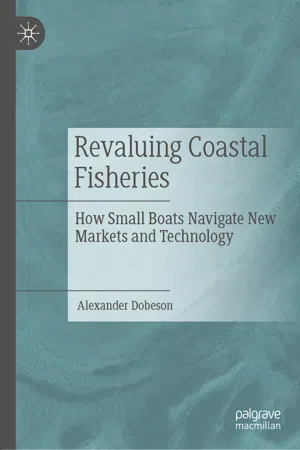
This book illustrates and explains the consequences of neoliberal reform on rural economies. Based on an ethnographic case study of coastal fisheries in Iceland, it poses the following questions: How are rural fishers navigating liberal capitalism? And how are new markets, property-rights and digital technologies transforming rural economies? By drawing on an extensive body of literature on economic sociology and science and technology studies, the book offers a novel understanding of the role of market-based reform for rural development.
eBook - ePub
Revaluing Coastal Fisheries
How Small Boats Navigate New Markets and Technology
- English
- ePUB (mobile friendly)
- Available on iOS & Android
eBook - ePub
About this book
Information
© The Author(s) 2019
A. DobesonRevaluing Coastal Fisherieshttps://doi.org/10.1007/978-3-030-05087-0_11. Introduction
Alexander Dobeson1
(1)
Uppsala University, Uppsala, Uppsala Län, Sweden
Keywords
EconomisationMarketisationValuationPractice turnRelational ethnographyLiberal capitalismSooner shall all the hummocks on Summerhouses land hop up to heaven and all the bogs sink down to bottomless bloody hell than I shall renounce my independence and my rights as a man.Bjartur of Summerhouses of Halldór Laxness’ Independent People (1946)
Bjartur’s Metamorphosis
Some place far away from the night crawlers and bohemia of Reykjavík ’s infamous nightlife scene in a rural Icelandic fishing community , situated in the remote rural Westfjords . After a restless winter’s night just below the Arctic Circle our main character—we shall call him Bjartur (‘the bright’) after the tragic hero of Summerhouses from Halldór Laxness’ epic novel1—decides to get up around 3:30 a.m. and evaluate whether or not the weather conditions will finally allow him to follow his occupation as an independent fisher.2 For the past fourteen days, strong westerly winds up to 30 metres per second have produced giant swells rolling into the fjord, making it virtually impossible to put out the hand-baited longlines on his small ten metre-long coastal fishing vessel. The struggle with the weather is nothing new for Bjartur who grew up in the harsh Arctic environment . The villagers are continuously confronted with the omnipotence of nature and the constant potential for disaster louring from the ocean and the mountains that embrace the fjord. Especially during wintertime when the sun disappears behind the mountains from November until February, and blizzards can cut off the village from the rest of civilisation for days. Bjartur knows that one can never influence the forces of nature, and although most city dwellers visiting the Westfjords in the summer cannot imagine living in a remote place like this, for Bjartur it is just his way of life, being his own master on his small boat,3 a childhood dream that eventually came true. The web of relations and practices through which Bjartur sails today, however, has changed dramatically in the past 30 years, and with it also the discourses and practices that constitute Bjartur as independent coastal fisher.
Not only Laxness’s stubborn small-scale farmer, but also our independent small boat fisher reminds us of the struggle for independence that is deeply inscribed in the cultural semantics of the small island state that was settled by Norwegian tax refugees around 850 AD. As far back as Bjartur can remember it has been his childhood dream to make a living on his own boat based on hard but honest work at sea, just as his family and ancestors have done over the generations. Being born just a few years after the first major crisis of the Icelandic fishing industry in the 1960s when the herring fisheries collapsed, Bjartur grew up in a time when small boat fisheries were being rebuilt on the cod - and lumpfish fisheries that were mainly a seasonal, though widespread business in local communities. In those days, however, large stern trawlers brought prosperity and wealth to rural coastal areas all around the country. As a consequence of unregulated fisheries and increasing capture capacity, however, fishing pressure grew too high and fish stocks started dwindling by the beginning of the 1980s. As an emergency measure, access to the fishing grounds that used to be a commons of the Icelandic people was closed. Consequently, a quota system, which allotted relative amounts of the Total Allowable Catch (TAC) based on historical catch records was implemented on a trial basis in 1984. As a result, the fish stocks literally became privatised overnight, and it did not take long for vested interests to secure the emergence of a market on which rights to future catches, called Individual Transferable Quotas (ITQs ), could be traded just like any other asset from the early 1990s.
Bjartur ’s family and most of the other members of the community in the Westfjords soon began to fear that this development would be detrimental for the rural areas of the country. A market-based system, the main concern was, could adversely affect the countryside by giving a competitive advantage to big capital holders around the capital region. Nevertheless, during his teenage years Bjartur’s community was thriving as two larger longline vessels provided many jobs, and it was still common for locals to run their own small coastal vessel as part of their seasonal full- or part-time occupation. Soon, Bjartur started helping out as deckhand on his parent’s small coastal vessel during his school holidays, which remained—as were all coastal vessels below 15 metres in length—widely protected from the regulatory framework of the ITQ system. After graduating from school, Bjartur finally attended navigation school in Reykjavík to becoming a captain himself and later made it to first mate on a large fishing vessel. But even though the pay was extraordinarily good, life on board a huge swimming metal box that included long trips away from home and his girlfriend soon reminded him of his childhood dream of being independent and his own master on a small fishing vessel based in his home community.
Recent developments in the fishing industry made this development even more attractive to him: the emergence of fish auctions in the late 1980s gave independent coastal fishers a much better standing and higher prices per kilo as they have liberated them from the power of the local processors . On the other hand, legal loopholes allowed large-scale investors to buy into the coastal fleet and start operations, ironically leading to a revival of the coastal fisheries . Hence, it was just a matter of time before the government started to implement stricter regulations, and many coastal fishers who had not been fishing much lately on their own vessels feared losing their right to fish as catch quotas were allocated based on historical catch rights with the implementation of the mother ITQ system in 1984. It was therefore about time for Bjartur to quit his job and start to pursue his dream on his parent’s old wooden fishing vessel.
With increasing capitalisation and professionalisation of the coastal fleet , many of the newer vessels were able to fish all year round, and above all, the efficiency of state of the art capture technologies increased season by season. As expected, it was just a matter of time before the government adopted new regulations for the coastal fisheries . As a consequence, the regulations started moving successively towards the market-based rationale of the ITQ system, going from a period of a limited numbers of days at sea for each vessel to a fully-fledged coastal ITQ system for all vessels under 15 metres. Eventually, in 2004 fishing rights could be fully transferred or leased between small boats , independently from a vessel’s homeport and geographical location.
Based on their historical catch records, Bjartur and his family were allotted a relative quota share that literally overnight turned them into members of a privileged class with access to the nation’s most valuable resource, being totally free to decide whether they wanted to buy more quota or sell out of the industry. In contrast to others from the community , however, the latter option was out of the question for Bjartur and his family with regard to what they have built up over the years. And besides that, it seemed that fishing on small boats had never been as comfortable before: in contrast to the olden days of ‘derby style’ fishing, in which small boat owners had to race against their competitors at sea, making them extremely vulnerable to taking risks in bad weather, the limitation of fishing rights had already secured the catch for the season; Bjartur simply needed to decide when to put to sea and harvest it until his quota for the season was used up.
Today, Bjartur and his family consider themselves lucky as they have so far managed to keep their independent business afloat. And in contrast to the hot air created by the financial alchemists in the capital region, the fish remained not only relatively abundant and real in the sea, but also brought in fresh foreign currency in the booming export industry—the main reason why Bjartur’s sister decided to move back from the financially devastated capital region to the Westfjords to find a job in the fishing industry after the 2008-financial crisis. In the neighbouring village, the economic success of the coastal fisheries has even lead people to talking about a ‘small boat revival’ (see Image 1.1), which was also the main reason which attracted my scholarly interest in this otherwise remote and desolated place on earth. But is it really only the stubbornness and hard work of Bjartur and his rural fellows at sea that accounts for their s...
Table of contents
- Cover
- Front Matter
- 1. Introduction
- 2. Fishing in Market-Based Resource Management
- 3. Economising Rural Independence
- 4. The Practice of Fishing
- 5. Enframing the Sea
- 6. When the Fish Ignore the Market
- 7. Fishing for Quality
- 8. The Fishery Panopticon
- 9. A New Culture of Liberal Rural Capitalism
- Correction to: Revaluing Coastal Fisheries
- Back Matter
Trusted by 375,005 students
Access to over 1.5 million titles for a fair monthly price.
Study more efficiently using our study tools.
Frequently asked questions
Yes, you can cancel anytime from the Subscription tab in your account settings on the Perlego website. Your subscription will stay active until the end of your current billing period. Learn how to cancel your subscription
No, books cannot be downloaded as external files, such as PDFs, for use outside of Perlego. However, you can download books within the Perlego app for offline reading on mobile or tablet. Learn how to download books offline
Perlego offers two plans: Essential and Complete
- Essential is ideal for learners and professionals who enjoy exploring a wide range of subjects. Access the Essential Library with 800,000+ trusted titles and best-sellers across business, personal growth, and the humanities. Includes unlimited reading time and Standard Read Aloud voice.
- Complete: Perfect for advanced learners and researchers needing full, unrestricted access. Unlock 1.5M+ books across hundreds of subjects, including academic and specialized titles. The Complete Plan also includes advanced features like Premium Read Aloud and Research Assistant.
We are an online textbook subscription service, where you can get access to an entire online library for less than the price of a single book per month. With over 1.5 million books across 990+ topics, we’ve got you covered! Learn about our mission
Look out for the read-aloud symbol on your next book to see if you can listen to it. The read-aloud tool reads text aloud for you, highlighting the text as it is being read. You can pause it, speed it up and slow it down. Learn more about Read Aloud
Yes! You can use the Perlego app on both iOS and Android devices to read anytime, anywhere — even offline. Perfect for commutes or when you’re on the go.
Please note we cannot support devices running on iOS 13 and Android 7 or earlier. Learn more about using the app
Please note we cannot support devices running on iOS 13 and Android 7 or earlier. Learn more about using the app
Yes, you can access Revaluing Coastal Fisheries by Alexander Dobeson in PDF and/or ePUB format, as well as other popular books in Social Sciences & Human Geography. We have over 1.5 million books available in our catalogue for you to explore.