With contributions presented during the Second International Risk Management Conference, this first volume addresses important areas of risk management from a variety of angles and perspectives. The book will cover three separate tracks, including: legal issues in risk management, risk management in the public sector and in healthcare, and environmental risk management, and will be of interest to academic researchers and students in risk management, banking, and finance.
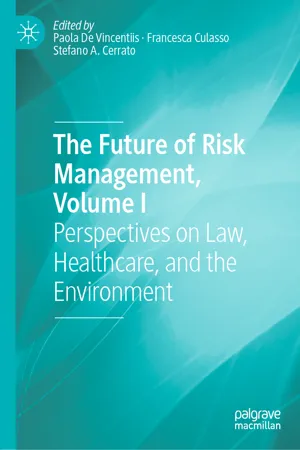
eBook - ePub
The Future of Risk Management, Volume I
Perspectives on Law, Healthcare, and the Environment
- English
- ePUB (mobile friendly)
- Available on iOS & Android
eBook - ePub
The Future of Risk Management, Volume I
Perspectives on Law, Healthcare, and the Environment
About this book
Information
Topic
CommerceSubtopic
Gestion des risques financiersPart IEnvironmental Risk Management
Part I “Environmental Risk Management” contains the contributions presented in the same name round table, which aimed at analysing the management of the environmental risks under different perspectives and the scientific, managerial and physical tools able to cope with them.
The evaluation and management of environmental risks and their economic impacts ask for the cooperation of multicultural research groups, which work together to share and integrate methodologies. In this view, Part I contains six chapters related to different economic fields and case histories that have allowed enriching the round table debate.
The Authors take into consideration the managerial perspective in assessing and managing risks, the financial and non-financial disclosed of risks and the role that new technologies or new processes may play in monitoring operational situations and detecting data in order to identify trends and the existence of potential risks.
Chapter 1, by Cantino et al., analyses an important economic sector, the Italian bus transportation, in achieving a business sustainability, testing the relative efficiency relying on accounting, technical, environmental and governance variables for the risk of the sector on the year 2010.
In Chapter 2, Ivanova and Kotcheva present a case study of household waste management process in a specific case history, the municipality of Ruse in Bulgaria, in involving the private companied in the detect and transportation of urban garbage, through direct individual interviews among 103 companies holding waste permits.
Chapter 3, by Varese and Ronco, intends to analyse some tools introduced in the EU customs strategy for improving import and export activities at EU level and, at the mean time, focusing on some mechanisms and tools adopted by quasi-public entities entrusted with the responsibility to carry out import–export formalities in extra-EU countries.
De Bernardi et al., furthermore, explore how and to what extent the biggest Italian nonfinancial companies of the FTSE-MIB disclose on climate change risk, analysing 25 Italian listed companies for 2017, pointing out that even if there has been an increase in climate-related risk disclosure, the items are still underdeveloped.
Lucchetti et al., moreover, present a framework for the identification of the hotspot in business activities, based on qualitative analysis of different kind of sources as literature review and case studies.
Finally, the last contribution, by Cisi et al., encompasses a systematic literature review on environmental risk management (ERM) seen through the lenses of the different theories of management, in order to elucidate their intersections and differences, alongside creating a study to aid the widespread of knowledge.
The result of the contributions shows that the facets of the concept of environmental risk require different methodological approaches, but that it is essential to deal with the issues in a systemic way to find effective and robust solutions.
Riccardo Beltramo
Stefano Duglio
© The Author(s) 2019
Paola De Vincentiis, Francesca Culasso and Stefano A. Cerrato (eds.)The Future of Risk Management, Volume Ihttps://doi.org/10.1007/978-3-030-14548-4_11. The Italian Bus Transportation Sector: The Management of Environmental Risks as a Factor for Achieving a Business Sustainability
Simona Alfiero1 , Valter Cantino1 , Gianluca Capecci1 and Alfredo Esposito1
(1)
Department of Management, University of Torino, Turin, Italy
Keywords
Risk managementEfficiencyData envelopment analysisEnvironmental effectsPerformanceJEL Classification
G32G21C61Q51L251.1 Introduction
The topic of public transport is of significance because of its being directly linked to the quality of life of citizens, in terms of fast transfers and reducing of CO2 emission. The quality of local public transport is significantly reflected in the country’s competitiveness as inadequate urban and peri-urban mobility imposes additional costs on citizens. The European Parliament has also expressed great attention to the issue of public transport in urban areas, underlining the need to give more emphasis to this aspect and proposing to add another objective to the 10 already stated in the strategy outlined in the White Paper “Roadmap to a Single European Transport Area—Towards a competitive and resource efficient transport system” [COM (2011) 144 final]1 and consisting in doubling use of public transport in urban areas by 2030, also in order to achieve the 60% greenhouse gases (GHG) emission reduction target by 2050 with respect to 1990. Investing in public transport could lead to significant benefits in terms of economic growth, social cohesion, innovation, employment and sustainable development. The energy consumption, referred to kilometres and passengers, are influenced by size and type of service, urban or suburban, mode and means of transport and characteristics of the vehicles. Anyway, the energy consumption of public transport, being equal number of passengers, is much lower than those of private mobility. A turnover of over 12 billion euros a year, more than 1000 active firms, over 126 thousand employed and 5.2 billion passengers transported each year: this is the local public transport in Italy.
According to data of the European Union (EU transport in figure—statistical pocketbook 20172), in Italy public transport satisfy about 19% of the mobility needs of citizens on land, that is slightly higher than the European average (18,8%). Compared to the latter, however, in the Italian system the largest percentage is ensured by road transport (buses and coaches—12.2% in Italy compared with 9.4% as EU average) compared with those on railways (trains, tram and metro—7.0% in Italy compared with 9.4% as EU average). Furthermore, the buses and coaches used in Italy have a higher average age (11.4 years) than that of the other European countries (for instance, in France, Spain and UK they reach a maximum of eight years, while in Germany the average age is 6.9 years). All above means that in Italy are used means of transport that pollute more (buses and coaches compared to railways), also because they are old and are not equipped with the most recent anti-pollution devices.
In this view, carbon footprint measures the level of energy efficiency and it shows how much a firm is working to improve its results. Reducing carbon emissions, on the one hand, could allow saving money—for instance, reducing the consumption of fossil fuels—but, on the other hand, it costs, as when it is necessary to develop new technologies.
In Italy, public transport sector has suffered years of low investments both on vehicles and on roads, due to the prolonged economic crisis and the unfavourable economic situation of recent years. In the past, many local transport companies (as in many European countries) wer...
Table of contents
- Cover
- Front Matter
- Part I. Environmental Risk Management
- Part II. Public Sector and Health Management
- Part III. Risk Management and Tax Consequences: From “Enhanced Relationship” to “Co-operative Compliance”
- Back Matter
Trusted by 375,005 students
Access to over 1.5 million titles for a fair monthly price.
Study more efficiently using our study tools.
Frequently asked questions
Yes, you can cancel anytime from the Subscription tab in your account settings on the Perlego website. Your subscription will stay active until the end of your current billing period. Learn how to cancel your subscription
No, books cannot be downloaded as external files, such as PDFs, for use outside of Perlego. However, you can download books within the Perlego app for offline reading on mobile or tablet. Learn how to download books offline
Perlego offers two plans: Essential and Complete
- Essential is ideal for learners and professionals who enjoy exploring a wide range of subjects. Access the Essential Library with 800,000+ trusted titles and best-sellers across business, personal growth, and the humanities. Includes unlimited reading time and Standard Read Aloud voice.
- Complete: Perfect for advanced learners and researchers needing full, unrestricted access. Unlock 1.5M+ books across hundreds of subjects, including academic and specialized titles. The Complete Plan also includes advanced features like Premium Read Aloud and Research Assistant.
We are an online textbook subscription service, where you can get access to an entire online library for less than the price of a single book per month. With over 1.5 million books across 990+ topics, we’ve got you covered! Learn about our mission
Look out for the read-aloud symbol on your next book to see if you can listen to it. The read-aloud tool reads text aloud for you, highlighting the text as it is being read. You can pause it, speed it up and slow it down. Learn more about Read Aloud
Yes! You can use the Perlego app on both iOS and Android devices to read anytime, anywhere — even offline. Perfect for commutes or when you’re on the go.
Please note we cannot support devices running on iOS 13 and Android 7 or earlier. Learn more about using the app
Please note we cannot support devices running on iOS 13 and Android 7 or earlier. Learn more about using the app
Yes, you can access The Future of Risk Management, Volume I by Paola De Vincentiis, Francesca Culasso, Stefano A. Cerrato, Paola De Vincentiis,Francesca Culasso,Stefano A. Cerrato in PDF and/or ePUB format, as well as other popular books in Commerce & Gestion des risques financiers. We have over 1.5 million books available in our catalogue for you to explore.